The short answer
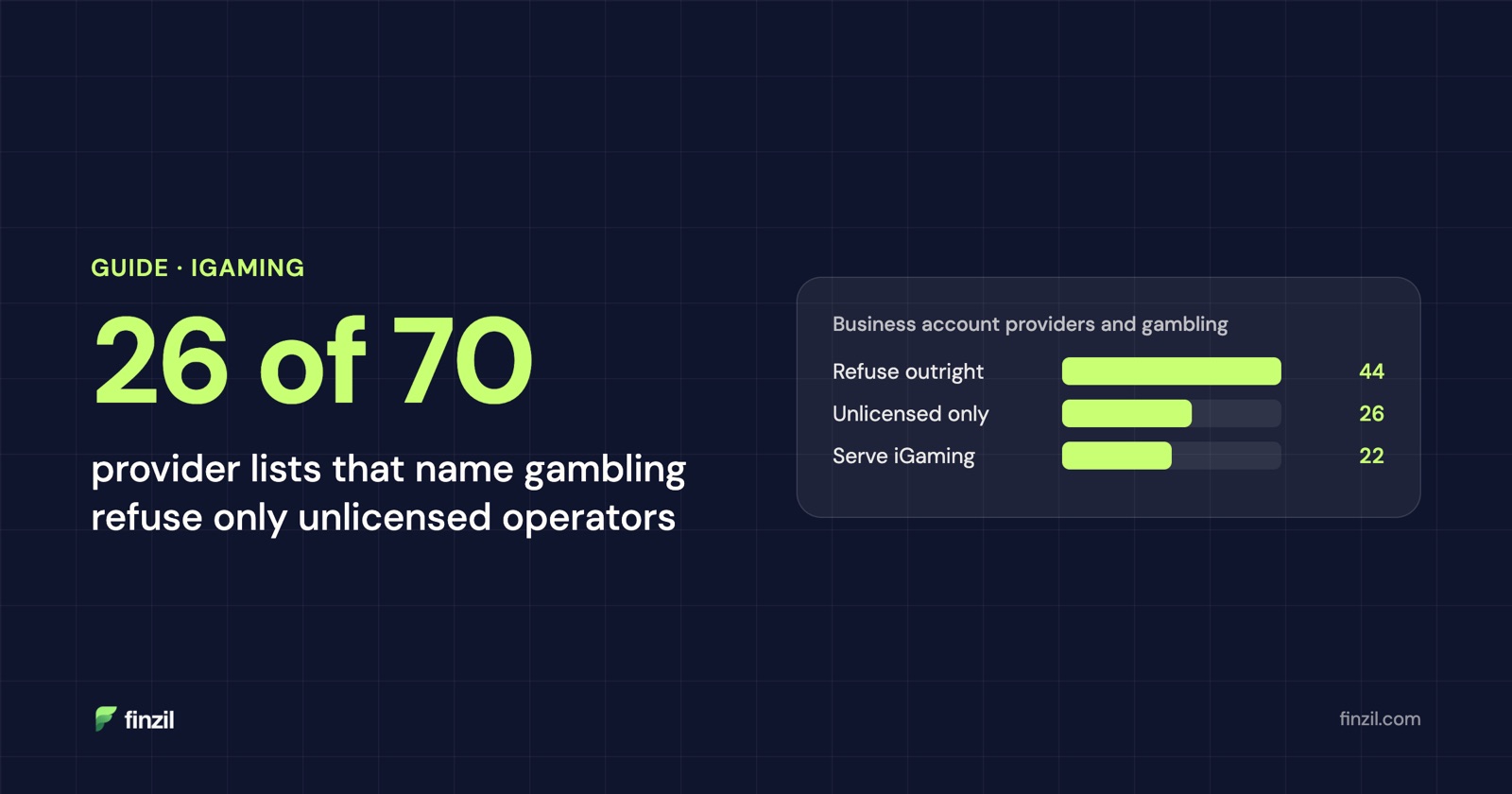
Most business account providers refuse gambling, but not all of them refuse licensed operators. Of 94 providers on Finzil that publish a list of industries they won't serve, 70 name gambling. Read word for word, 44 of those refuse gambling outright and 26 refuse only unlicensed or illegal gambling. 22 providers say in their own documents that they serve iGaming. Which licence you hold decides which of them will look at you, and you should expect to pay more than a standard account.
- 70 of 94 published industry lists name gambling (74%), Finzil, October 2026.
- 26 of those 70 refuse only unlicensed or illegal gambling.
- Monthly fees for gaming tiers run from €200 to €350, plus set-up fees of up to €1,500.
Where these numbers come from
Finzil keeps profiles of 177 banks, e-money institutions and payment firms, built from each provider's own documents and checked between 1 and 15 October 2026. 94 of them publish a list of industries they refuse or restrict. We read every line that mentions gambling, betting, casinos, lotteries or wagering, and sorted each provider by its exact wording.
That wording is the whole game. "Gambling" and "unlicensed gambling" look alike on a long list. For a licensed operator, one is a closed door and the other is an open one.
Three kinds of "no", and one kind of "yes"
| What the provider's list says | Providers | What it means for a licensed operator |
|---|---|---|
| Gambling, with no qualifier | 44 | Closed. A licence doesn't change the answer |
| Only unlicensed or illegal gambling | 26 | Open in principle. Your licence is the first document they will ask for |
| Gambling is named as a sector they serve | 22 | Open, usually with a separate price list and longer onboarding |
The 26 aren't all the same. Several narrow "licensed" down further, in writing:
- Payset lists casinos, betting and online gambling among the sectors it serves, where they are regulated in the EEA or the United Kingdom.
- MultiPass serves EU-licensed gambling and betting, and its list refuses unlicensed or offshore gambling.
- Bank of Cyprus refuses online gambling and casinos that are not regulated in a country it approves.
- Memo Bank refuses gambling and betting except operators approved by France's gambling authority, the ANJ.
So "we accept licensed gambling" often means "we accept some licences". A Malta, UK or EU national licence opens more doors than an offshore one, and Payset and MultiPass put that line in writing.
Who says they serve iGaming
These 22 providers describe iGaming or gambling as a sector they serve. Most are e-money institutions licensed in Lithuania, Malta or the UK. Three are banks.
| Type | Providers |
|---|---|
| Banks | Bank of Valletta, Lidion Bank, Jetonbank |
| E-money and payment institutions | Bankera, Bilderlings, Checkout.com, Equals Money, Finci, FinXP, Fire, MultiPass, Nexpay, OpenPayd, Papaya, PayDo, Payset, Pervesk, Vialet, Wallter, xpate |
| Wallets used for player payments | Skrill Business, Neteller |
Two things to know before you read that as a shortlist. "Serves iGaming" means the provider will consider you, not that it will approve you. And several of them serve iGaming suppliers and affiliates as well as operators, which matters if you build games or platforms rather than run a casino.
What it costs
Providers that take gambling usually price it separately. From their published price lists:
| Provider | Tier | Monthly fee | Set-up fee |
|---|---|---|---|
| Bilderlings | Gaming | €350 | Not published |
| Bankera | Premium (crypto exchanges, iGaming operators, payment companies) | €200 | €900 |
| Pervesk | Class A (crypto, gaming, forex, payment businesses) | €200 | €900 |
| Vialet | Regulated Enterprises (high-risk businesses) | €200 | €1,500 |
Transfer fees move too. Wallter charges 1% on incoming SEPA payments for high-risk businesses, against 0.5% for low and medium risk. On €500,000 a month of incoming payments, that difference is €2,500 a month.
Our view: the monthly fee is the smallest number in that table. The per-transaction pricing and any rolling reserve decide what a gaming account really costs, and they are usually agreed one to one. Ask for them in writing before you sign.
You may not be an operator
The word "gambling" catches more businesses than casinos. Compliance teams match your description against their list, and these get caught regularly:
- Game studios and platform providers that sell to operators. FV Bank's list, for example, names "gambling facilitators".
- Affiliates paid by operators for traffic. 12 providers on Finzil name affiliate marketing as a sector they serve.
- Sweepstakes, prize draws and skill games, which several lists name next to gambling.
- Video game companies with loot boxes or in-game currencies.
If you are a supplier, say so in the first line of your application, and attach your B2B licence if your market requires one. In the UK, companies that make or supply gambling software need their own Gambling Commission licence. In Malta, suppliers hold a B2B licence from the MGA.
Licence by licence
The licence is the first document every provider asks for. How they read it varies.
- UK Gambling Commission, Malta Gaming Authority, EU national licences. The licences most of the 26 providers have in mind. Expect normal enhanced due diligence.
- Curaçao. Since 24 December 2024 the Curaçao Gaming Authority licenses operators directly under the National Ordinance on Games of Chance (LOK), replacing the old master licence and sub-licence system. Providers can now check one regulator's register for your licence, which helps, but some lists still read Curaçao as offshore.
- Other offshore licences. Anjouan and similar licences are cheaper and faster to obtain, and harder to bank. Where a provider's list says "offshore gambling", these are what it means.
The pack that gets a gaming application read
Prepare this before you apply, and send the same pack to every provider:
- Your licence, with the link to the regulator's public register, and any conditions on it.
- The markets you serve and block, with how you geo-block. Providers will check this against their own country lists.
- Ownership and management, up to the real people, with identity documents for every owner of 25% or more and every director.
- Your AML and responsible gambling policies, and the name of your MLRO.
- Payment flows: which payment service providers take player deposits, how settlements arrive, how player withdrawals are paid, and expected monthly volumes by currency.
- How player money is protected, if your licence requires segregated player funds.
- Financial statements, or for a new operator, a business plan with projected volumes.
A business account is not card acceptance. The account receives settlements and pays your bills; taking player deposits by card needs an acquirer that accepts gambling transactions (card scheme merchant code 7995). Apply for both, and tell each provider who the other is.
Finzil checks your licence, country of registration and owners against the published rules of 177 providers. Check your company.
Questions people ask
Which banks accept iGaming companies?
Of 177 providers on Finzil, 22 say in their own documents that they serve iGaming, including three banks: Bank of Valletta, Lidion Bank and Jetonbank (October 2026). Most of the rest are e-money institutions licensed in Lithuania, Malta or the UK.
Can a Curaçao-licensed casino open a business bank account in Europe?
Yes, at some providers. Since December 2024 Curaçao licenses operators directly, which makes licences easier to verify. Some providers still accept only UK, EEA or other approved licences, so check each provider's wording before you apply.
Why do banks refuse gambling companies?
Gambling combines high volumes, cross-border payments, chargebacks and money laundering risk, so it needs more monitoring than most providers want to pay for. 44 of 94 published industry lists on Finzil refuse gambling with no exception for licensed operators.
How much does a business account for an online casino cost?
Published gaming tiers run from €200 to €350 a month, with set-up fees of up to €1,500 (Finzil, October 2026). Transaction fees and reserves are usually agreed individually and cost more than the monthly fee.
General information, not legal or financial advice. Figures from 177 provider profiles on Finzil, checked between 1 and 15 October 2026; counts of gambling wording read by hand.
Providers in this article
How they compare
The providers named above, with where they are licensed and what they are known for. Each links to its full profile.
| Provider | Licensed in | Known for |
|---|---|---|
 PaysetE-money institution PaysetE-money institution |  | 35 currenciesHigh-risk industries |
 MultiPassE-money institution MultiPassE-money institution |  | Dedicated managerOffshore considered |
 Bank of CyprusBank Bank of CyprusBank |  | Cypriot IBANDeposit protection |
 Memo BankBank Memo BankBank |  | API bankingVirtual IBANs |
 Bank of VallettaBank Bank of VallettaBank |  | Maltese IBANDeposit protection |
 Lidion BankBank Lidion BankBank | | iGaming-friendly10 currencies |
19 more providers are linked in the article.
Not sure which one fits? Your profile ranks them for your business, with the reason behind each.