The short answer
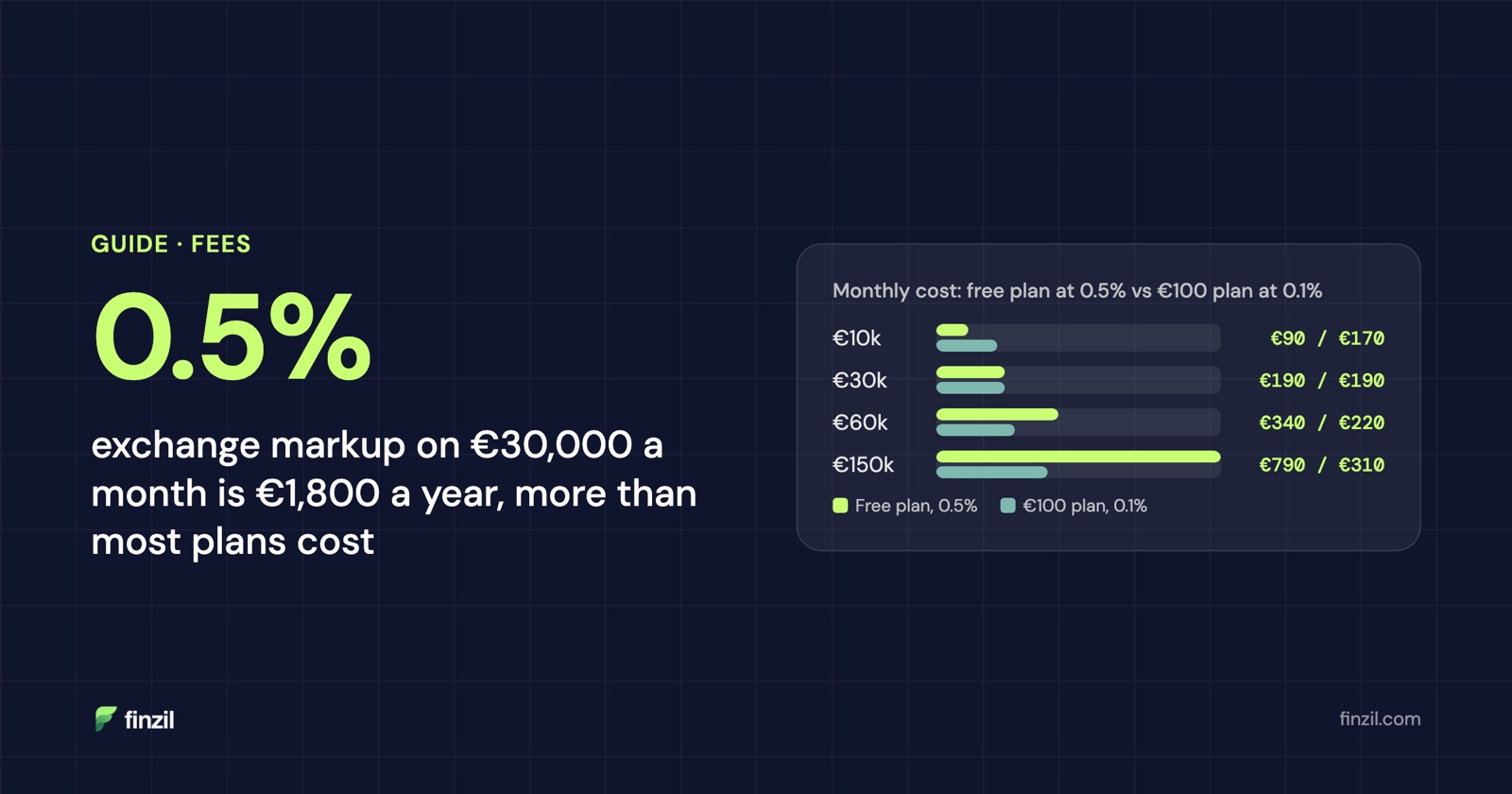
A multi-currency business account charges you in five places: the monthly plan, setting up account details, receiving money, sending money abroad, and converting currencies. The exchange markup is the one that grows with your business. A 0.5% markup on €30,000 converted a month costs €1,800 a year, more than most plans. Yet 45 of 103 providers we checked don't publish it.
What you are actually buying
"Multi-currency" covers three different things, and providers often blur them together.
- Holding balances in several currencies. Easy, and almost every provider offers it.
- Local account details in a currency: a US routing and account number, a UK sort code, a euro IBAN. With these, a customer in that country pays you as if you were a local business, usually free and often the same day. This is the part that matters if Amazon, Stripe or a client in another country pays you.
- Paying out in a currency, either through a local payment system or by SWIFT.
A provider can let you hold 40 currencies and give you local details in only a handful. Wise Business, for example, states balances in 40+ currencies and account details in 22. Payoneer offers local receiving details in 13 currencies. Ask for the list of local details, not the headline number.
The five fees, with real ranges
The figures below come from 144 business account profiles on Finzil, built from each provider's published price list and checked between 1 and 14 October 2026.
1. The monthly plan
Of the 110 providers that publish plan prices, 48 have a plan with no monthly fee. Paid entry plans start at a few euros and run to €1,000 a month for providers built around crypto firms or large companies.
A free plan is not always the cheaper plan. Free plans often come with higher exchange markups or a small allowance of free transfers. Revolut Business shows how allowances work: its 0.6% exchange fee applies once you go over the monthly allowance in your plan, which is £1,000 on Basic, £15,000 on Grow and £60,000 on Scale.
Some banks waive the fee only above a minimum balance. In the UAE, Emirates NBD's free packages need an average balance of AED 50,000 to AED 3.5 million, and below it you pay up to AED 1,500 a month.
2. Setting up the account
Most providers charge nothing to open. A few charge for account details or onboarding: Wise charges a one-time £50 for account details, and 3S Money charges an opening fee from €500 for a relationship-managed account.
3. Receiving money
Incoming payments through a local system (SEPA, Faster Payments, ACH) are free at most providers. Incoming SWIFT payments often cost a flat fee, and the sending and intermediary banks can take their own cut before the money arrives, so €10,000 sent can arrive as €9,960.
4. Sending money abroad
For payments that go by SWIFT, the fee is easy to compare because most providers publish it. Among the 38 providers that publish a flat SWIFT fee in euros, pounds, dollars or Swiss francs, the lowest fee ranges from €1 at Holvi (from an account in the same currency) to €75 at Bilderlings. The middle of the range is around €15. Another 8 providers don't offer outgoing SWIFT payments at all.
Watch who pays the other banks' charges. "Shared" means the recipient bears the intermediary charges; "our" means you pay all of them so the full amount arrives. Airwallex charges £10 shared and £20 when you cover all bank charges. iBanFirst charges €5 shared and €25 when you pay all charges.
5. Converting currencies
This is the fee that decides the bill once you trade in volume. Of the 103 providers whose exchange fee we could check:
- 57 publish their exchange fee, from 0% to 3% above the market rate. The middle of the range is 0.5%.
- 45 don't publish one. You see the rate when you convert, but not the margin inside it.
Some publish more than one rate. Airwallex charges 0.5% on 11 major currencies and 1% on the rest. Revolut adds 1% outside market hours. Statrys starts at 0.1% on major currencies and 0.15% on others.
Card spending in foreign currencies is often priced separately, and usually higher than conversions inside the account. Check both if your team pays for things abroad by card.
A worked example: when does a paid plan pay for itself?
Take a company that converts money every month and sends four SWIFT payments to suppliers. Compare two typical price lists built from the ranges above. These are illustrations, not specific providers.
| Account A | Account B | |
|---|---|---|
| Monthly plan | €0 | €100 |
| Exchange markup | 0.5% | 0.1% |
| SWIFT payment (shared charges) | €10 | €15 |
| Converted each month | Account A per month | Account B per month | Cheaper |
|---|---|---|---|
| €10,000 | €90 | €170 | A |
| €30,000 | €190 | €190 | Same |
| €60,000 | €340 | €220 | B |
| €150,000 | €790 | €310 | B |
The answer flips at around €30,000 a month. Below that, the free plan with the higher markup wins. Above it, the €100 plan pays for itself, and by €150,000 a month it saves nearly €5,800 a year. That is why the question "which account is cheapest?" has no answer until you know how much you convert.
Is there a best multi-currency business account?
No single account is cheapest or best for everyone. Three facts about your company decide it:
- Where the company is registered. 49 of the 148 providers on Finzil only accept companies from countries they name, and 29 of those accept one country only. An account you can't open doesn't belong on your shortlist.
- Which currencies you need local details in, not just balances. A company paid by US customers needs US account details. A company paid by European customers needs a euro IBAN.
- How much you convert each month. Use the worked example above with your own numbers.
Then check one more thing: where the money is held. Most multi-currency accounts are run by e-money or payment institutions, not banks. Your money is safeguarded, which means kept separate from the provider's own funds, but it is not covered by deposit insurance such as the UK's FSCS. In the UK, the FCA's stricter safeguarding rules for these firms have applied since 7 May 2026, with daily checks, monthly reporting and annual audits.
Costs that don't appear in the headline price
- Exchange allowances that end at a monthly limit, after which the markup rises.
- Higher markups at weekends or outside market hours.
- Different markups for less common currencies.
- Intermediary bank charges on SWIFT payments, deducted before the money arrives.
- Inactivity fees. Holvi's free plan charges €4.50 after 30 days without activity.
- Minimum balance charges, common at banks in the UAE.
- Charges per extra user, which add up when the finance team grows.
Every provider profile on Finzil lists these lines from the provider's own price list, with the date we checked it. Compare providers, or check which ones accept your company.
Questions people ask
What is the best multi-currency business account?
There isn't one for everyone. The right account depends on where your company is registered, which currencies you need local account details in, and how much you convert each month. A free plan suits small conversion volumes; above roughly €30,000 a month, a paid plan with a lower exchange markup is often cheaper.
How much do multi-currency accounts charge for currency exchange?
Published markups range from 0% to 3% above the market rate, with the middle of the range at 0.5%, across the providers on Finzil in October 2026. 45 of the 103 providers we checked don't publish their markup.
How much does a SWIFT transfer cost from a business account?
Among 38 providers that publish a flat fee, the lowest fee ranges from €1 to €75, with the middle at around €15. Paying all intermediary charges yourself usually costs more, for example £20 instead of £10 at Airwallex.
Is money in a multi-currency account protected?
At a bank, deposits are usually covered by deposit insurance up to a limit. At an e-money or payment institution, your money is safeguarded, meaning held separately from the firm's own funds, but deposit insurance such as the FSCS doesn't apply.
Prices change. Every figure here comes from the provider's own published price list, checked between 1 and 14 October 2026. General information, not financial advice.
Providers in this article
How they compare
The providers named above, with where they are licensed and what they are known for. Each links to its full profile.
| Provider | Licensed in | Known for |
|---|---|---|
 Wise BusinessE-money institution Wise BusinessE-money institution |   | Low FX costsStandard businesses |
 PayoneerE-money institution PayoneerE-money institution |   | Marketplace payoutsMass payments |
 Revolut BusinessBank Revolut BusinessBank |  | Cards and spend controlsStartups and SMEs |
 Emirates NBDBank Emirates NBDBank |      +4 +4 | Business packagesVisa debit card |
 3S MoneyE-money institution 3S MoneyE-money institution |  | Local IBANsNon-residents accepted |
 HolviPayment institution HolviPayment institution |  | 18 currenciesFree plan |
4 more providers are linked in the article.
Not sure which one fits? Your profile ranks them for your business, with the reason behind each.