The short answer
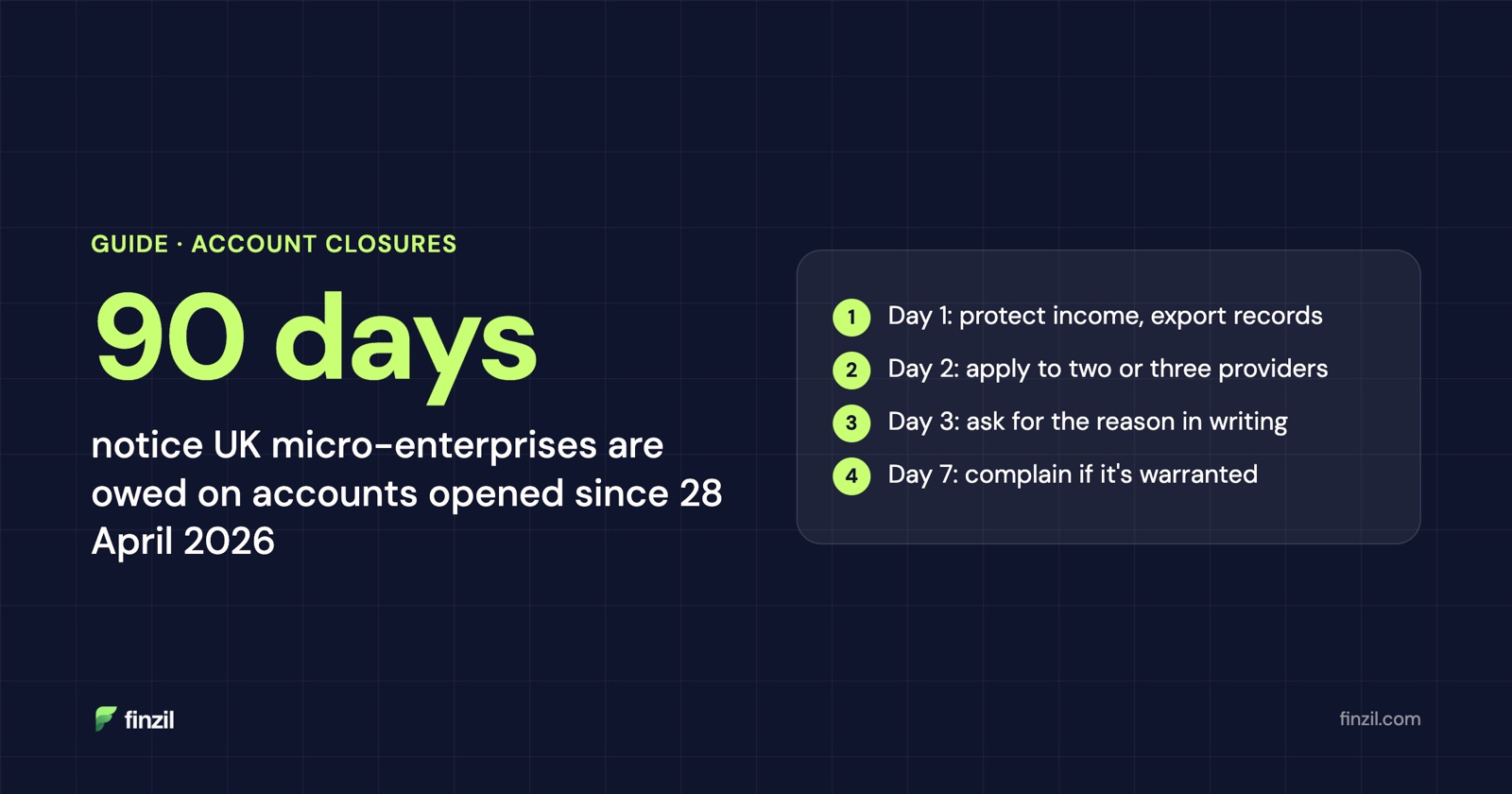
A provider can close a business account for almost any reason, but in the UK it now owes most small businesses more notice and an explanation. For contracts agreed since 28 April 2026, micro-enterprises and charities get at least 90 days' notice and a specific reason, unless financial crime law prevents it. Whatever the notice, use the first week to protect your income, save your records, open a second account and complain in writing.
- Notice for UK micro-enterprises: 90 days for contracts agreed since 28 April 2026, two months before that.
- A UK payment services complaint must be answered within 15 business days.
- 138 of the 177 providers on Finzil let you open an account remotely (October 2026).
Closed, frozen or restricted: know which one you have
The letter often doesn't say it plainly, and each needs a different response.
| What happened | What it usually means | What you can do |
|---|---|---|
| Notice of closure with a date | The provider has decided to stop serving you, often for risk appetite | Use the notice period to move. Ask for the reason and complain if it doesn't hold up |
| Immediate closure | The provider believes it has grounds to end the contract without notice, often a suspicion or a serious breach of terms | Ask for your balance to be returned, in writing. Complain |
| Frozen account, no closure yet | A review is under way, or the provider has reported a suspicion and is waiting for permission to proceed | Answer any information request quickly and completely. Don't move the business's story around |
| Restricted features (no outgoing payments, no cards) | A review, often triggered by an unusual payment | Same as a freeze: respond fast, with documents |
A freeze that lasts weeks with no explanation can mean the provider has filed a suspicious activity report. In the UK, if it asks the National Crime Agency for consent to release the money, the agency has 7 working days to reply and, if it refuses, a further 31 days, which a court can extend up to 186 days in total. The provider is not allowed to tell you any of this, because it would be tipping off. Silence is not always a sign of bad faith.
What notice you're owed
United Kingdom. For payment accounts agreed on or after 28 April 2026, providers must give consumers, micro-enterprises and charities at least 90 days' notice, with an explanation "sufficiently detailed and specific" for you to understand why, and tell you how to complain to them and to the Financial Ombudsman. For contracts agreed before that date, the old minimum of two months applies. There are exceptions where giving notice or reasons would break financial crime law.
A micro-enterprise has fewer than 10 staff and an annual turnover or balance sheet of no more than €2 million. Larger companies' contracts can switch these protections off, so for them the account terms decide the notice, and it can be much shorter.
European Union. Under the Payment Services Directive, closing an open-ended payment account needs at least two months' notice. As in the UK, business contracts can opt out, so check your terms.
United States. No general federal rule requires notice or a reason for closing a business deposit account. The account agreement decides.
In all three, you are entitled to your balance, unless a court order or a legal hold says otherwise. Ask how and when it will be paid, and to which account.
The first 7 days
Day 1: protect what's coming in
- Read the letter for three things: the closure date, whether payments in will still be accepted until then, and how the balance will be returned.
- List every payment that arrives into this account: customers, marketplace payouts, card settlements, refunds, tax repayments. These are the ones that will bounce or get stuck.
- Export everything: statements for at least the last two years, payment history, invoices and card transactions. App access can end before the closure date.
Day 2: open the second account
- Apply to two or three suitable providers at the same time, with identical information. Choose by your situation, not by brand: where the company is registered, its industry and where its owners live. Most providers open accounts remotely, and the quickest take days, not weeks.
- Answer the question honestly. Many application forms ask whether you've had an account closed. Say yes, and give the reason if you know it. A wrong answer found later is grounds to close the new account too.
Day 3: ask why
- Ask once, in writing: "Please confirm the reason for closing our account, so we can address it." Under the UK rules for contracts since 28 April 2026, a micro-enterprise is owed that explanation. Others may still get one.
- Fix what can be fixed. If the reason is a missing document, an unexplained payment or an out-of-date description of your business, send what's needed and ask whether that changes the decision. Sometimes it does.
Days 4 to 6: move the money flows
- Send new payment details to customers and platforms as soon as the new account works, never before. Update invoices, your website and your marketplace settings.
- Move outgoing payments: payroll, direct debits, tax, card subscriptions.
Day 7: complain if it's warranted
- Make a formal complaint if the notice was shorter than you were owed, no reason was given when one was due, or the balance isn't being returned. A UK provider has 15 business days to give a final answer to a payment services complaint, or 35 in exceptional cases.
- Take it to the Financial Ombudsman if you're unhappy with the answer. UK micro-enterprises can complain, as can small businesses with a turnover under £6.5 million and either fewer than 50 staff or a balance sheet under £5 million.
What not to do
- Don't move money out in a rush to accounts in other names. It looks like the very thing the provider may be worried about.
- Don't open new accounts under a different company to hide the closure. Providers compare directors, owners and addresses.
- Don't argue on social media before you've complained. It rarely changes the decision and can make a later complaint harder.
- Don't wait for the closure date. The notice period is the time you have to move without disruption.
Can a closure follow you?
A closure on its own isn't shared between providers. A fraud marker is different. In the UK, a provider that suspects fraud can record a marker with Cifas, and other members will see it when you apply. You can ask Cifas for a copy of what it holds about you, free of charge, and challenge a marker you think is wrong.
Our view: the businesses that get through a closure with least damage are the ones that already had a second account. A second provider, used for a small share of payments every month, costs little and turns a closure from an emergency into an admin task.
Finzil shows which providers accept your company, from their published rules, before you apply. Check your company.
Questions people ask
Can a bank close my business account without giving a reason?
In the UK, since 28 April 2026, providers must give micro-enterprises and charities a specific reason and 90 days' notice for new contracts, except where financial crime law prevents it. Larger businesses and older contracts depend on the account terms.
How much notice does a bank have to give before closing a business account?
In the UK, 90 days for micro-enterprises and charities on contracts agreed since 28 April 2026, and two months for older contracts. In the EU, two months unless the contract says otherwise. In the US, the account agreement decides.
Why is my business bank account frozen?
Usually because the provider is reviewing an unusual payment or your business details, or has reported a suspicion and is waiting for permission to continue. Answer information requests quickly and fully. The provider is not allowed to tell you whether a report was made.
How do I get my money back after a business account is closed?
The balance is yours unless a court order or legal hold applies. Ask the provider in writing how and when it will be paid and to which account, and complain if it isn't returned.
General information, not legal or financial advice. UK rules from the Payment Services and Payment Accounts (Contract Termination) (Amendment) Regulations 2025, in force 28 April 2026, and the Financial Ombudsman Service's eligibility rules. Provider figures from 177 profiles on Finzil, checked between 1 and 15 October 2026.