The short answer
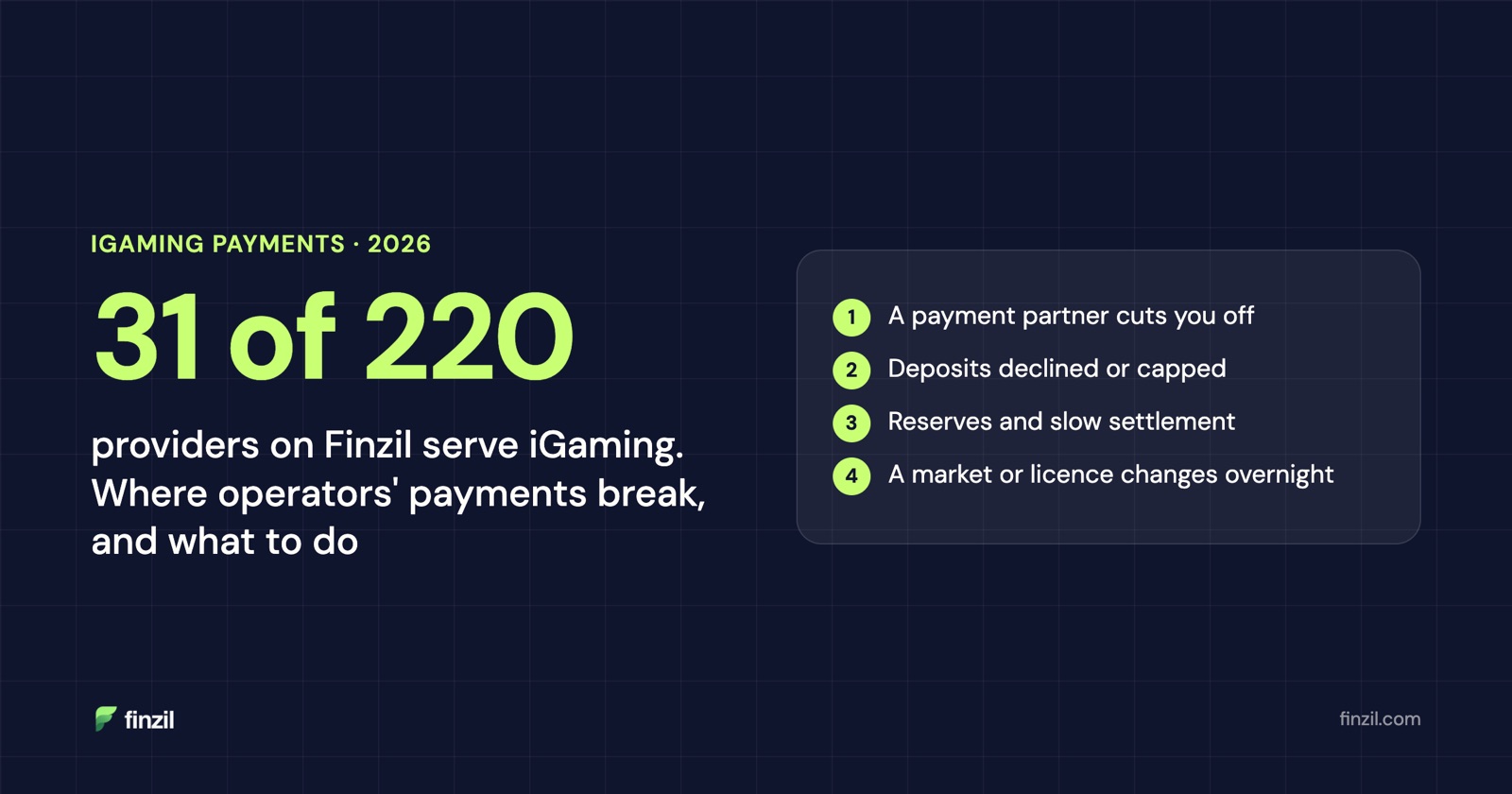
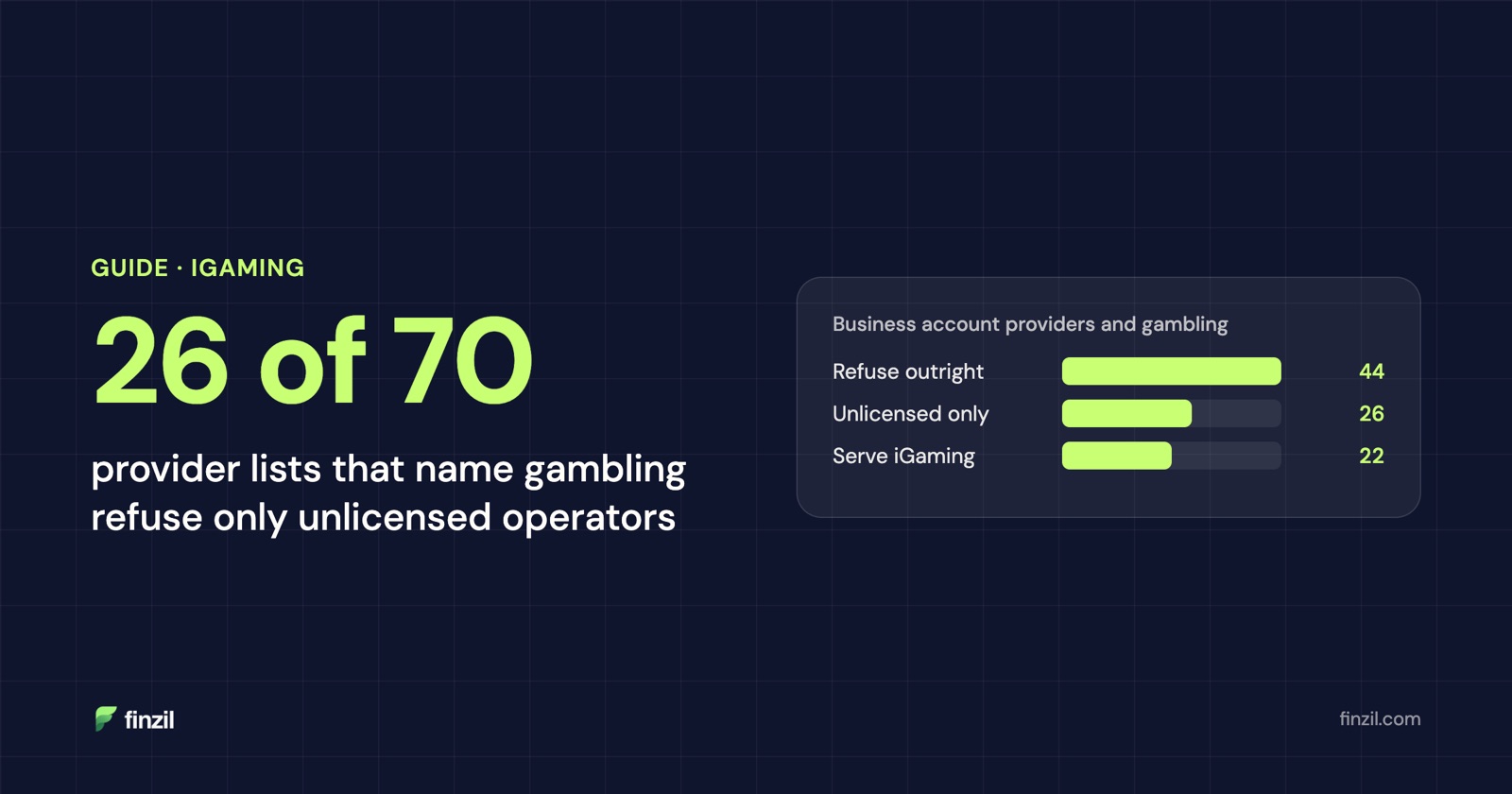
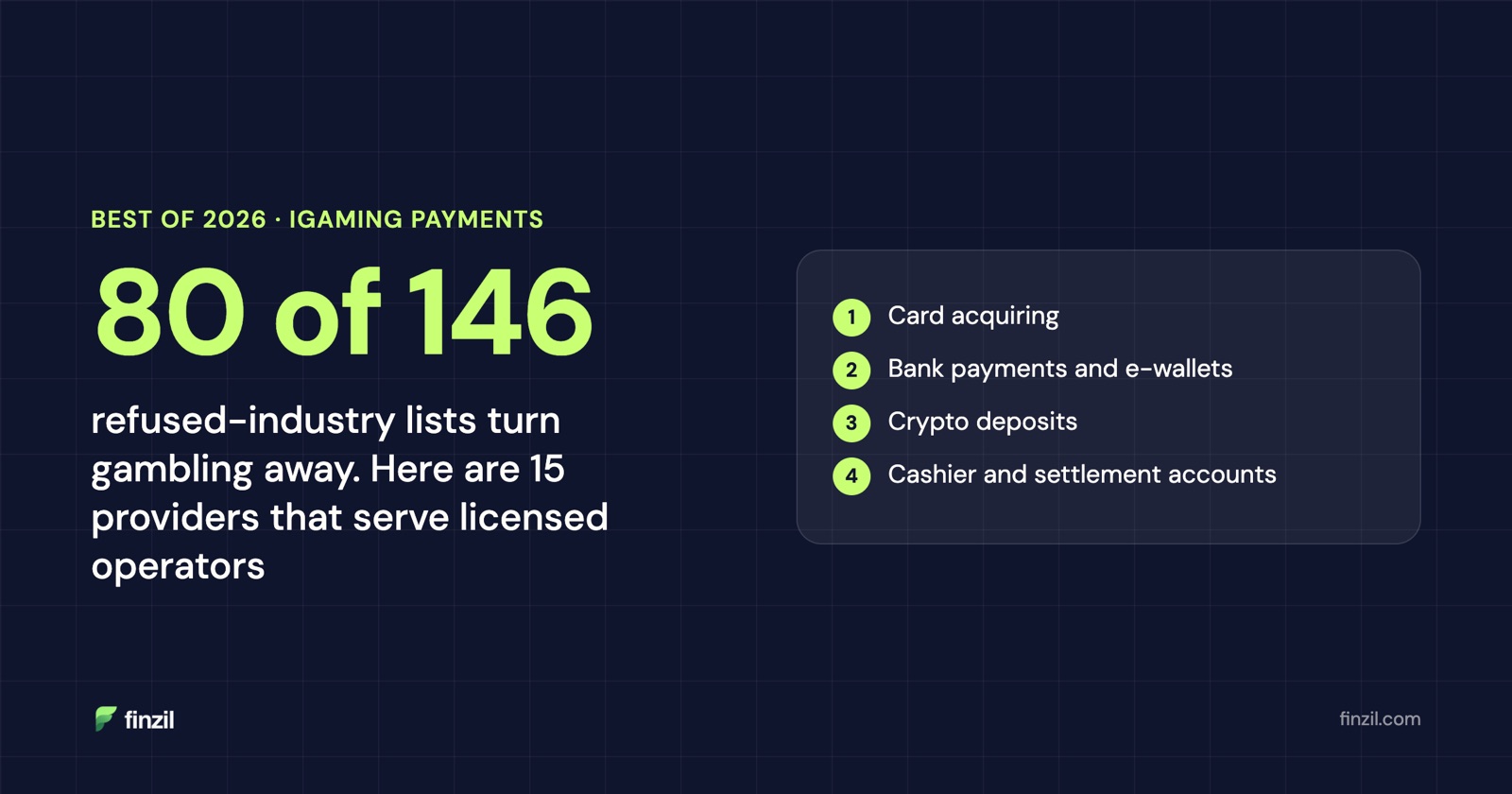
Most payment providers refuse gambling: Stripe lists it as prohibited, and 80 of the 146 providers on Finzil that publish a refused-industry list turn it down outright. Fifteen providers below say in their own documents that they serve licensed iGaming operators, across card processing, bank payments, e-wallets, crypto, cashiers and settlement accounts (checked 20 November 2026).
- No provider covers the whole chain. Operators combine a card acquirer, a bank or wallet method, a cashier and a settlement account.
- Your licence decides the list. A UK or Maltese licence opens the most doors; for others, the provider decides case by case.
- Nobody here publishes iGaming pricing for card processing. Ask for the rate, the rolling reserve (the share of each payment held back for months) and the settlement day in writing.
How we picked
We read each provider's own industry pages, terms and lists of refused businesses, and the regulator registers they point to. A provider is listed only where its own pages say it serves gambling or gaming operators, or refuse only unlicensed gambling. Nine of the fifteen have a full profile on Finzil, checked between 13 and 23 October 2026. The other six were checked on their own websites on 20 November 2026. Nobody paid to be listed, and being listed does not mean a provider will accept your business.
"Best for" names the job each provider is built for. It is not a ranking.
iGaming payment providers by job
| Provider | Best for | Licensed in | What it publishes about gambling |
|---|---|---|---|
| Nuvei (nuvei.com) | Card acquiring plus cashier in one contract | UK (FCA), Netherlands, Cyprus, Lithuania; money transmitter licences in 39 US jurisdictions | Gaming page for operators; 720 payment methods, 150+ currencies |
| Paysafe (paysafe.com) | Card acquiring with US Pay by Bank | UK (FCA), Ireland | "iGaming payment gateway"; 250+ methods |
| Worldpay (worldpay.com) | Card acquiring at high volume | Not stated on its gaming page | "Over 200 gaming operators"; card payouts of winnings |
| Checkout.com (checkout.com) | Card acquiring for established operators | UK, France and eight more | Gambling accepted with specific approval |
| Trustly (trustly.com) | Bank deposits that also identify the player (Pay N Play) | Sweden, UK (FCA) | Pay N Play in Sweden, Finland, Estonia, Netherlands |
| Brite (britepayments.com) | Instant bank payouts | Sweden (Finansinspektionen) | Payouts under 40 seconds, 24/7 |
| Skrill Business (skrill.com) | E-wallet deposits and payouts | UK, Ireland, US | Refuses only unlicensed gambling |
| Neteller (neteller.com) | E-wallet deposits and payouts | UK, Ireland, Canada | Refuses only unlicensed or illegal gambling |
| Luxon Pay (luxon.com) | E-wallet built for gaming | UK, Canada | Built for deposits and withdrawals at gaming merchants |
| Payhound (payhound.com) | Crypto deposits converted to EUR, GBP or USD | Malta (MiCA and financial institution) | Names iGaming among the sectors it serves; €400 to open, €100 a quarter |
| Praxis (praxis.tech) | Cashier connecting many processors | None: software, holds no funds | iGaming industry page; Stake and Codere Online named as clients |
| Paytently (paytently.com) | Payment orchestration plus IBAN accounts | Malta (MFSA) | Refuses gambling only without an appropriate licence |
| Xace (xace.io) | Settlement accounts for operators, suppliers and affiliates | UK (FCA), Malta | Licensed casinos, sportsbooks and white-labels; £250 a month |
| ONE.io Connect (connect-one.io) | Collection accounts in 12 currencies | UK (FCA), Canada | Mainly Tier 1 and Tier 2 licences; others reviewed one by one |
| OpenPayd (openpayd.com) | Virtual IBANs and payouts at volume | UK, Malta, Canada | iGaming named among the sectors it serves |
Card processing: three big acquirers say yes, Stripe says no
Card deposits need an acquirer (the company that processes card payments for the merchant) that will take gambling's own merchant category code, 7995.
Nuvei sells acquiring and a cashier together, with 720 payment methods and about 40 cryptocurrencies. Its licence page lists e-money and payment licences in the UK, the Netherlands, Cyprus and Lithuania, and money transmitter licences in 39 US jurisdictions. Paysafe, which also owns Skrill and Neteller, reported on 12 November 2026 that its merchant business grew on North American iGaming. Worldpay, owned by Global Payments since 9 January 2026, says it works with over 200 gaming operators and pays winnings back to cards.
Checkout.com lists gaming among the industries it serves, but gambling needs its specific approval.
On the other side: Stripe lists gambling as prohibited. Adyen's own list marks legal gambling as "restricted", meaning more documents are needed, and any US-based gambling as prohibited. Its price list adds up to 3% for gambling on Trustly payments.
Bank payments carry no card chargebacks
A bank payment moves money straight from the player's account, so there is no card issuer to decline it and no chargeback (a card payment the player disputes and has reversed) months later.
Trustly's Pay N Play combines the deposit with identity checks, so a player can register and deposit in one step. Its developer documentation lists it in Sweden, Finland, Estonia and the Netherlands. Brite focuses on the other direction: its documentation says payouts arrive in under 40 seconds, around the clock. Both are licensed by Sweden's Finansinspektionen.
Bank payments can still cost gambling merchants extra. Adyen's price list says additional rates of up to 3% can apply to gaming and gambling merchants on Trustly. On €200,000 of monthly deposits, that could be up to €6,000 a month on top of the standard fee.
E-wallets and crypto take the deposits cards refuse
E-wallets put a regulated wallet between the player and the casino. Skrill Business and Neteller, both Paysafe, refuse only unlicensed gambling. Luxon Pay is built for gaming: its fees fall as a player's quarterly deposits at gaming merchants rise.
For crypto, Payhound, licensed in Malta under the EU's MiCA rules, names iGaming among the businesses it serves. It converts player deposits into euros, pounds or dollars on arrival, and publishes its prices: €400 to open and €100 a quarter, so €800 in the first year before transaction fees.
A cashier connects the processors; it doesn't hold the money
A cashier (also called payment orchestration) is the deposit page and the routing behind it: it picks the processor for each payment and sends a declined card to a second one. Praxis says its service does "not include transaction processing" or holding client funds. You still need the processors.
Paytently combines orchestration with IBAN accounts under a Maltese payment licence. PaymentIQ, another cashier platform, was sold by Worldline to Incore Invest in March 2026. Its own site no longer mentions gaming, so we left it out of the table.
Settlement accounts receive what the processors pay out
Every processor above pays into a business account in the operator's name. That account is the hardest part to replace: 80 of the 146 providers on Finzil that publish a refused-industry list turn gambling away. Xace takes licensed casinos, sportsbooks, white-label operators, suppliers and affiliates, for £250 a month. ONE.io Connect takes mainly operators with Tier 1 and Tier 2 licences and reviews others one by one. OpenPayd names iGaming among its sectors. The full list of accounts, by licence and price, is in our iGaming business account guide and on the iGaming industry page.
Your licence decides which providers answer
- UK Gambling Commission or Malta Gaming Authority. Every provider in the table can look at you. Expect enhanced checks.
- Curaçao. Since its new law of December 2024, providers ask for the direct licence from the Curaçao Gaming Authority, not an old sub-licence. Providers that sort licences into tiers, like ONE.io Connect, don't publish where Curaçao sits: ask before you apply.
- United States. Each state licenses its own market, and some also approve the payment companies that serve operators: Nuvei, for one, was approved by Michigan's Gaming Control Board in 2021. Adyen refuses US gambling.
- No licence. Every provider here refuses unlicensed gambling.
What to ask before you sign
Card processors that take gambling don't publish prices, so the cost sits in the contract. Ask for these in writing:
- The rate and the extras: card rate, cross-border fees, and any gambling surcharge per method.
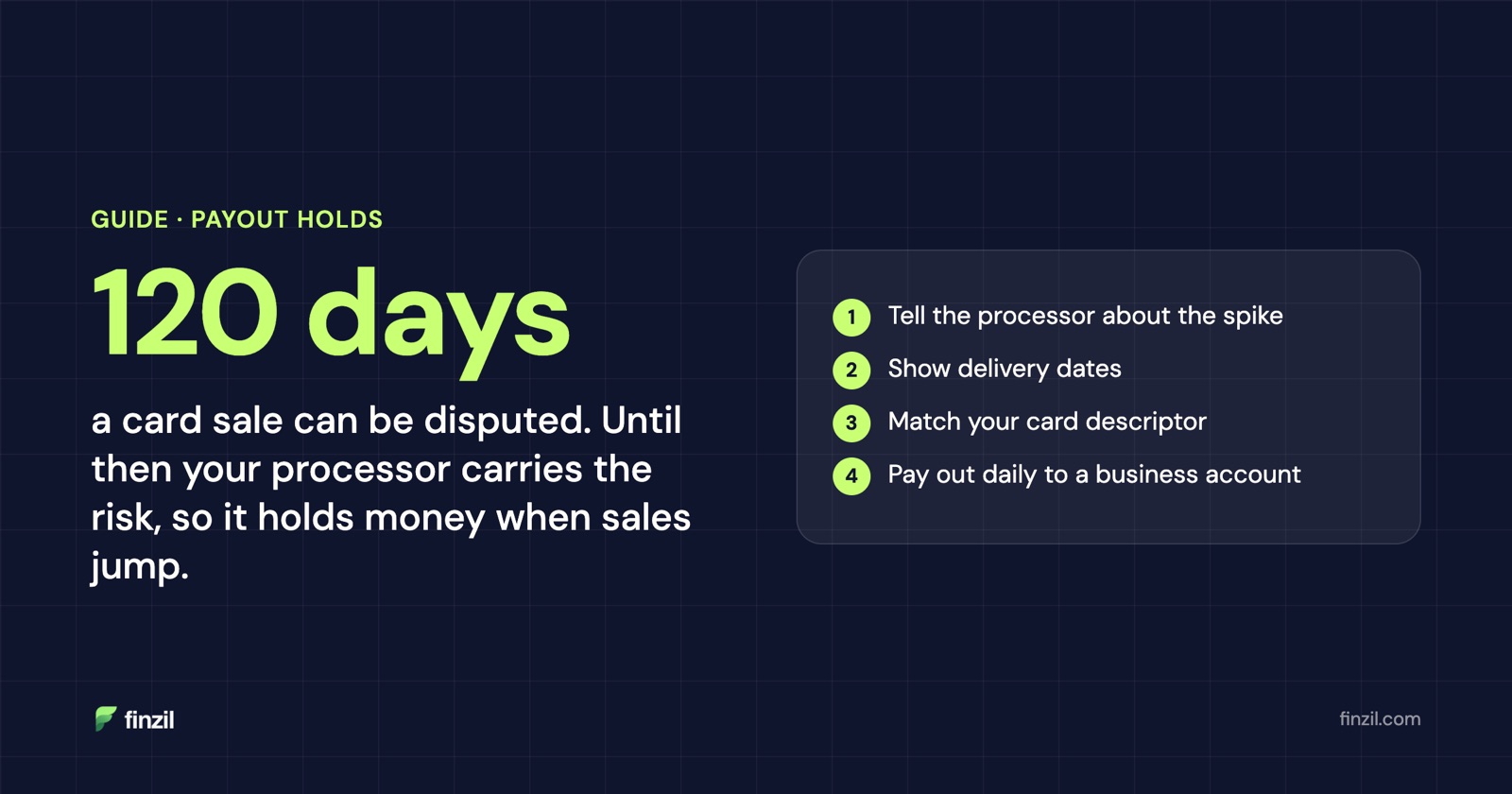
- The rolling reserve: high-risk processors that publish terms quote 5–15% of volume, often held 6–12 months (see where operators' money gets stuck). Get the release date.
- Settlement: which day the money reaches your account, and whether weekends count. Brite's own support pages say merchant withdrawals made at the weekend wait for the next working day.
- The service level: uptime, payout time and support hours. No regulator sets a standard for these, so the contract is the standard. Worldpay states 99.9% uptime on its gaming page.
- Offboarding notice: how many days you get if the provider leaves gambling, or leaves you.
Our view: start with two methods per market and two settlement accounts in different countries. Losing one provider then slows the business instead of stopping it.
What to do
- List your markets and licences. That decides which rows of the table apply.
- Pick one card acquirer and one bank or wallet method for each market.
- Add a cashier once you run more than two processors.
- Open a settlement account before the first processor goes live: check which providers accept your licence.
Questions people ask
What are the main iGaming payment providers in 2026?
Card acquiring: Nuvei, Paysafe, Worldpay and Checkout.com (with approval). Bank payments: Trustly and Brite. E-wallets: Skrill, Neteller and Luxon Pay. Crypto: Payhound. Stripe's list of prohibited businesses includes gambling (Finzil, November 2026).
How do iGaming payment solutions handle declined deposits?
A cashier sends a declined card payment to a second processor, then offers a bank payment or e-wallet if that fails too. Card issuers can refuse gambling's merchant code 7995 as policy, which is why operators keep at least two routes per market.
What SLA does a typical iGaming payment solution offer?
There is no regulator standard. Providers state their own: Worldpay 99.9% uptime on its gaming page, Brite payouts in under 40 seconds around the clock. Put uptime, payout time and settlement day in the contract.
What is an iGaming merchant account?
An account with a card acquirer that accepts gambling's merchant category code 7995. Expect to show your gambling licence and to agree a rolling reserve; Nuvei, Paysafe, Worldpay and Checkout.com offer them to licensed operators (Finzil, November 2026).
Sources: Finzil provider profiles (298, checked 13–23 October 2026; counts of 20 November 2026); Nuvei, Paysafe, Worldpay, Trustly, Brite, Praxis, Adyen and Worldline websites and documentation (checked 20 November 2026); Global Payments (9 January 2026). General information, not financial or legal advice.
Providers in this article
iGaming payment providers on Finzil
Payment providers named above that have a full Finzil profile. Each profile shows its licences, the markets it accepts and what it charges.
| Provider | Licensed in | Known for |
|---|---|---|
 Checkout.comE-money institution |   | Enterprise paymentsCard issuing |
 Skrill BusinessE-money institution |   | Merchant wallet40+ currencies |
 NetellerE-money institution |  | Merchant wallet30 currencies |
 Luxon PayE-money wallet | | iGaming wallet38 currencies |
 PayhoundCrypto payments provider |  | iGamingStablecoins |
 PaytentlyPayment institution | | iGamingIBAN |
 XacePayment institution | | iGamingGBP and EUR |
 ONE.io ConnectPayment institution | | iGaming12 currencies |
 OpenPaydE-money institution | | Virtual IBANsFintech infrastructure |
Not sure which one fits? Your profile ranks them for your business, with the reason behind each.