The short answer
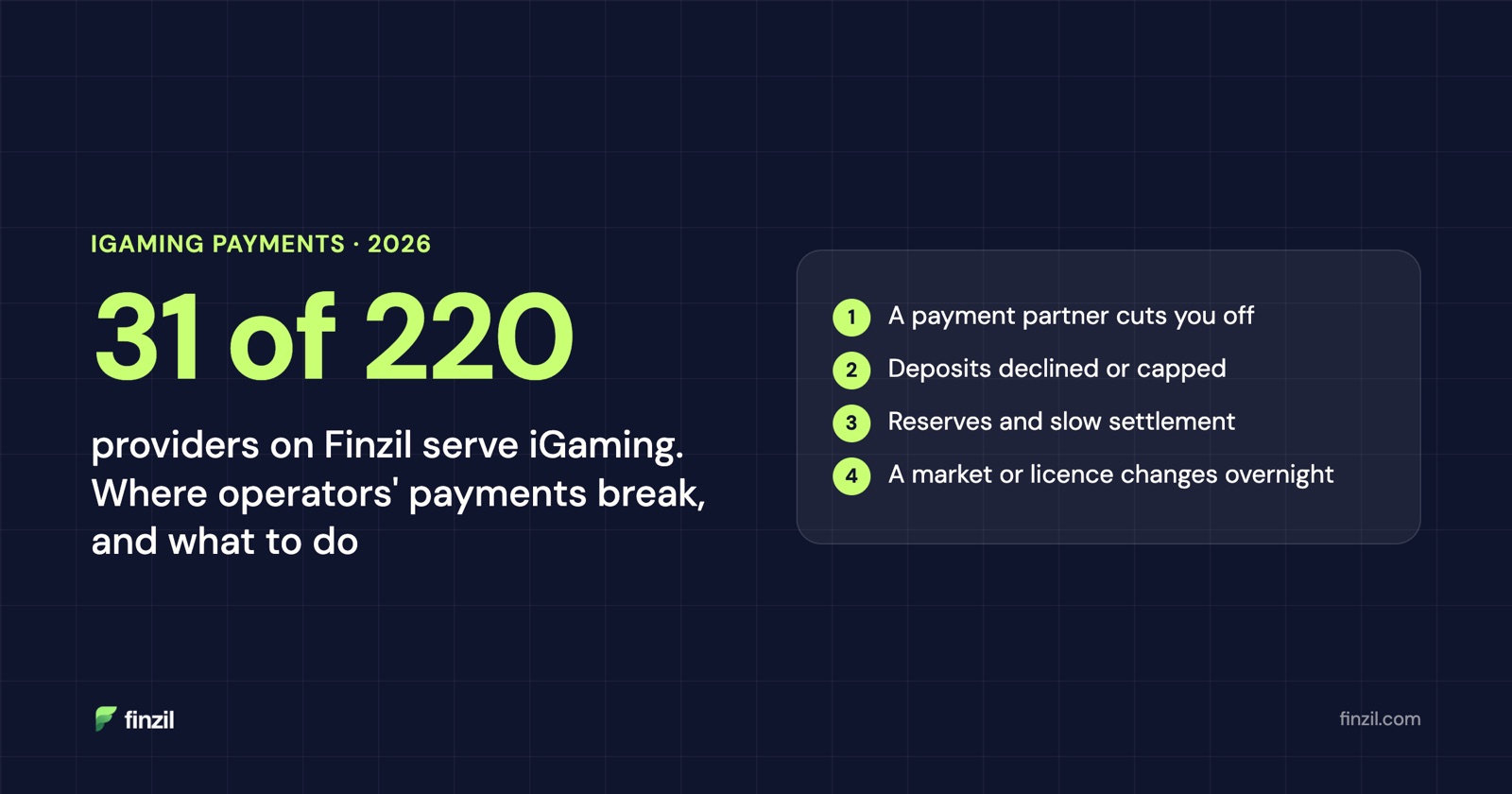
The biggest iGaming payment problems of 2025 and 2026 are four: losing a payment partner, deposits declined or capped by new player checks, reserves and slow settlement that lock up cash, and markets or licences that change at short notice. Most of them land on the same place: the business account that receives settlement. Of 220 providers on Finzil, 31 say they serve iGaming.
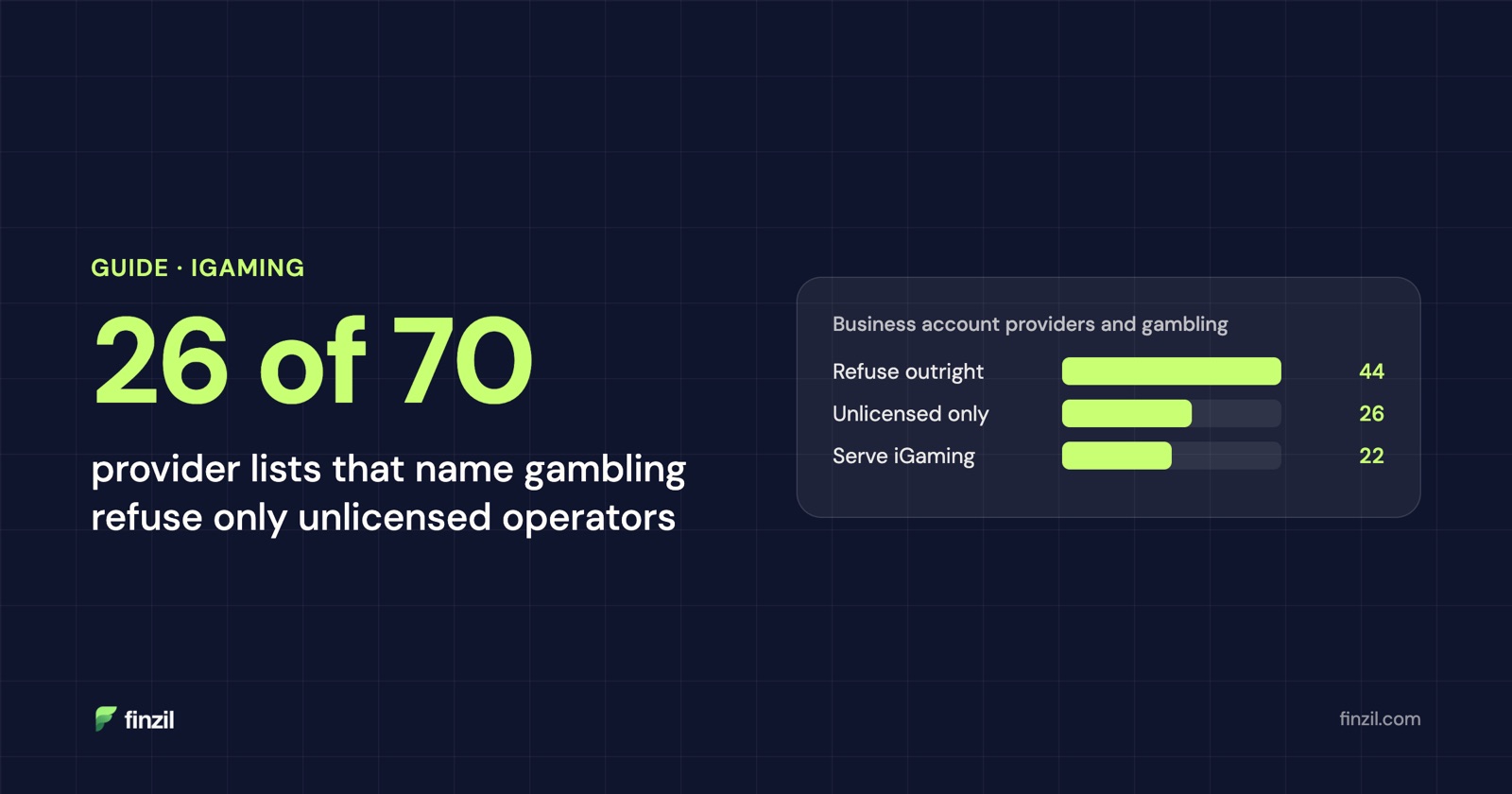
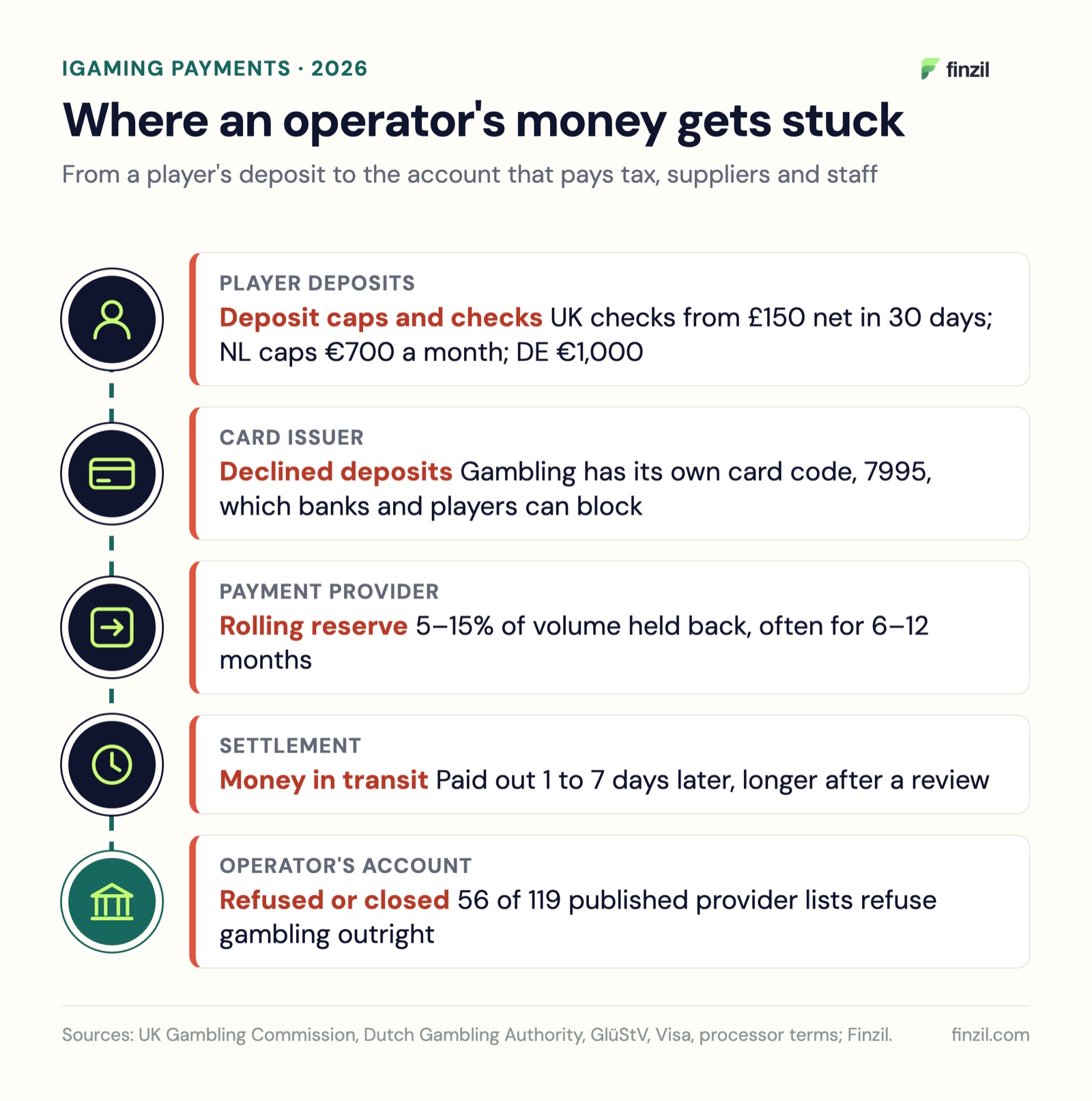
- 56 of the 119 providers that publish an industry list refuse gambling with no exception for licensed operators (Finzil, October 2026).
- The UK checks spending from £150 in net deposits over 30 days, and the Netherlands blocks deposits above €700 a month net.
- High-risk processors quote rolling reserves of 5–15% of volume, often held for 6–12 months.
What operators are searching for
We looked at the iGaming searches that showed finzil.com in Google over the last 12 months: 178 different search terms and 11,295 impressions. Nine in ten were some form of "iGaming payment solutions", "payment providers" or "payment gateway". The single largest was "igaming payment solutions" with 2,583 impressions.
The rest is more telling. "igaming payments challenges" had 372 impressions on its own, and people typed full questions: how payment solutions "handle declined deposits", what SLA a payment solution offers, what fees operators are charged, which option settles fastest. Only 62 impressions came from searches about a bank account or an EMI.
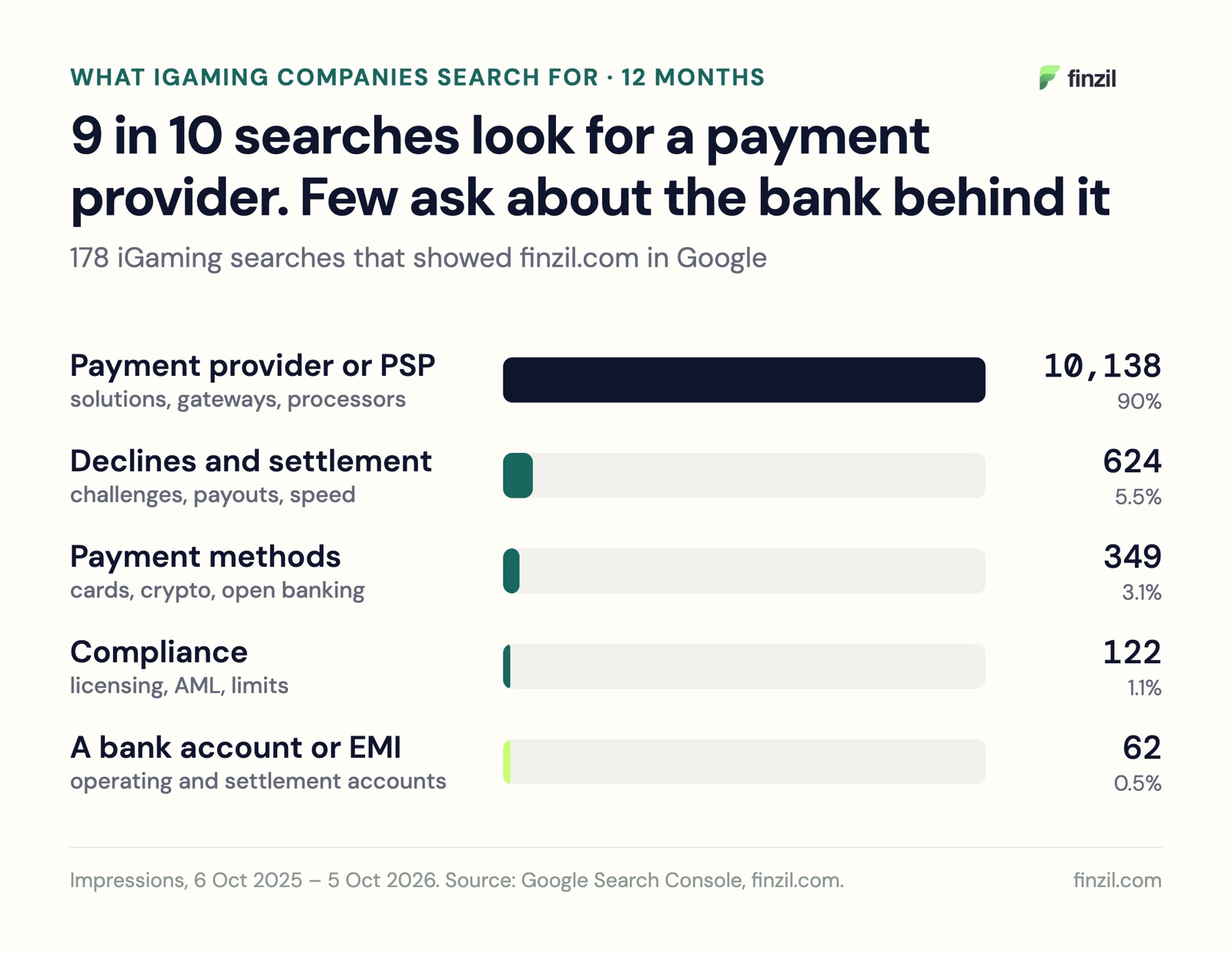
In our experience that order is back to front. A payment provider can usually be found. The account the provider settles into, and the account that pays tax, suppliers and staff, is where operators get refused or closed. It is also what every payment provider asks for during onboarding.
Where the money gets stuck
A player's deposit passes five points before an operator can spend it. Each one has become harder in the last two years.
1. A payment partner cuts you off
The most expensive problem is the one with the least warning: a payment provider or bank leaves gambling, or leaves you. Processors that work with operators plan for it openly. One operator guide lists the "offboarding notice" next to outages and reserve changes as a normal failure mode, and advises moving volume gradually before the cut-off date.
It also happens to the providers themselves. Kea, which sold business accounts and stablecoin payments aimed at iGaming, crypto and forex businesses, stopped taking new customers after Canada's FINTRAC revoked the registration of Gulliver Pay Inc., the company that provides its services, on 1 May 2026.
What to do:
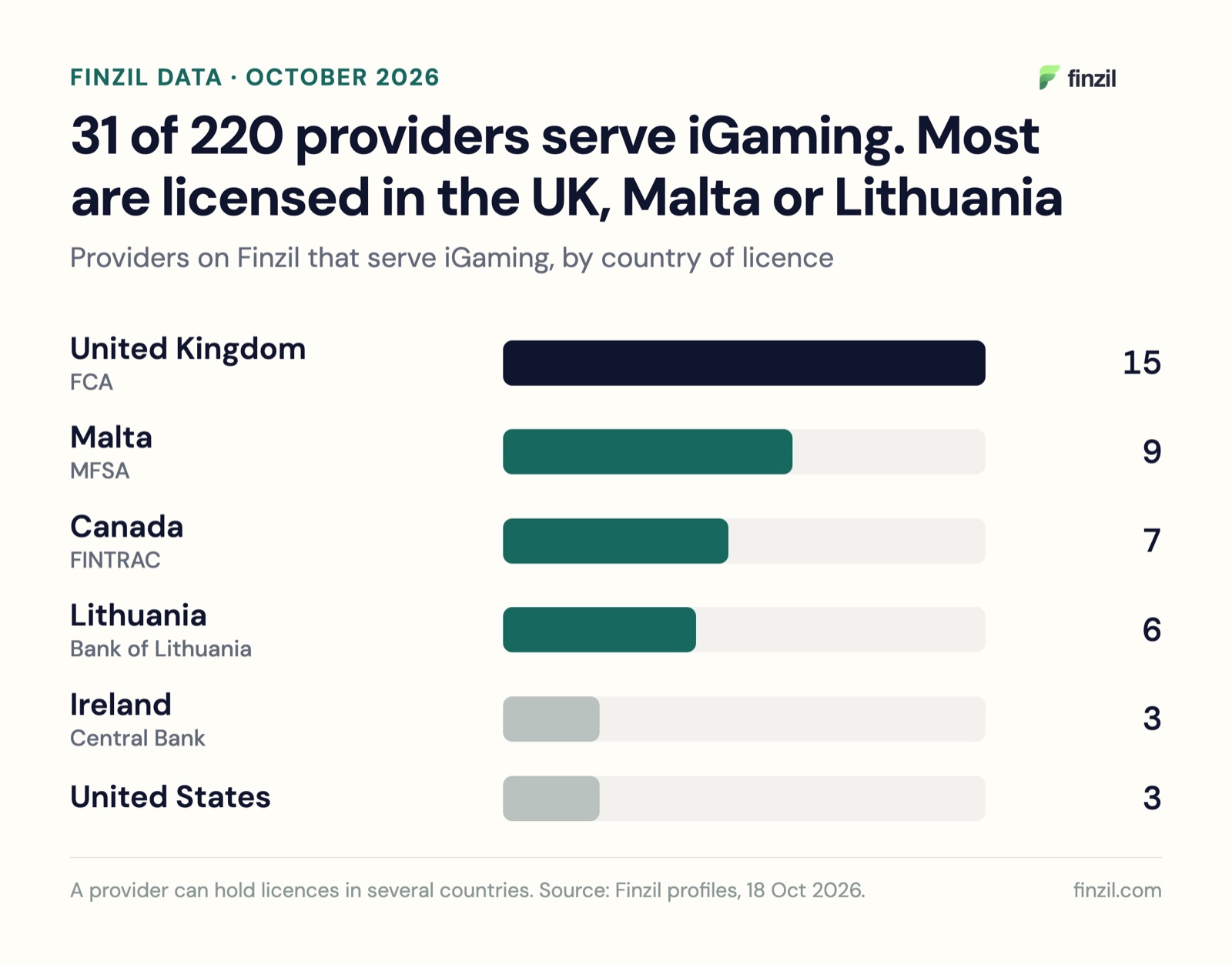
- Keep at least two settlement accounts, with different providers licensed in different countries. Of the 31 providers on Finzil that serve iGaming, 15 hold a UK licence, 9 a Maltese one, 7 a Canadian registration and 6 a Lithuanian licence.
- Keep a current application pack (licence, ownership chart, AML policy, six months of statements) so a second account takes weeks, not months.
- Read the provider's own list of refused industries before you apply, not after. Where gambling is on it, a licence rarely changes the answer.
2. Deposits declined or capped
More deposits now fail before they reach the operator, for two reasons.
Card declines. Card schemes put gambling under its own merchant category code, 7995. Issuers can and do refuse that code as a matter of policy, whatever the operator's licence, and many UK banking apps let customers block gambling payments themselves. Searches like "how do igaming payment solutions handle declined deposits" come from this.
Player checks and caps. Regulators now cap or check deposits directly:
| Market | Rule | Since |
|---|---|---|
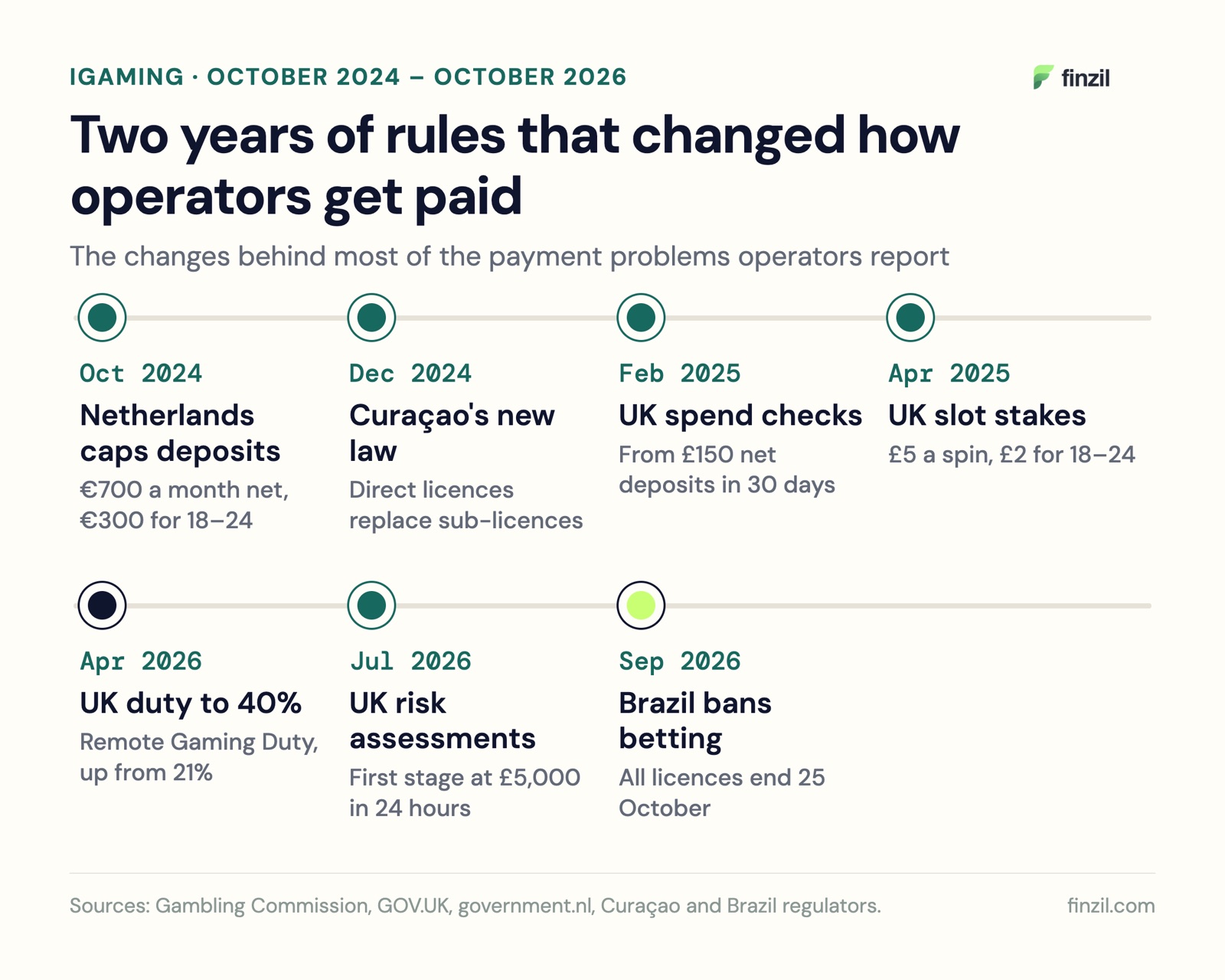
| United Kingdom | Financial vulnerability check above £150 net deposits in a rolling 30 days | 28 February 2025 |
| United Kingdom | Online slots stake limit of £5 a spin, £2 for 18–24-year-olds | 9 April and 21 May 2025 |
| United Kingdom | Financial risk assessments, first stage at £5,000 net deposits in 24 hours (£2,500 for under-25s) | Confirmed July 2026, start date to follow |
| Netherlands | Deposits blocked above €700 a month net (€300 for 18–24) until affordability is shown | 1 October 2024 |
| Germany | €1,000 a month deposit limit across operators, tracked centrally | 1 July 2021 |
What to do: offer a bank payment option next to cards (open banking payments carry no card chargebacks), and send declines to a second processor before showing an error. For the checks, the UK Gambling Commission says 97% of financial risk assessments should be frictionless, so the work is in the flow, not the documents.
3. Reserves and slow settlement
A new operator's processor usually holds back part of every deposit as a rolling reserve. High-risk processors that publish their terms quote 5–15% of volume, often held for 6–12 months, and settle anywhere from the next day to a week later. One processor's own case study describes an MGA-licensed casino whose acquirer held 25% for 12 months.
For a growing operator that means cash it has earned but can't use, while UK Remote Gaming Duty rose from 21% to 40% of gross gaming revenue on 1 April 2026. Margins fell and working capital got tighter at the same time.
What to do:
- Ask for the reserve percentage, the holding period and the release schedule in writing. A reserve with no release date is a warning sign.
- Ask for a review after six clean months. Low chargeback ratios are the main argument for a lower reserve.
- Spread volume across processors, so a reserve or a volume cap at one doesn't stop the business.
4. A market or licence changes overnight
Two changes show how fast the ground moves:
- Curaçao. Its new gaming law came into force in December 2024 and replaced the old master-licence and sub-licence system with direct licences from the Curaçao Gaming Authority. Operators had to re-apply, and banks and payment providers asked for the new licence before continuing.
- Brazil. On 25 September 2026 a provisional measure banned betting and its advertising, and all licences end on 25 October. We covered it in Brazil's betting ban.
What to do: tell your providers before a regulator does. A provider that hears about a licence change from you, with the new licence attached, has a reason to keep you. One that reads it in the news has a reason to review you.
What to do this quarter
- List every account money passes through: processors, e-wallets, settlement accounts, operating accounts. Mark which ones you could not replace within a month.
- Open a second settlement account with a provider in a different country, before you need it.
- Get each processor's reserve, release schedule and settlement time in writing.
- Add a bank payment option for markets where card declines are high.
- Keep one application pack up to date, so any provider can say yes quickly. Our iGaming business account guide lists what goes in it.
- Check which providers accept your licence and markets on Finzil.
Questions people ask
What are the main payment challenges for iGaming operators in 2026?
Losing a bank or payment provider, card deposits declined under the gambling code 7995, deposit checks and caps in markets like the UK and the Netherlands, and rolling reserves of 5–15% held for months. Finzil, October 2026.
Why are iGaming deposits declined?
Card issuers can refuse gambling transactions (merchant category code 7995) as a policy, players can block gambling in many banking apps, and regulators cap deposits: €700 a month net in the Netherlands, €1,000 a month in Germany.
How much rolling reserve do iGaming payment processors hold?
High-risk processors that publish their terms quote 5–15% of processing volume, usually held for 6–12 months. Terms are negotiable after a clean processing history.
Which banks and EMIs accept iGaming operators?
Of 220 providers on Finzil, 31 name iGaming as a sector they serve, mostly EMIs licensed in the UK, Malta and Lithuania. 56 of the 119 providers that publish an industry list refuse gambling outright (October 2026).
Do UK online casinos have to check players' finances?
Yes. Since 28 February 2025 operators check customers whose net deposits pass £150 in 30 days, and financial risk assessments start at £5,000 in 24 hours once the first stage begins.
Sources: Finzil provider profiles (220, checked 18 October 2026); Google Search Console for finzil.com, 6 October 2025 – 5 October 2026; UK Gambling Commission (LCCP 3.4.4, online slots stake limit guidance, financial risk assessments update of 7 July 2026); government.nl (1 October 2024); GOV.UK; Curaçao Gaming Authority; Ministério da Fazenda; FINTRAC register; published processor terms. General information, not financial or legal advice.
iGaming-friendly providers
Providers that serve iGaming operators
Providers on Finzil that name iGaming among the sectors they serve. Licensed in the countries shown, with what they are known for. Each links to its full profile, with the licences and markets it accepts.
| Provider | Licensed in | Known for |
|---|---|---|
 PaysetE-money institution PaysetE-money institution |  | 35 currenciesHigh-risk industries |
 PayDoE-money institution PayDoE-money institution |   | Dedicated IBANHigh-risk industries |
 FinXPE-money institution FinXPE-money institution | | Dedicated EUR IBANHigh-risk industries |
 Lidion BankBank Lidion BankBank | | iGaming-friendly10 currencies |
 AndariaE-money institution AndariaE-money institution | | iGamingVirtual IBANs |
 PaytentlyPayment institution PaytentlyPayment institution | | iGamingIBAN |
 XacePayment institution XacePayment institution | | iGamingGBP and EUR |
 ONE.io ConnectPayment institution ONE.io ConnectPayment institution | | iGaming12 currencies |
 NexpayE-money institution NexpayE-money institution |  | Dedicated IBANCrypto and gaming |
 BilderlingsE-money institution BilderlingsE-money institution |  | Direct IBANHigh-risk industries |
Not sure which one fits? Your profile ranks them for your business, with the reason behind each.