The short answer
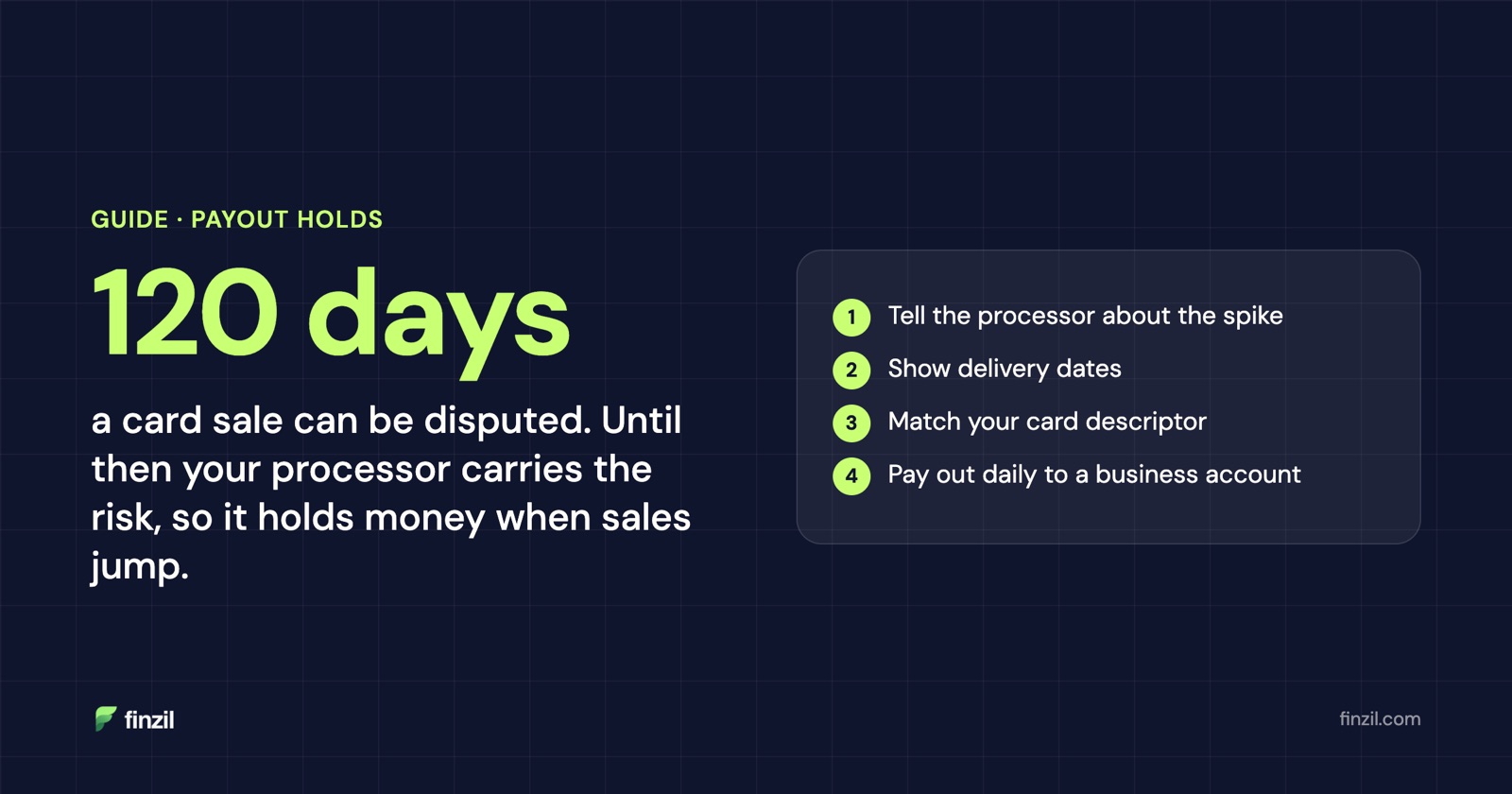
A payment processor holds payouts because it pays your customers' refunds and chargebacks if you can't, and a card sale can be disputed for about 120 days. A sudden jump in sales, a long wait for delivery, rising disputes and a new account all raise that risk. Peak season brings them together. Tell the processor what's coming before it sees it, and keep your operating cash outside the processor balance.
- 120 days: how long card networks typically give cardholders to dispute a payment (Stripe)
- 30–90 days: the usual length of a Stripe reserve (Stripe)
- 1.5%: Visa's "excessive" fraud-and-dispute ratio for merchants in its AP, Canada, EU and US regions since 1 April 2026, down from 2.2% (Visa)
- 94,900 Shopify merchants had their highest-selling day ever over Black Friday–Cyber Monday 2025 (Shopify)
Where this comes from
Black Friday is on 27 November 2026 and Cyber Monday on 30 November. Every year around them, merchant forums fill with the same message: "Your payouts from Shopify Payments are on hold while we review your account."
The rules below come from the processors' own help pages and terms (Stripe, Shopify Payments, PayPal UK), Visa's 2025 fact sheet and Braintree's page on Mastercard's chargeback programme, checked on 17 November 2026. Merchant experiences from Shopify Community threads are reported as what merchants describe, not as data.
What this can't show: no processor publishes how many accounts it holds or for how long, and we haven't seen individual contracts. This explains how the system works, not how often it bites.
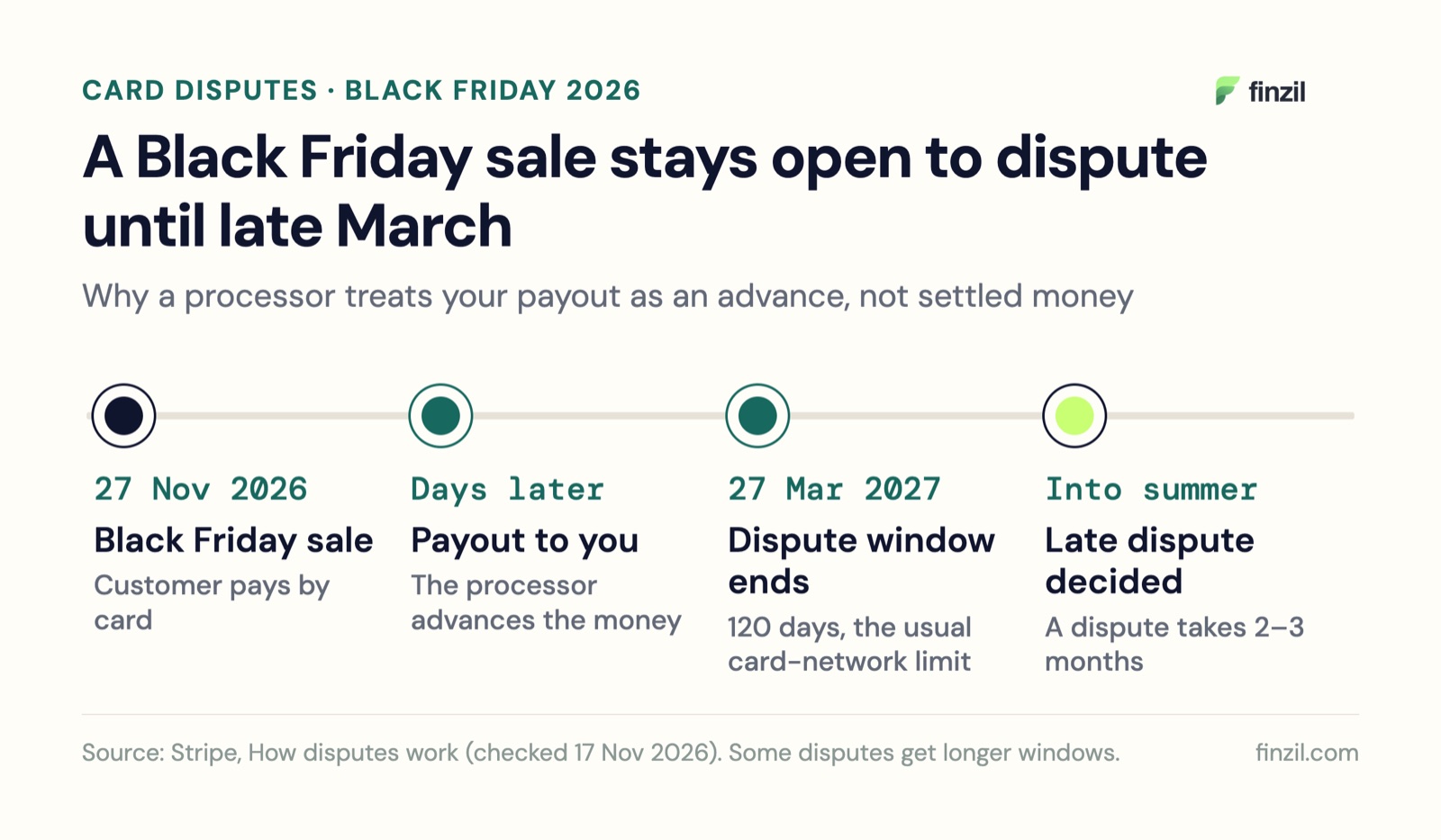
Your payout is an advance against 120 days of refunds
Follow one card sale:
- A customer pays £100 on Black Friday.
- A few days later the processor pays the £100, minus its fee, into your bank account.
- For about 120 days, the customer can ask their card issuer to reverse the payment. For a future event or service, Stripe says the clock starts on the event date, not the payment date.
- If they do, the card network takes the money back from the processor, and the processor takes it from your balance, plus a dispute fee.
- If your balance is empty and you can't pay, the processor carries the loss.
Step 5 is the whole story. Stripe's reserves guide says that, as a processor, it is "responsible for the chargebacks and refunds" when a business takes payments and can't fulfil the orders. Its dispute guide adds that a dispute can take 2–3 months from start to decision.
So a Black Friday sale stays the processor's risk until spring, and a disputed one can stay open into summer. A hold or a reserve is the processor keeping some of your money until that window closes.
Peak season sets off four of the processor's alarms at once
Volume far above your history. Stripe lists "an unexplainable sharp increase in processing volume" as a reason for a reserve. PayPal UK lists "a recent sales spike". Shopify names volume surges next to chargebacks and refund rates. Over Black Friday–Cyber Monday 2025, more than 94,900 Shopify merchants had their highest-selling day ever, Shopify says. A risk model sees the spike before it sees the reason.
A long gap between payment and delivery. Pre-orders, made-to-order goods, slow shipping and event tickets keep the processor exposed for longer. Stripe names "longer-than-average delivery windows". At peak, carriers slow down and late parcels turn into "item not received" disputes.
Disputes and refunds going up. Stripe and Shopify both watch dispute and refund rates. One cause takes an afternoon to fix: the statement descriptor, the name on the customer's card statement. Shopify lists unrecognised transactions among the causes of chargebacks. A shop that bills under a different name collects disputes from honest customers.
A new, dormant or higher-risk account. PayPal UK names first-time sellers, accounts that haven't sold for a long time, and items such as tickets, gift cards, consumer electronics and travel packages. Stripe says it is more likely to delay payouts on new accounts.
Stripe's word is "unexplainable". A spike the processor knew about in advance is a different event from one it finds on a Friday night.
Hold, reserve or delay: five tools with different exits
They differ in how much money they take and when it comes back.
| Tool | What happens | In the processor's words | How long |
|---|---|---|---|
| Account hold | All payouts stop until a review ends | Shopify: no payouts "until the reason for the hold is resolved" | Shopify publishes no timeline |
| Rolling reserve | A percentage of every sale is held; each slice comes back after a set number of days | Stripe's example: 25% for 30 days. PayPal UK's: 5% for 60 days | Stripe: normally 30–90 days |
| Fixed reserve | A percentage of each sale, or a fixed sum, is held until one release date | Stripe: held "until a specified release date". Shopify: "a specific sum for a defined duration" | Set in the reserve email |
| Minimum reserve | A minimum balance stays in the account and can't be paid out | PayPal UK: "a specific minimum amount of money you're required to keep available" | Until PayPal changes it |
| Payout delay | One payment's payout is pushed back | Stripe: released "14 days from the notification date" | 14 days at Stripe |
Two details catch sellers out. A new reserve only fills from new sales, so Stripe says it can also move part of your existing balance into it. And Shopify's payment terms for Ireland let it hold up to "the full amount" of a transaction's funds, with no fixed number of days.
Few processors publish reserve terms in advance. Of the seven card-payment providers on Finzil with full payment-acceptance data, four (Stripe, Checkout.com, Worldpay and Fondy) say reserves are set case by case. One, Moneliq, publishes a figure: 10% rolling for 180 days.
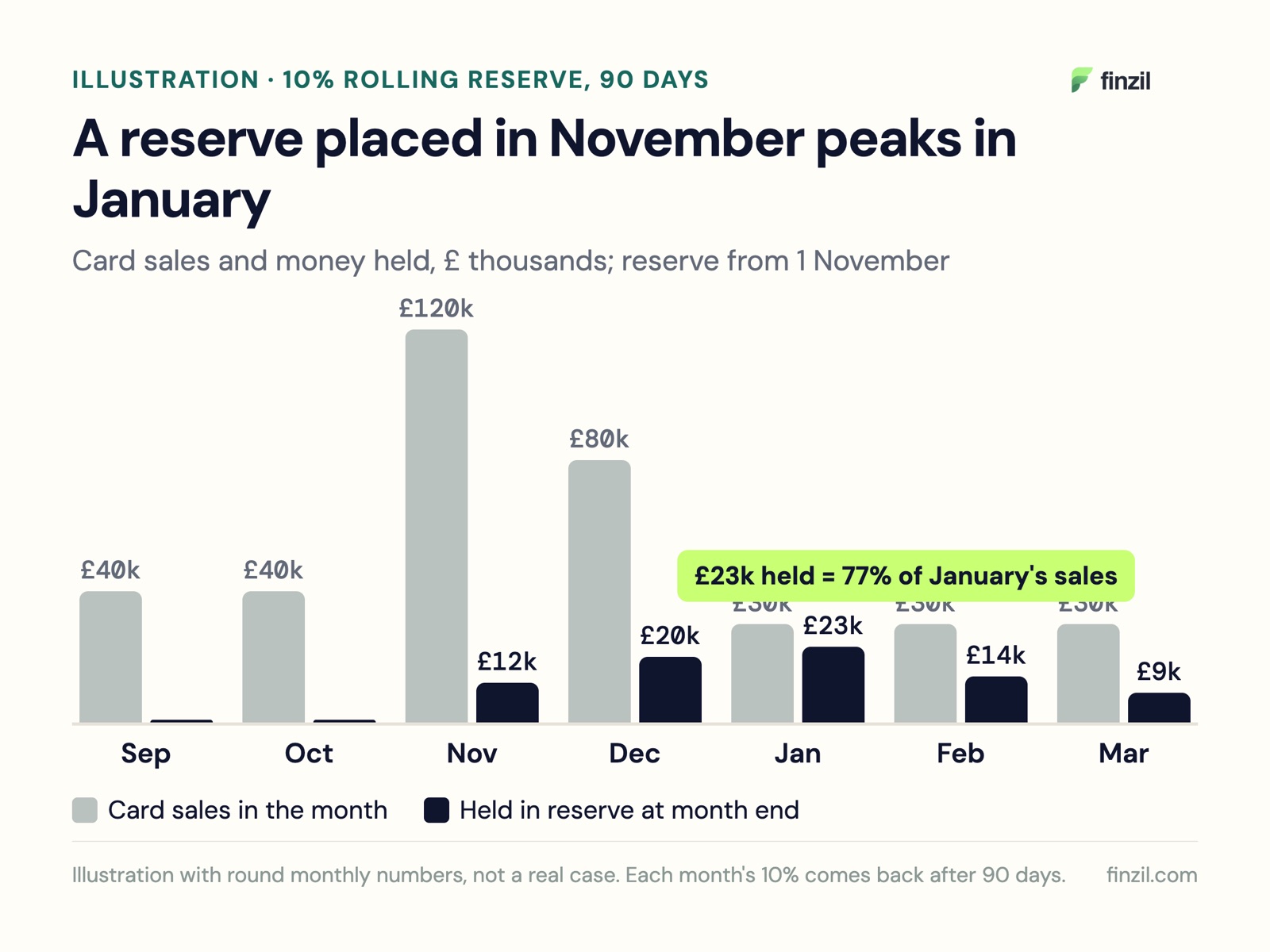
A rolling reserve hurts most after the peak, not during it. Take an online shop that sells £40,000 a month by card, £120,000 in November and £80,000 in December. It gets a 10% reserve, held for 90 days, from 1 November. The amount locked up keeps growing after Black Friday and peaks at about £23,000 at the end of January, when sales are back to £30,000. That is three-quarters of a quiet month's card income, held in the month the January bills arrive. (An illustration with round monthly numbers, not a real case.)
Your processor is judged more strictly than you are
Visa and Mastercard watch every merchant's fraud and disputes, and their thresholds explain much of a processor's caution.
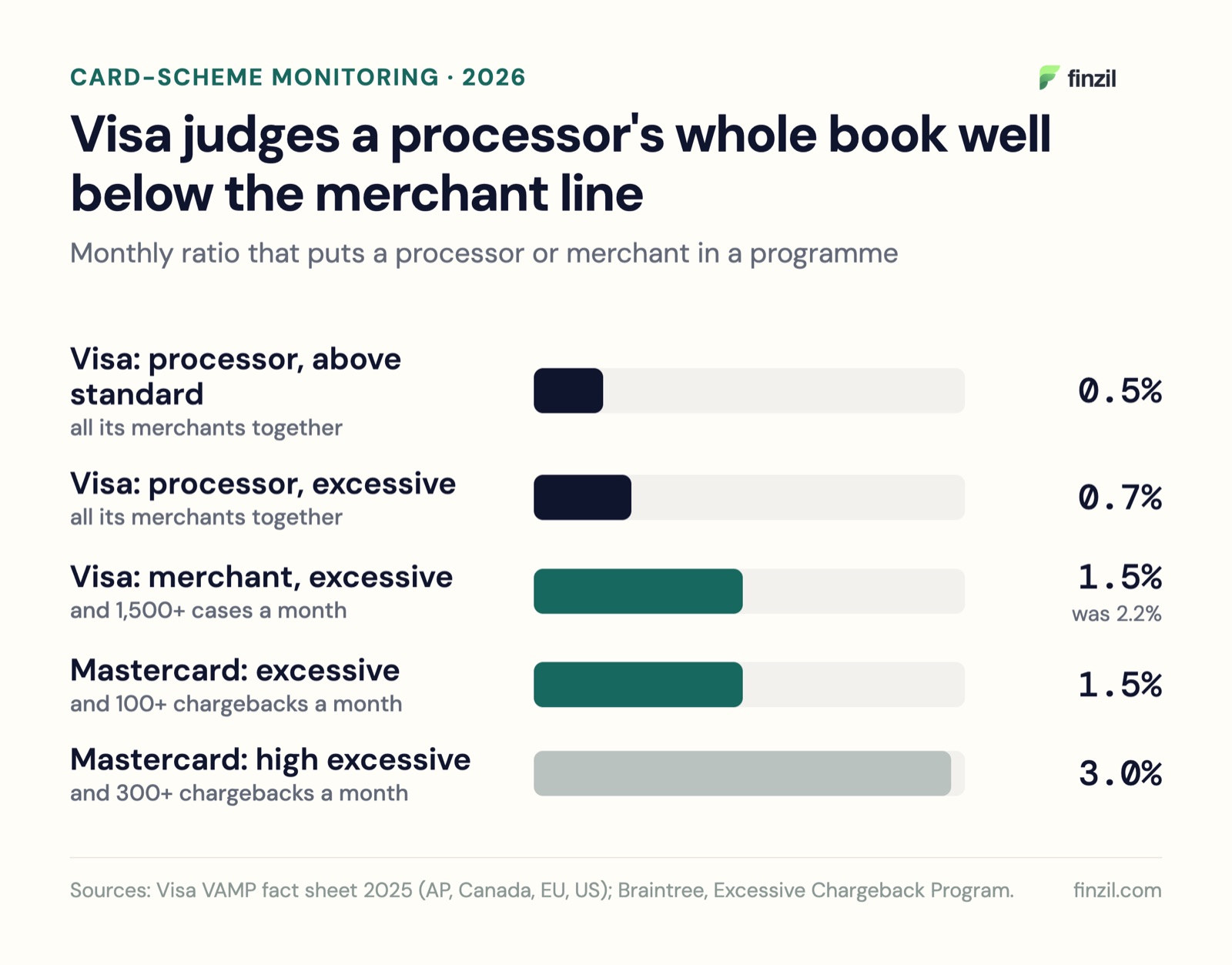
Visa's Acquirer Monitoring Program (VAMP) divides fraud reports and disputes on online card payments by settled transactions. Since 1 April 2026, a merchant in Visa's AP, Canada, EU and US regions is "excessive" at 1.5%, with at least 1,500 fraud reports and disputes in the month. Until then the line was 2.2%. Mastercard flags an "excessive chargeback merchant" at 1.5% and 100 chargebacks a month, and a "high excessive" one at 3% and 300. That's according to Braintree, PayPal's card-processing business, which puts the first fine at $1,000 in a merchant's second month in the programme.
Few small shops reach 1,500 disputes a month. The pressure comes through the processor. Visa also judges the acquirer (the bank or processor that takes card payments for merchants) across all its merchants: "above standard" at 0.5% and "excessive" at 0.7%. A processor whose book nears 0.7% has every reason to act on single sellers long before any of them reaches 1.5%.
A bad season can follow a seller to the next processor. Shopify's help pages say a merchant can be added to MATCH, Mastercard's list of terminated merchants, when monthly chargebacks pass 1% of transactions and $5,000. Shopify says it generally can't process for businesses on that list. xpate lists "merchants in card-scheme chargeback/fraud monitoring programmes" among the businesses it refuses.
Once the money is held: what to send and how long it takes
Read the email first. Stripe and Shopify both send the reserve terms (percentage and period) by email. Shopify's appeal is a reply to that email within the timeframe it gives, and Shopify says some reserves can't be appealed. At Stripe, the appeal option sits on the Balances page of the Dashboard; if it isn't there, you contact support.
Then send everything in one go. Stripe's credit review page lists what it can ask for:
- bank balance and transaction history
- financial statements and management accounts
- refund, cancellation and delivery policies
Our view: add tracking numbers for open orders, supplier invoices for the stock, and one paragraph on the spike (last year's peak, this year's forecast, the promotion).
Timelines are thin. PayPal UK aims to review an account within 3 days of receiving everything it asked for. Stripe reviews a reserve a few days before it expires and can lift, cut or extend it. Shopify publishes no review time for account holds.
On Shopify Community, merchants describe holds from a few days to "near on a month", agents who couldn't say when a review would end, and card payments that kept working while payouts stopped.
Sellers also ask about 120-day holds. Shopify's terms set no fixed number of days. Our view: 120 days is the card dispute window, and Shopify's terms let a processor keep funds after an account ends to cover the chargebacks and refunds that can arrive in it.
Our view: keep operating cash out of the processor balance
A processor balance is money the processor hasn't yet decided to release. It isn't a business account (PSP, EMI or bank explains the difference), and nobody has promised it will be paid out on Friday.
The single-processor trap: one processor's balance is the only route a business's card income takes. Then one review stops payroll, stock orders and VAT together. The fixes are cheap:
- Pay out daily to a business account. Stripe offers daily, weekly, monthly and manual payouts; manual lets money pile up where a hold can catch all of it.
- Keep a second processor approved and tested. On Shopify Community, staff have pointed merchants on hold to alternative payment gateways, which helps only if one said yes in October.
- Hold a buffer for one payroll and one stock order, as if the next two payouts don't arrive.
- Keep a second business account, so the account your payouts land in isn't a single point of failure either (what to do when a business account is closed).
The second account is the harder part. Online sellers are welcome in principle: 155 of the 300 providers on Finzil list e-commerce among the industries they serve. Applications fail on the detail. Where the company is registered, where the owners live and what the shop sells decide who says yes. 20 providers name supplements or nutraceuticals on their refused lists, some only when unregulated.
What to do before 27 November
- Write to your processor now with numbers: last year's peak week, this year's forecast, the promotion dates and the stock you've bought. Keep the reply.
- Put delivery dates on product pages and in order confirmations. For pre-orders, Stripe recommends partial deposits, a limit on orders and realistic delivery dates.
- Check that your statement descriptor matches the shop name customers know.
- Refund fast. A refund costs the sale; a dispute costs the sale, a fee and a mark on your ratio. Upload tracking for every parcel: PayPal UK says it helps prevent disputes.
- Answer every dispute inside its deadline. Stripe says you usually have 7–21 days, depending on the card network.
- Put the review pack in one folder: bank statements, latest accounts, policies, supplier invoices.
- Set payouts to daily, and get the second processor and second account in place before the hold, not after it.
Questions people ask
Why is Shopify holding my funds for 120 days?
Shopify's terms set no fixed holding period. Card networks typically allow 120 days for a dispute, and Shopify's terms let a payment processor keep funds after an account ends to cover chargebacks, refunds and disputes. In our view, that window is where the 120 days comes from.
How long can Stripe hold my money in reserve?
Stripe says a reserve normally lasts 30–90 days, to allow time for refunds and chargebacks. It reviews the reserve a few days before expiry and can lift, cut or extend it; in rare cases a reserve lasts indefinitely (November 2026).
Why did my payouts stop right before Black Friday?
Processors flag sales that jump far above an account's history. Stripe lists "an unexplainable sharp increase in processing volume" as a reason for a reserve. Telling the processor about the peak in advance, with numbers, gives the reviewer the explanation before the model sees the spike.
What chargeback rate gets a merchant into trouble?
Visa counts a merchant as excessive at a 1.5% fraud-and-dispute ratio with at least 1,500 cases a month (AP, Canada, EU and US regions, since 1 April 2026). Mastercard's line is 1.5% with 100 chargebacks a month. Processors act earlier, because Visa judges their whole portfolio at 0.5–0.7%.
Sources: Stripe, "Reserves", "Reserves – frequently asked questions", "Credit account review process", "Payout availability delays" and "Accepting payments for pre-orders" (support.stripe.com), "How disputes work" (docs.stripe.com); Shopify Help Center, "Overview of reserves in Shopify Payments", "Shopify Payments account holds" and "Fraud and dispute monitoring programs"; Shopify Payments Terms of Service (Ireland), sections C4 and D3; Shopify press release, 2 December 2025; PayPal UK, "Why is your PayPal payment on hold"; Visa, "Visa Acquirer Monitoring Program Overview" (2025); Braintree, "Excessive Chargeback Program"; Shopify Community threads on payout holds (2023–2024); Finzil provider profiles (300, checked October to November 2026). All checked 17 November 2026. General information, not financial or legal advice.
Providers in this article
Payment processors named in this article
Card-payment providers named above. Read each one's payout schedule and reserve terms before your peak.
| Provider | Licensed in | Known for |
|---|---|---|
 StripeE-money institution |    | Online payments44 countries |
 Checkout.comE-money institution |  | Enterprise paymentsCard issuing |
 WorldpayPayment institution |  | Card machinesOnline payments |
 FondyE-money institution | | Payment acceptanceBusiness account |
 MoneliqE-money institution | | Multi-currencyAcquiring |
 PayPal BusinessBank (Luxembourg) and e-money institutions |    | Online paymentsNo IBAN |
Not sure which one fits? Your profile ranks them for your business, with the reason behind each.