The short answer
A business account application is six questions asked with paper. Who you are, who controls the company, where it and its owners live, whether the business is real, where the first money comes from, and what the account will be used for. Every document on a provider's list answers one of them. Applications fail less often for a missing document than for two documents that tell different stories.
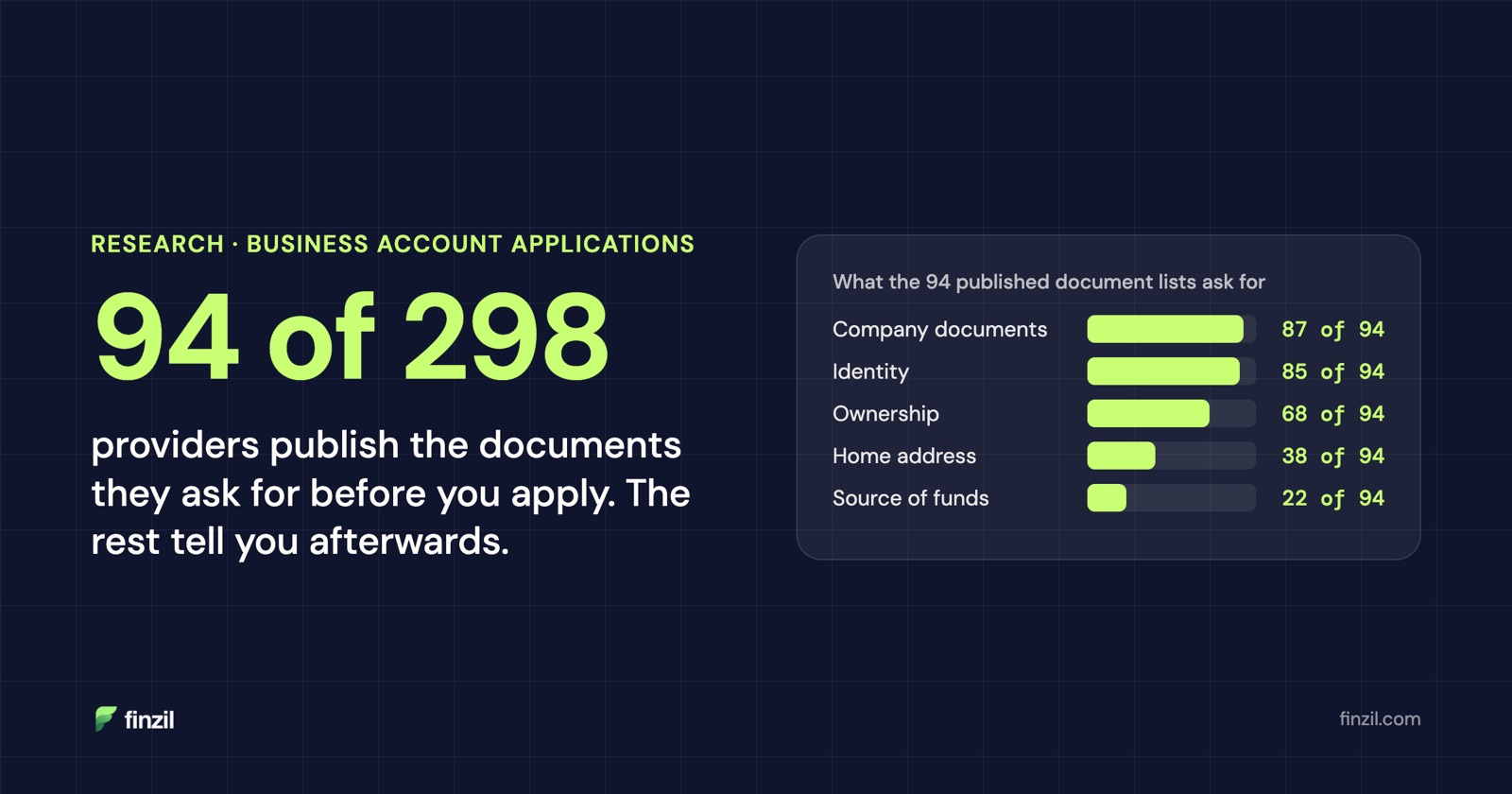
- 94 of 298 providers on Finzil publish the list of documents they ask for; the rest ask after you apply (November 2026)
- 38 of those 94 want proof of home address for owners or directors; 22 ask where the money comes from; 12 run a video or selfie check
- 74.1% of the accounts e-money institutions closed for suspected mule activity in 2025 were under six months old (FCA, September 2026)
Where this comes from
The counts come from the 298 provider profiles on Finzil. Each provider's own onboarding page was read and checked between 8 October and 4 November 2026; 94 publish a document list. We sorted every line on those lists into categories and read the matches by hand. The outside research is the FCA's multi-firm review of money mule accounts (23 September 2026), Companies House's identity-verification guidance on GOV.UK, and the EU's Anti-Money Laundering Regulation (2024/1624).
What the data doesn't show: the 204 providers that publish no list ask for documents too, we just can't count them. A provider that doesn't name source of funds on its page can still ask for it in week two. And a published list is a floor. Airwallex's ends with a questionnaire "where relevant"; Mercury's with "additional company or personal documents requested by Mercury or its banking providers". Treat every list as the minimum.
Every document answers one of six questions
Providers don't collect documents because they like paper. Their regulator makes them establish a set of facts before they open an account, and each fact has a usual piece of evidence. Once you see the question behind the document, the odd requests stop looking odd.
| Question the provider must answer | Documents that answer it | Providers that name it (of 94) |
|---|---|---|
| Does this company exist, and in what form? | Certificate of incorporation, articles or memorandum, a register extract, a trade licence | 87 |
| Who are the people? | Passport or national ID of directors, owners and signatories; a video selfie or liveness check | 85 (identity), 12 (video or selfie) |
| Who controls it? | Shareholder register, structure chart, UBO declaration | 68 |
| Where do they live, and where does it operate? | Utility bill or bank statement for each person; lease or bill for the business address | 38 (home address), 24 (business address) |
| Is the business real? | Website, contracts, invoices, bank statements, financial statements | 10 (website), 14 (contracts or invoices), 22 (statements) |
| Where does the first money come from, and what will the account do? | Source-of-funds or source-of-wealth evidence; expected turnover and currencies | 22 (source of funds), 8 (expected volumes) |
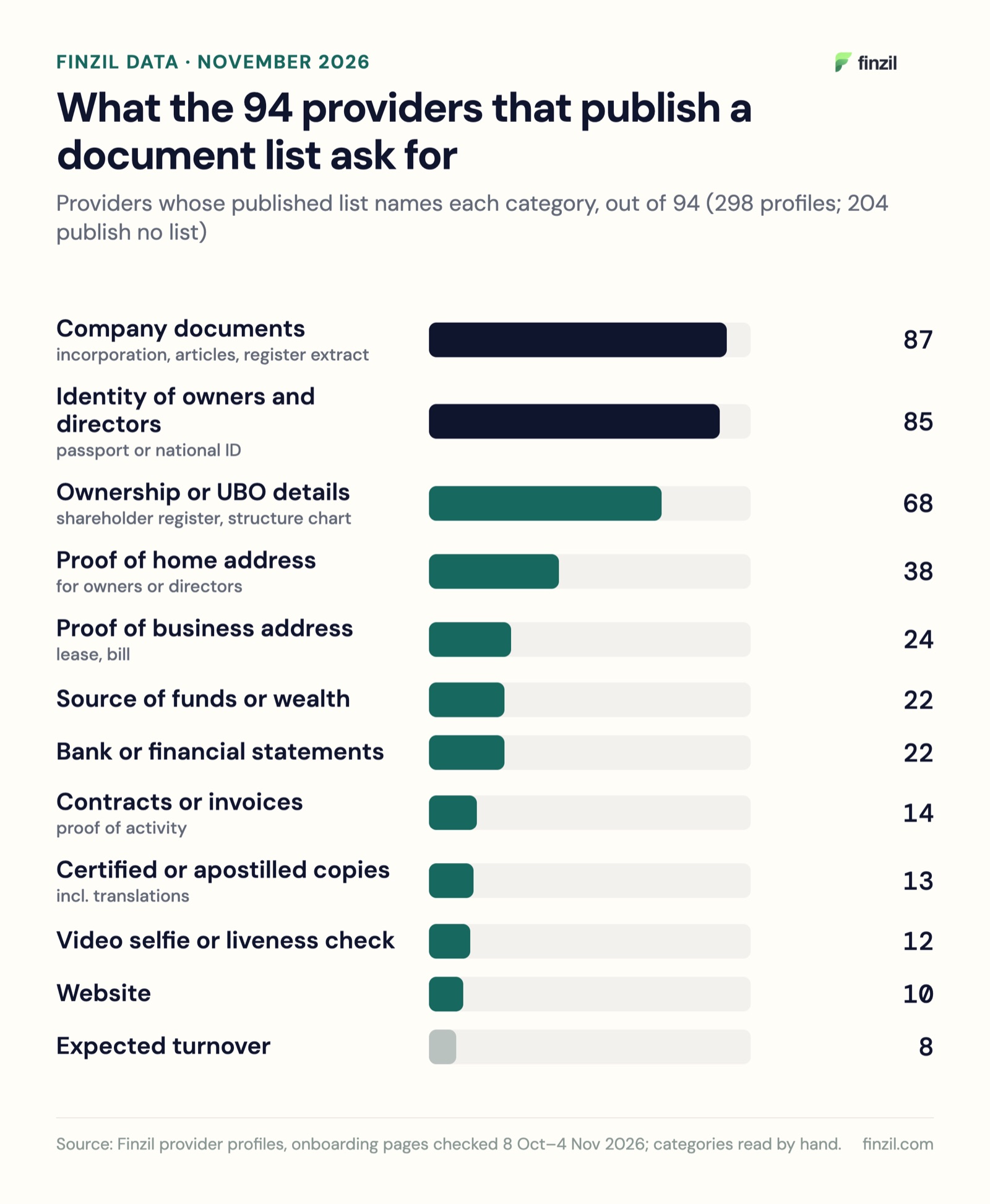
The first three rows are near-universal. The last three are where applications stall: they ask for things a young company may not have yet, and the answers have to agree with each other.
Providers don't check documents one by one. They check that the documents, the form and the public registers describe the same company.
"UBO" means a person, not a company
A UBO (ultimate beneficial owner) is the human being who, at the end of every holding company and trust, owns or controls the business. Providers must identify them; a company can't be one. The usual threshold is more than 25% of shares or votes. It is also the test for a PSC, the owner or controller a UK company must list on the Companies House register. Airwallex asks for photo ID and residential address for "all 25%+ UBOs"; Revolut Business for a document listing directors and "major shareholders with 25%+ ownership".
One change is on the way in the EU. From 10 July 2027 the Anti-Money Laundering Regulation (2024/1624, Article 52) counts anyone holding 25% or more, not more than 25%. A cap table with four equal partners will have four UBOs instead of none.
Where ownership runs through another company, the provider wants the chain drawn. Bank of East Asia asks for an "organisational chart for multi-layer ownership", Pervesk for a "signed shareholder structure". Draw it once, with percentages at every level. The names on it must match the passports you send.
Why a new company gets asked for invoices it doesn't have
Fourteen of the 94 lists ask for contracts, invoices or other proof of activity, and ten ask for a website. A company registered last month has neither. The request still makes sense from the provider's side. A company with no trading history and no visible customers looks the same on paper as a shell set up to receive one payment and disappear. The provider needs something that shows the business exists outside the application form.
Providers that publish a list usually say what they accept instead. Revolut's line reads "Website, supplier contract, sales invoice with matching bank statement or other proof of business activity". Airwallex asks for "Invoices, contracts or business plan for a new business if requested". Loop lists bank statements, revenue proof, contracts, tax documents, a professional licence, "seller-portal exports or online presence". Stripe asks only for a "phone number and working website".
For a company with no customers yet, the pack that works in our experience has three parts. A signed contract or letter of intent with the first customer or supplier. A live website with prices, terms and a contact address. And a one-page description of what you sell, to whom, in which countries, and how customers will pay. That last page does more than any single document, because it's what the compliance analyst compares everything else against.
Checks got heavier because closures did
Providers didn't start asking for source of funds and expected turnover out of curiosity. The FCA's multi-firm review of money mule accounts, published on 23 September 2026, counted 238,396 suspected mule accounts closed by UK firms in 2025, up from 184,935 in 2023. At e-money institutions, offboarding rose 164.6% in a year. And 74.1% of the accounts EMIs closed were less than six months old; at payment institutions it was 56.9%. Across all firms, 55,353 accounts were shut within three months of opening.
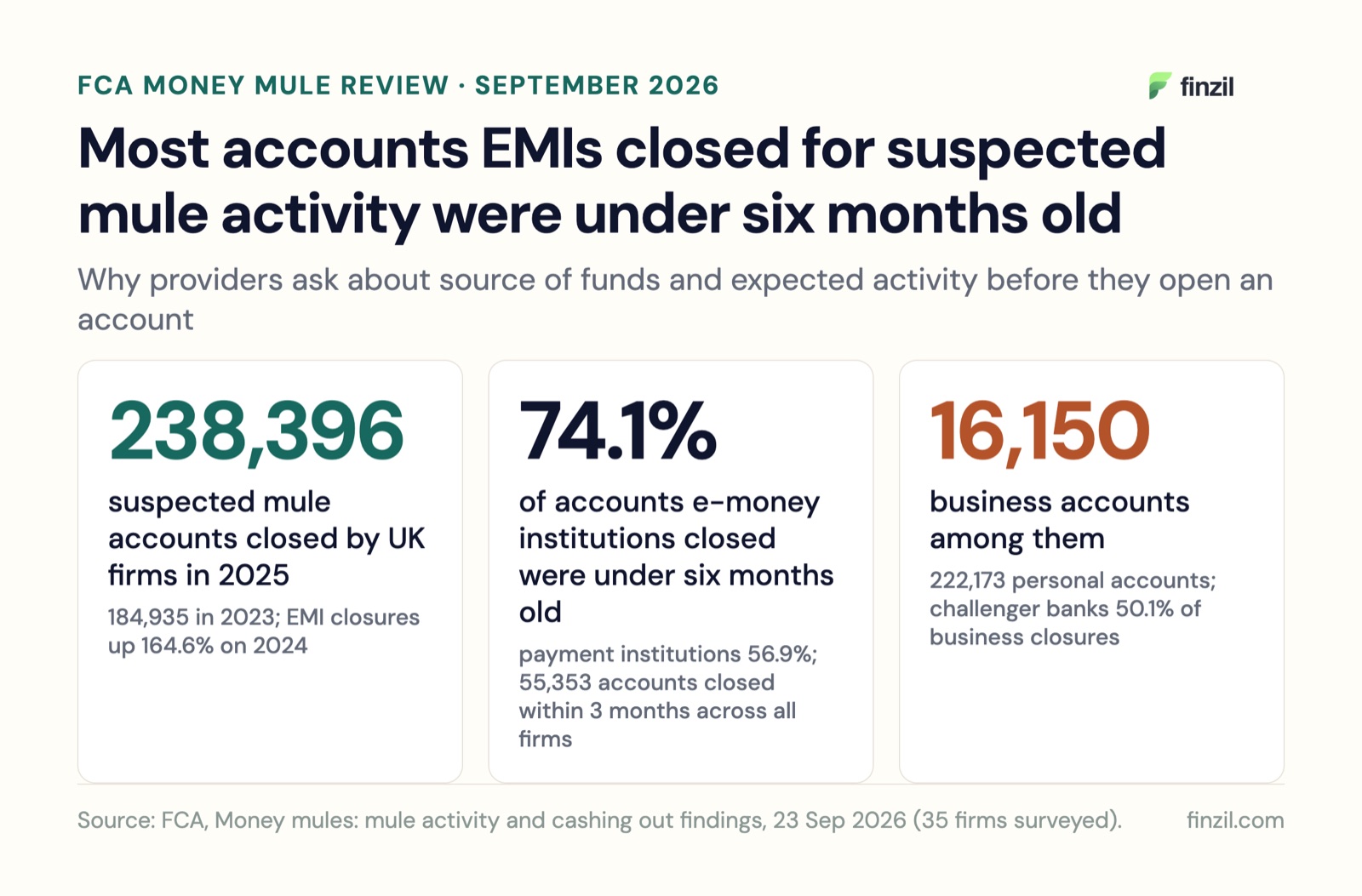
Business accounts were a small part of the total: 16,150 in 2025, against 222,173 personal accounts. But the pattern inside that number is what drives onboarding. A mule account is opened, receives money from people it has no relationship with, and sends it on within days. So a provider that has just read this review wants to know, before it opens the account, where the first money will come from and what a normal month will look like.
If your first inflow matches what you said, you are a customer. If it doesn't, you are a pattern. Our article on the review covers what happens after opening; the documents at application are the provider's attempt to settle the question before.
The FCA's data shows the age of the closed accounts, not when the suspicious activity happened, and says nothing about how many customers were closed by mistake.
Companies House now checks your directors before the provider does
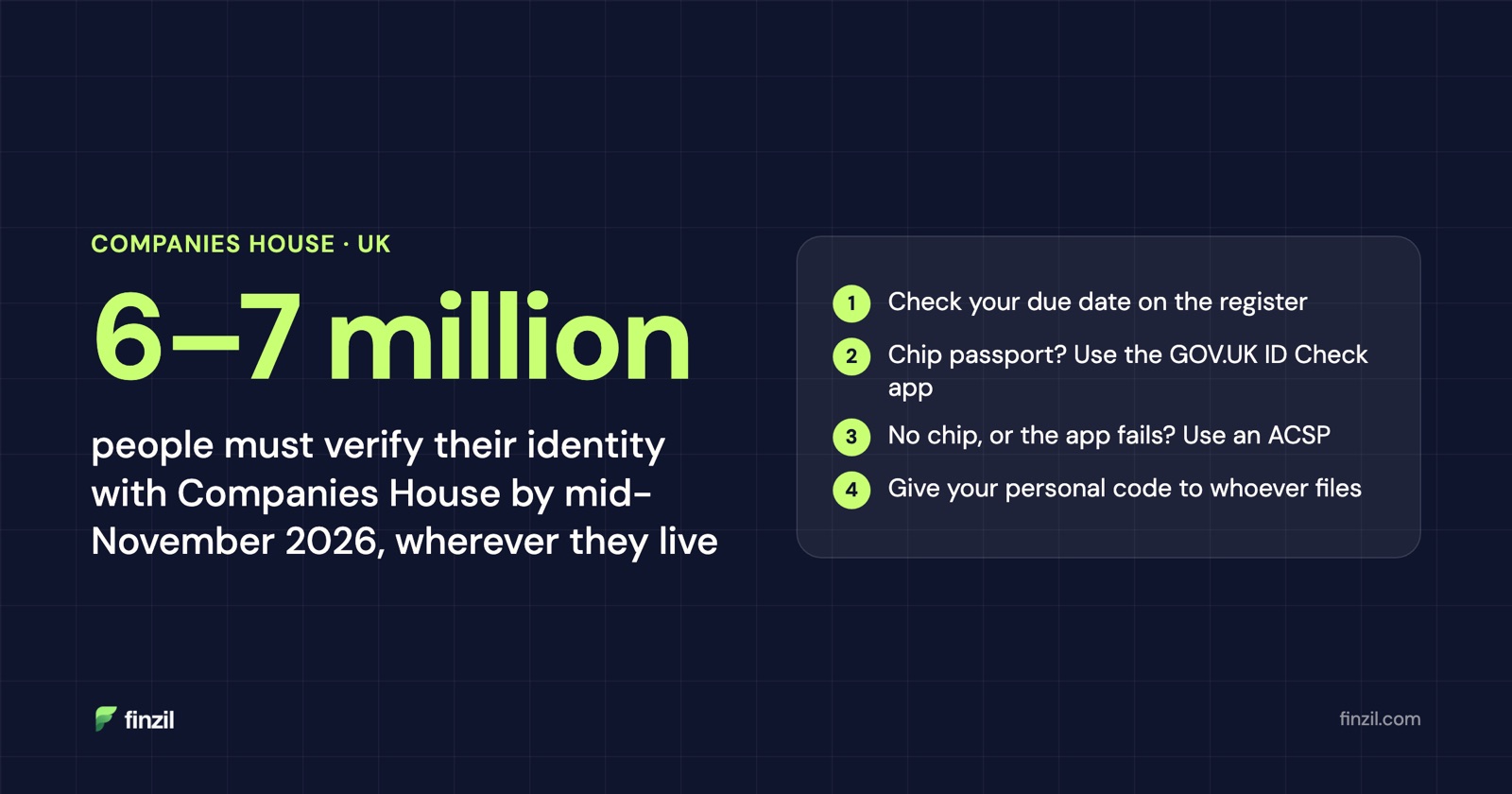
For a UK company there is a second checker in the room. Since 18 November 2025, every director and PSC must verify their identity with Companies House. GOV.UK calls that date "the start of a 12-month transition period", and Companies House estimates "6 to 7 million people will need to verify their identity by mid-November 2026". Existing directors give their personal code with the company's next confirmation statement.
Providers read the register. A UK company whose directors show as unverified in December 2026 raises a question before any document is opened. Verify first, then apply; our step-by-step guide for directors abroad covers the app route and the agent route.
The pack by company type
Most of the pack is the same everywhere: identity, ownership, addresses, a business description. The company documents differ by where the company is registered, and so does the thing providers worry about.
| UK Ltd | UAE free zone company | US LLC | EU company | |
|---|---|---|---|---|
| Proof the company exists | Certificate of incorporation; Companies House extract (free, online) | Trade licence; certificate of incorporation from the free zone | Articles of organisation; certificate of good standing from the state | Commercial register extract, usually under 3 or 6 months old |
| Constitution | Articles of association | Memorandum of association | Operating agreement | Statutes or articles |
| Ownership | PSC register; shareholder list | Share certificates; register from the free zone | Operating agreement with member percentages; often a structure chart | Shareholder register; UBO register extract |
| Tax identity | UTR (sometimes VAT number) | Corporate tax registration (TRN) | EIN letter from the IRS (CP 575 or 147C) | VAT or tax number |
| Address | Registered office plus a trading address if different | Lease or flexi-desk agreement (the free zone address alone is often not enough) | Registered agent address plus the real operating address | Registered seat; lease or utility bill |
| What providers worry about | Directors who live abroad; a registered-office-only address | Nobody resident in the UAE; a licence activity that doesn't match the business | Single-member LLCs with a foreign owner; a registered agent as the only address | Ownership chains that cross borders; untranslated documents |
Axos Bank's list shows how the US pack is sorted by structure. An LLC brings "operating agreement and articles of organization"; a sole proprietor an "IRS SS-4 or 147c letter". UAE banks bring their own extra: ADCB asks for a "valid tenancy contract" and a passport or Emirates ID for signatories and owners. Our UAE bank requirements article has seven banks' lists side by side.
Owners abroad: the same documents, with stamps on them
When the owners live in a different country from the company, three things change.
Certified copies and apostilles. Thirteen of the 94 lists mention certified, notarised, apostilled or translated documents. Pervesk wants a certified copy of every company document and "certified English translations/apostille/legalisation where required". Nexpay asks for "legalised foreign documents unless waived". Bank of East Asia accepts documents "certified by a Hong Kong lawyer, accountant, chartered secretary or notary" when originals aren't produced. An apostille is a stamp from the issuing country that makes a public document valid abroad under the 1961 Hague Convention. It takes days to weeks and costs money, so find out which documents need one before you order anything.
Proof of address from where you actually live. Providers want the address on the form, the address on the bill and the address in the passport scan to agree. Privalgo puts it plainly: "utility bill, bank statement or rental agreement from your home country". Most want it recent; Bankera says "no older than three months".
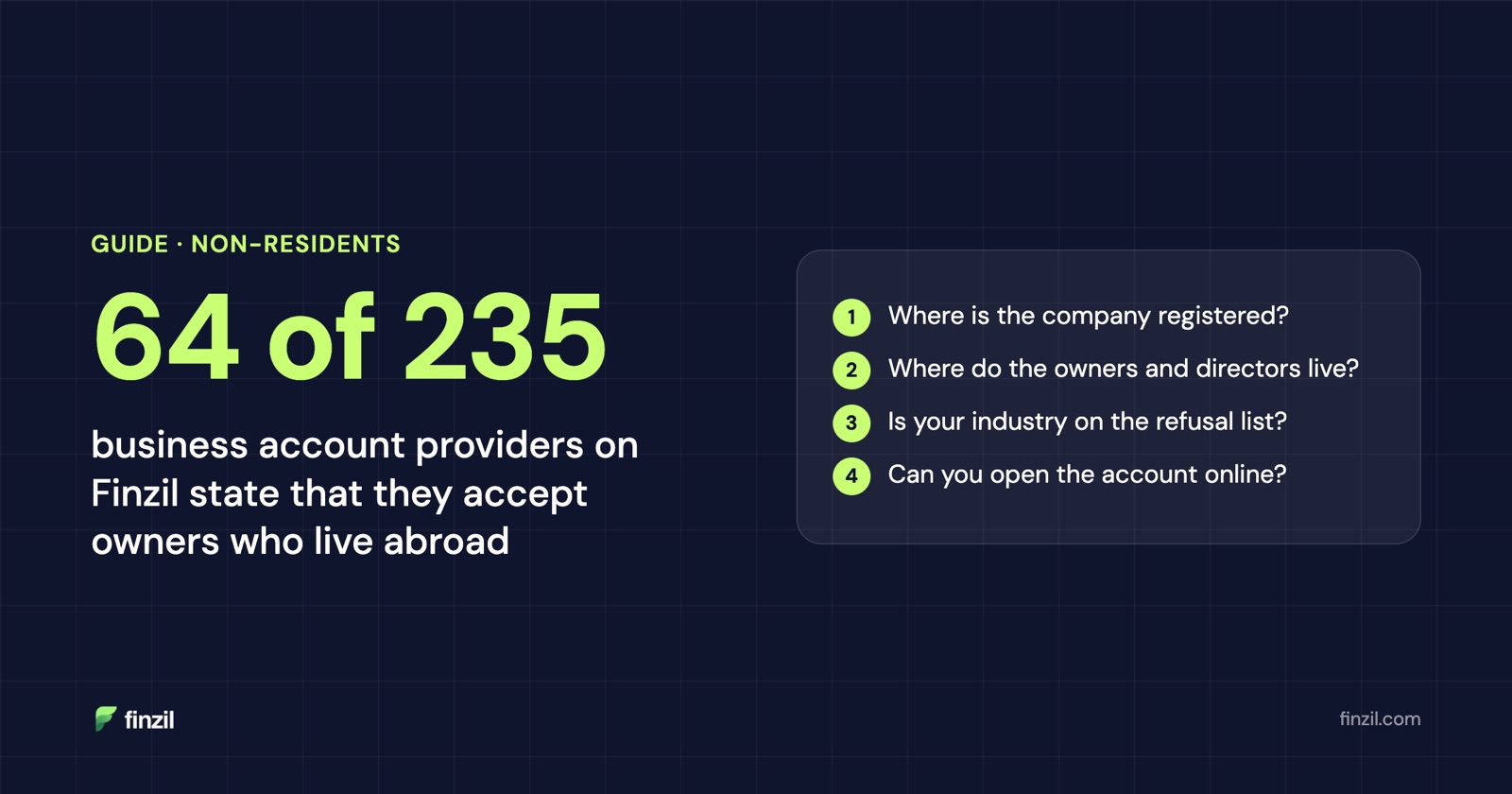
Whether you are eligible at all. The document list won't tell you. Of the 106 providers on Finzil that state a position on owners who live abroad, 75 accept them and 28 don't, and the ones that don't rarely say so on the onboarding page. Who accepts non-resident owners is in our article on opening as a non-resident; UK companies with directors abroad have their own comparison.
Three mismatches that get applications turned down
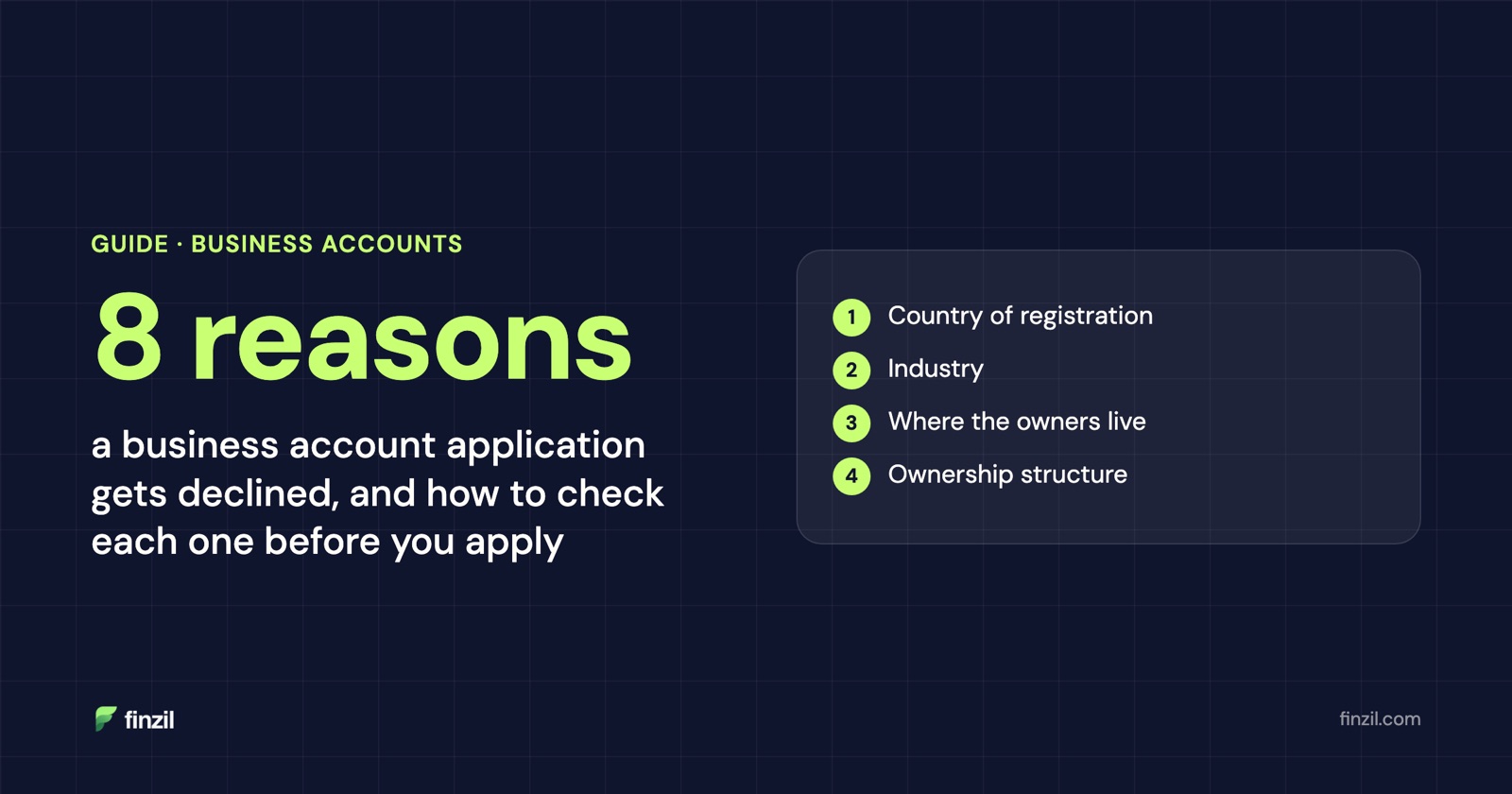
Rejections are rarely about one missing page. In our experience they come from the documents disagreeing with each other or with the form. Three patterns cover most of them.
The address mismatch. The form says the company trades from London. The lease is for a serviced office that only forwards mail, the director's bill is from Lisbon, and the website lists a phone number in Dubai. None of these is wrong on its own. Together they make the analyst ask where the business is actually run from, and the application waits for the answer.
The activity mismatch. The incorporation documents say "software consultancy", the website sells supplements, and the expected-turnover box says €400,000 a month from a company registered six weeks ago. The provider can't tell which description is true, so it treats all three as unreliable. Keep the registered activity, the website and the description in the application saying the same thing, and give a first-year turnover you can explain.
The ownership mismatch. The shareholder register shows two people at 50% each. The passports sent are for one of them and a third person who "runs things". The structure chart was drawn before the last share transfer. Providers must identify the real owners; a gap here is the one they can't wave through.
Our guide to rejected applications has the eight published reasons and what to do in the 48 hours after a decline. The cheaper route is to spot the mismatch before the provider does.
Opening takes 24 hours or three months, and most don't say
Only 25 of the 298 providers publish how long opening takes. Among those that do:
- Revolut Business aims to review an application within 24 hours.
- Statrys reviews within 24 to 48 working hours and activates in under three days once documents are complete.
- Satchel says its compliance review can take 7 to 10 business days.
- 3S Money says one to two weeks.
- Sparkasse Bank Malta says "a couple of weeks to a few months, depending on the customer's risk profile and how quickly the documents arrive".
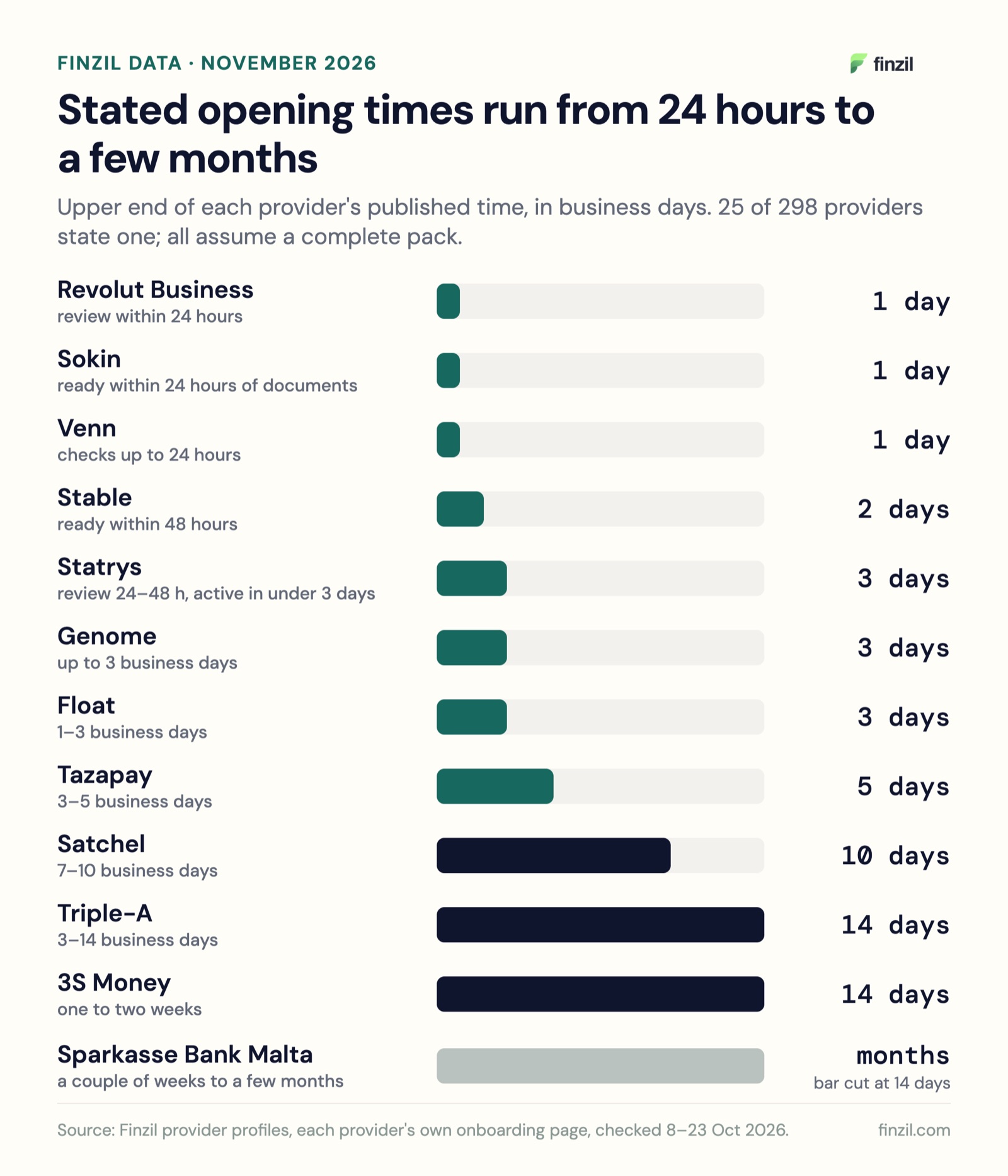
That last clause is the honest one. Every published time assumes a complete pack. The clock stops each time the provider asks for something and restarts when it arrives, so a pack that triggers two follow-up requests turns a 48-hour review into a three-week one. Sending the full pack on day one, including what the list says is only requested "where applicable", is the single biggest thing an applicant controls.
Our view: the application is one story told four times, in the form, the company documents, the owners' documents and the website. Write the story first (a page: what you sell, to whom, from where, how you get paid, who owns the company), then gather documents that prove it. Applying to providers one at a time with a pack that doesn't quite hang together is how a two-day decision becomes a two-month one. The harder question is which providers accept a company registered where yours is, with owners living where yours do. That isn't on any document list.
What to prepare before week one
- Write the one-page description: activity, customers, countries, how customers pay you, who you pay, expected monthly volume by currency, and the source of the first deposit.
- Pull the company documents from the register: incorporation certificate, constitution, a register extract under three months old, a good-standing certificate where your country issues one.
- Draw the ownership chart down to every person with 25% or more, with percentages at each level, and check it against the shareholder register.
- For every director and every owner at the threshold: a passport scan with the chip page, and a proof of address under three months old from the country they live in.
- UK companies: verify every director and PSC with Companies House before applying.
- Owners abroad: ask which documents need an apostille or a certified translation, and order those first; they take longest.
- Evidence the business is real: live website with prices, terms and contact details; the first contract or letter of intent; bank statements from any existing account.
- Read the document list against the form before you press send, looking for the three mismatches above.
Then apply only where your company and its owners are accepted. Of the 102 providers on Finzil that publish a fixed list of accepted countries, 68 accept companies from one country only (Finzil, November 2026), and no document pack changes that.
Questions people ask
What documents do I need to open a business bank account?
Across the 94 providers on Finzil that publish a list: proof the company exists (87 of 94), identity documents for directors and owners (85), ownership details (68), proof of home address for the people (38), proof of business address (24), source of funds (22), bank or financial statements (22) and evidence of trading such as contracts, invoices or a website (14 and 10). Checked November 2026.
What is a UBO and why does the bank want their passport?
A UBO (ultimate beneficial owner) is the person who ultimately owns or controls the company, usually anyone with more than 25% of shares or votes. Regulations require providers to identify and verify these people, so each one supplies ID and proof of address. In the EU the threshold becomes 25% or more from 10 July 2027.
Why does a bank ask a new company for invoices or contracts?
To see that the business exists outside the application. A company with no history looks like a shell on paper. Providers that publish a list say what they accept instead: a business plan (Airwallex), a website or supplier contract (Revolut Business), or seller-portal exports and online presence (Loop).
Do non-resident owners need apostilled documents?
Often. Thirteen of the 94 published lists mention certified, notarised, apostilled or translated copies, usually for documents issued outside the provider's country. Ask the provider which documents before you order them; an apostille can take weeks.
How long does a business account application take?
Only 25 of 298 providers on Finzil state a time. Published times run from a 24-hour review (Revolut Business) to "a couple of weeks to a few months" (Sparkasse Bank Malta), and all assume a complete pack. Each follow-up request restarts the clock.
Sources: Finzil provider profiles (298, onboarding pages checked 8 October to 4 November 2026); FCA, "Money mules: mule activity and cashing out findings", multi-firm review, 23 September 2026; GOV.UK, "Verify your identity for Companies House" and "When you need to verify your identity for Companies House" (2026); Companies House blog, 16 October 2025; Regulation (EU) 2024/1624, Article 52 and EUR-Lex summary; Companies Act 2006, Schedule 1A. General information, not financial or legal advice.
Providers in this article
Providers that publish their document list
The providers quoted in this article all publish what they ask for before you apply. Read who each one accepts before gathering anything.
| Provider | Licensed in | Known for |
|---|---|---|
 Revolut BusinessBank |   | Cards and spend controlsStartups and SMEs |
 AirwallexE-money institution |   | Global accountsOnline businesses |
 StatrysMoney service operator |   | Hong Kong accountFree account |
 3S MoneyE-money institution |   | Local IBANsNon-residents accepted |
 PrivalgoE-money institution | | FX specialistNamed accounts |
| AAxos BankBank (FDIC-insured) |  | No monthly feeFree incoming wires |
Not sure which one fits? Your profile ranks them for your business, with the reason behind each.