The short answer
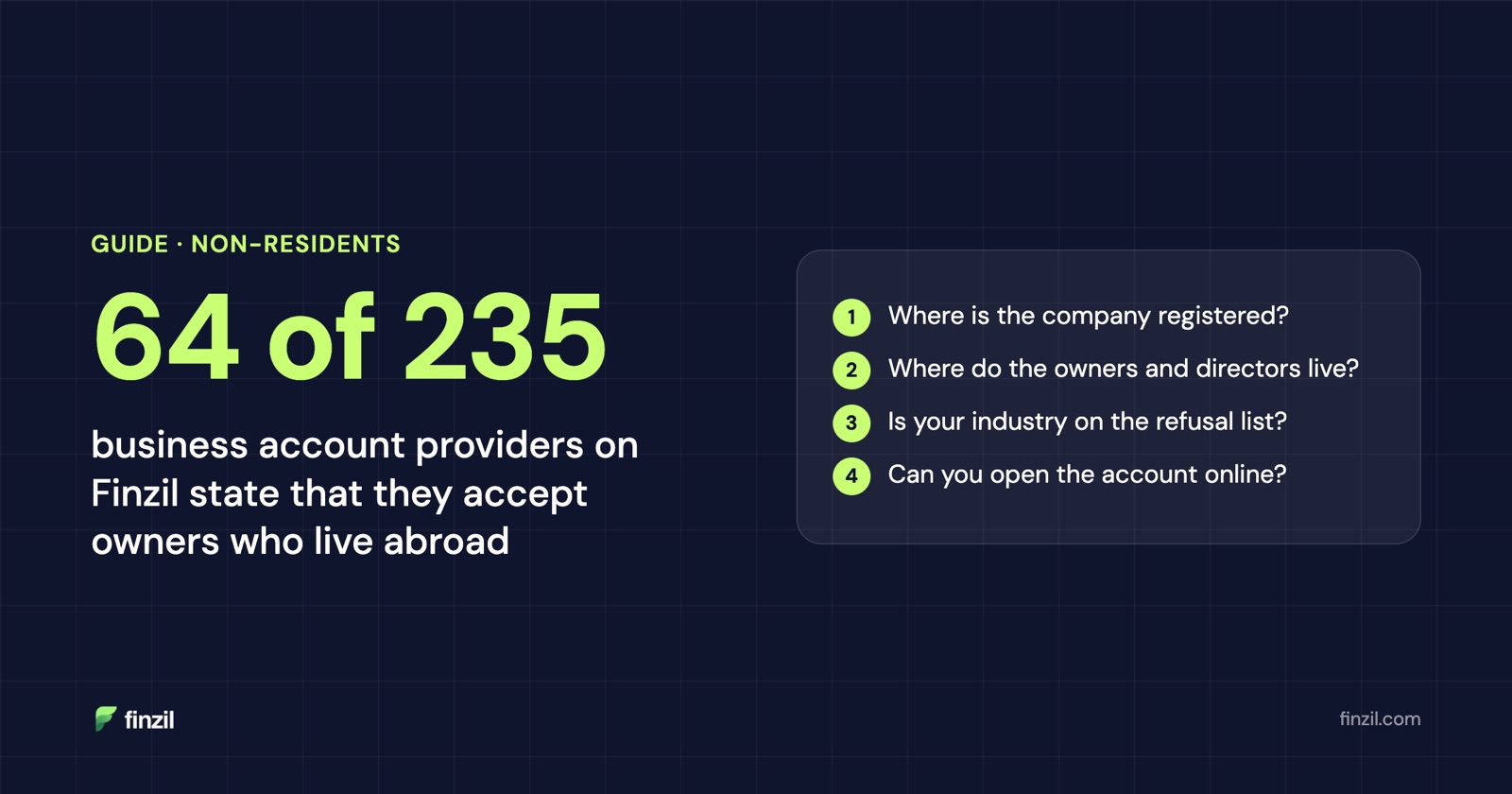
You can open a business account for a company whose owners live abroad, but most providers decide on two lists: the countries your company may be registered in, and the countries its owners may live in. Of the 235 providers on Finzil, 83 say clearly whether they accept non-resident owners: 64 do and 19 do not. Of the 76 that publish a fixed list of accepted countries, 52 accept companies from one country only (Finzil, October 2026).
- 64 providers on Finzil state that they accept non-resident owners
- 19 state that they do not; most are domestic digital banks
- 191 of 235 let you open the account online; 13 require a visit in person, all of them banks
Where these numbers come from
Each Finzil profile records what the provider publishes about who it accepts: the countries of incorporation, where owners may live, and whether the account opens online. The figures cover the 235 profiles checked between 1 and 19 October 2026. "Fixed list" means a provider names fewer than 100 accepted countries; longer lists are built from the countries a provider refuses and are counted separately.
Two different questions: where the company is, and where you are
Providers ask two separate things, and an application can fail on either.
Where is the company registered? Many providers only open accounts for companies registered in their own country. A UK digital bank takes UK companies; a French one takes French companies. Of the 76 providers that publish a fixed list, 52 accept a single country.
Where do the owners and directors live? This is what "non-resident" usually means: a UK company whose director lives in Spain, or an Estonian company owned from Brazil. Some providers accept any residence; some accept a list of countries; some require at least one director in the country.
Our view: the second question decides more applications than the first. A company registered in the right country can still be refused because of where its director lives.
Who accepts non-resident owners
Among the 83 providers that state their position, the split follows the provider type:
| Provider type on Finzil | Accept non-residents | Do not | Not stated |
|---|---|---|---|
| Banks (72) | 25 | 12 | 35 |
| E-money institutions (87) | 17 | 0 | 70 |
| Payment institutions (18) | 4 | 0 | 14 |
No EMI on Finzil states that it refuses non-residents outright, but most publish a list of accepted countries instead of a yes or no. Read that list on the profile before you apply: it is the real answer.
Providers that state they accept non-resident owners include Revolut Business, Payset, WorldFirst, Finom, Mercury, Aspire, Tide, Satchel and LHV Bank. Each has conditions: Finom, for example, asks the legal representative and owners to hold a residence permit in one of the countries it supports.
UK companies with directors abroad
The UK is the most common case we see. A UK limited company is quick to form, but the UK digital banks mostly want a UK-resident director:
| Provider | Takes UK companies | Directors living abroad |
|---|---|---|
| Starling Bank | Yes | Not accepted |
| Monzo Business | Yes | Not accepted |
| Mettle | Yes | Not accepted |
| ANNA Money | Yes | Not accepted |
| Countingup | Yes | Not accepted |
| Allica Bank | Yes | Not accepted |
| Zempler Bank | Yes | Other directors may live in 36 listed countries; the director who applies must live in the UK |
| Tide | Yes | Accepted |
| GoSolo | Yes | Accepted from a list of countries |
Since November 2025, directors of UK companies must also verify their identity with Companies House. Our step-by-step guide for directors abroad covers it.
Opening online or in person
Most accounts open online: 191 of the 235 providers on Finzil say so. The 13 that ask for a visit are all banks, in nine countries: three in the UAE, two each in Cyprus and Singapore, and one each in Malta, Latvia, Georgia, Armenia, Mauritius and Hong Kong. For them, a branch meeting is part of the checks. If you cannot travel, filter for remote opening first.
What you will be asked for
The documents are similar everywhere:
- Company documents: certificate of incorporation, articles, register of shareholders and directors, and proof of the registered address.
- For each owner above 25% and each director: passport, proof of home address, and sometimes a short video check.
- A description of the business: what you sell, to whom, in which countries, and the volumes you expect.
- For non-residents, often: why the company needs an account in that country, and evidence of real activity there (contracts, invoices, a website).
The last point is where most non-resident applications stall. Our guide to rejected applications lists the reasons providers give and what to change before you apply again.
What to do
- Write down three facts: the company's country, every owner's and director's country of residence, and your industry.
- Keep only providers that accept all three; their lists are on each Finzil profile.
- Prefer providers that open online if you cannot travel.
- Prepare the business description and evidence of activity before you start.
- Apply to two or three that fit at the same time, not one after another.
Questions people ask
Can a non-resident open a business bank account?
Yes. 64 of the 235 providers on Finzil state that they accept owners who live outside the company's country (October 2026). Most of them are e-money institutions and international banks rather than domestic digital banks.
Can I open a UK business account if I live abroad?
With some providers. Starling, Monzo Business, Mettle, ANNA, Countingup and Allica require a UK-resident director; Tide and GoSolo state that they accept directors living abroad, and Zempler accepts other directors from 36 countries if the applicant lives in the UK.
Do I need to visit the bank in person?
Usually not. 191 of 235 providers on Finzil open accounts online. The 13 that require a visit are banks, most of them in the UAE, Cyprus and Singapore.
Why was my account application refused as a non-resident?
Usually because the owners' country is not on the provider's list, or because the company shows no business link to the country of the account. Check both before you apply again.
Sources: Finzil provider profiles (235 profiles, checked 1–19 October 2026); each provider's eligibility page, linked from its profile; Companies House identity verification guidance. General information, not financial or legal advice.
Providers in this article
How they compare
The providers named above, with where they are licensed and what they are known for. Each links to its full profile.
| Provider | Licensed in | Known for |
|---|---|---|
 Revolut BusinessBank |   | Cards and spend controlsStartups and SMEs |
 PaysetE-money institution | | 35 currenciesHigh-risk industries |
 WorldFirstE-money institution |  | Marketplace sellersTrade payments |
 FinomE-money institution | | Freelancers and small companiesInvoicing |
 MercuryFintech company |  | US business accountNon-residents accepted |
 AspirePayments platform |    | Free planCorporate cards |
11 more providers are linked in the article.
Not sure which one fits? Your profile ranks them for your business, with the reason behind each.