The short answer
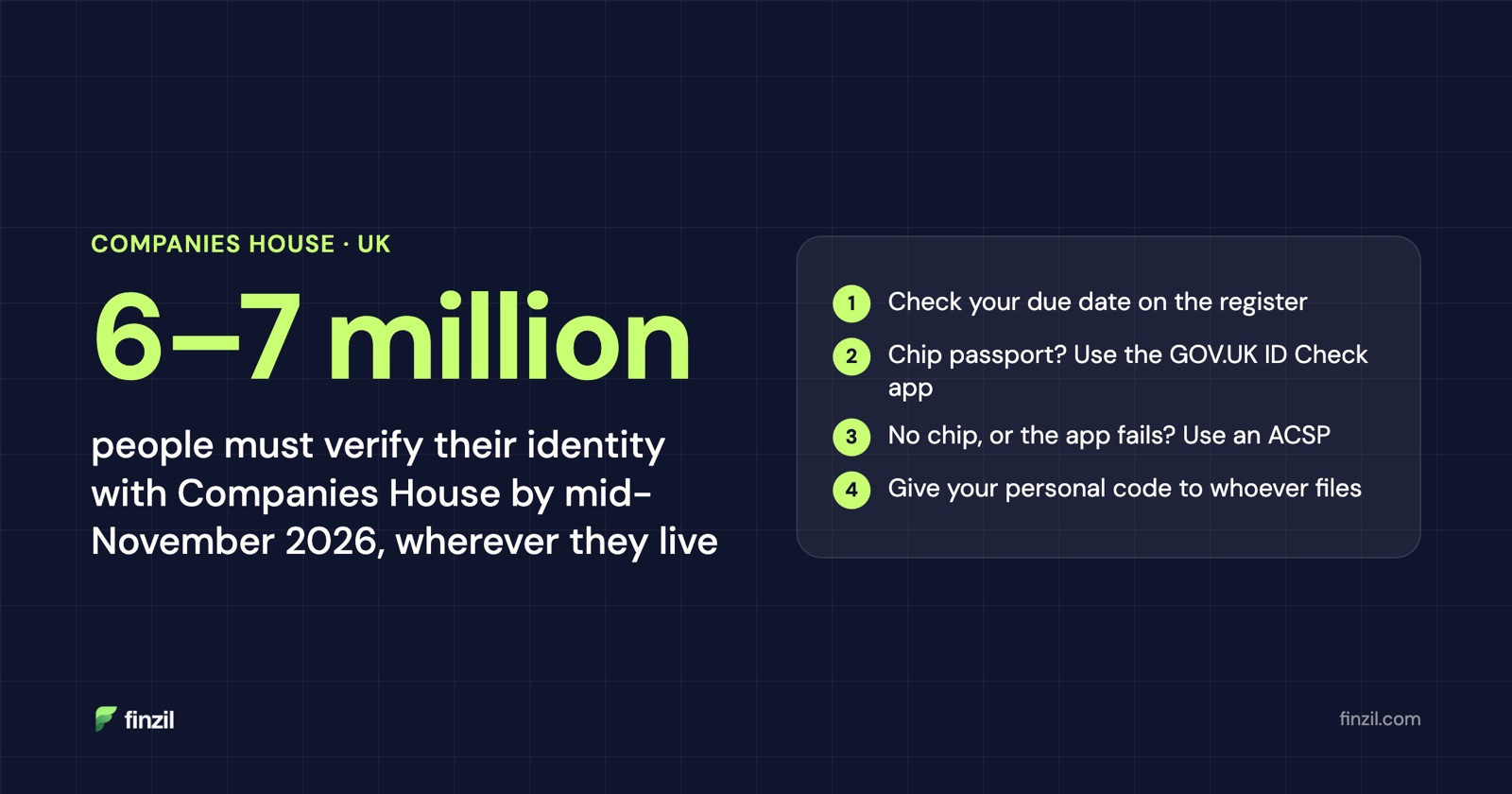
Every director of a UK company has to verify their identity with Companies House, wherever they live. Existing directors must do it before the company's next confirmation statement, and the 12-month transition ends in November 2026. From abroad, use the GOV.UK ID Check app with a chip passport, or an Authorised Corporate Service Provider. Without it, the company can't file.
What changed, and when
The Economic Crime and Corporate Transparency Act 2023 made identity verification a legal requirement from 18 November 2025. It covers company directors, people with significant control (PSCs) and LLP members. Companies House gave existing companies a 12-month transition, and its own estimate is that 6 to 7 million people need to verify by mid-November 2026 (Companies House blog).
Living outside the UK changes nothing about the obligation. A director in Dubai, Bucharest or Lagos has the same duty as a director in Leeds. What it changes is which ways of verifying will actually work for you.
Many people haven't done it yet. Law Debenture, citing Companies House figures, reported that by the end of June 2026 only 55% of directors and 42% of PSCs had told Companies House they were verified (Law Debenture).
When your own deadline falls
There isn't one date for everyone. It depends on your role and your company's filing calendar.
| You are | When you must verify |
|---|---|
| A director appointed before 18 November 2025 | Before your company files its next confirmation statement. The company can't file it until every director has given their personal code |
| A director appointed after 18 November 2025 | Before you are appointed |
| A PSC | Within a 14-day window that Companies House sets. The dates depend on when you were registered and whether you are also a director |
| A director of several companies | Separately for each company, by each company's own confirmation statement date. You verify once and link the same personal code to every role |
The easiest way to find your dates is the Companies House register itself. Search for the company, open the officers and PSC tabs, and the register shows the date each person's verification is due.
If your confirmation statement is due in the next few weeks, this is urgent. The transition ends in mid-November 2026, and there is no sign of a grace period after it.
Your three ways to verify from abroad
GOV.UK lists several routes. Two of them work for most people who live outside the UK. (GOV.UK guidance)
| Route | Works from abroad? | What you need | Cost |
|---|---|---|---|
| GOV.UK One Login with the GOV.UK ID Check app | Yes, for most people | A passport with a biometric chip (UK or any other country) and a smartphone that can read it | Free |
| GOV.UK One Login by answering security questions | Rarely | Details from a UK passport, UK driving licence or a UK bank account | Free |
| GOV.UK One Login, then in person at a Post Office | Only during a visit to the UK | Photo ID such as a passport or an EU national identity card | Free |
| An Authorised Corporate Service Provider (ACSP) | Yes, from any country | Documents from the ACSP's approved list | The ACSP's fee |
Route 1: the app
If your passport has a chip (look for the small camera-like symbol on the cover), start here. You create a GOV.UK One Login account, choose "Verify your identity for Companies House", download the GOV.UK ID Check app, scan the passport's chip with your phone and take a short face video. It usually takes minutes.
It doesn't always work. Some directors living abroad have reported in comments on Companies House's own blog that the face scan failed at the last step. If it fails twice, stop and use an ACSP.
Route 2: an Authorised Corporate Service Provider
An ACSP is a company formation agent, accountant, solicitor or similar firm that has registered with Companies House to verify identities. GOV.UK states you can use one "from any country". The ACSP checks your documents to the same standard as Companies House, then gives you your personal code.
This is the route for you if your passport has no chip, if the app fails, or if you would rather someone else handled it. Before you pay:
- Check the firm is registered. An ACSP has to be registered with Companies House and supervised by a UK anti-money-laundering body. Ask which supervisor it is registered with before you send documents.
- Ask your formation agent or accountant first. If they set up your company or file your accounts, they may already be an ACSP, and they can then file the confirmation statement for you too.
- Ask what documents they accept. ACSPs work from an approved list, and some accept national identity cards that the app doesn't.
What to do with your personal code
When you are verified you get a Companies House personal code. It belongs to you, not to the company, and you use it for every UK company role you hold.
- Give it to whoever files for the company, such as your accountant or formation agent. They need it for the confirmation statement.
- Keep it private otherwise. Companies House asks you to treat it like your tax reference number.
- Don't send identity documents to Companies House by email or post. GOV.UK says you must not.
Your bank or EMI won't ask for this code. Their own identity checks are separate, and verifying with Companies House doesn't replace them.
Why your bank will notice if you don't
Not verifying is an offence, and Companies House can fine you. For a company run from abroad, the bigger risk is what happens next.
- The confirmation statement can't be filed while any director is unverified, so it becomes overdue. Overdue filings show on the public register.
- Banks and EMIs read that register. They check it when you apply and when they review your account. An overdue confirmation statement is the kind of thing that leads to questions, a frozen account or a closure. Companies House also plans to mark unverified people on the register.
- A company that stops filing can be struck off. Once a company is dissolved, any money left in its accounts passes to the Crown until the company is restored.
None of this is likely if you verify now. All of it is avoidable.
A checklist for directors outside the UK
- Look up each of your companies on the Companies House register and note the due date shown for each of your roles.
- Check your passport for the chip symbol.
- With a chip passport: create a GOV.UK One Login account and verify in the GOV.UK ID Check app.
- Without one, or if the app fails twice: choose an ACSP, ideally your formation agent or accountant.
- Send your personal code to whoever files your company's confirmation statement.
- Make sure every other director and PSC has done the same. One unverified director blocks the whole filing.
- File the confirmation statement on time.
If you are also looking for a business account for your UK company while living abroad, 38 of the 51 providers on Finzil that state a policy accept owners who live outside the country where the company is registered. See which ones accept your company.
Questions people ask
Do I need to verify if I live outside the UK?
Yes. Directors and PSCs of UK companies must verify their identity with Companies House wherever they live. Living abroad only affects which verification route works for you.
Can I verify with a non-UK passport?
Yes. The GOV.UK ID Check app accepts passports from any country if they have a biometric chip. If yours doesn't, an Authorised Corporate Service Provider can verify you with documents from its approved list.
What is the deadline for existing directors?
Existing directors must verify before their company files its next confirmation statement after 18 November 2025. The 12-month transition period ends in mid-November 2026.
What happens if a director doesn't verify?
The director commits an offence and can be fined, and the company can't file its confirmation statement. An overdue statement shows on the public register, which banks check, and a company that stops filing can eventually be struck off.
Does Companies House verification replace my bank's identity checks?
No. Banks and EMIs run their own checks under anti-money-laundering rules. Your Companies House personal code is for Companies House filings only.
This guide explains the rules as published by GOV.UK and Companies House on 14 October 2026. It is general information, not legal advice. For anything specific to your company, ask your accountant or formation agent.