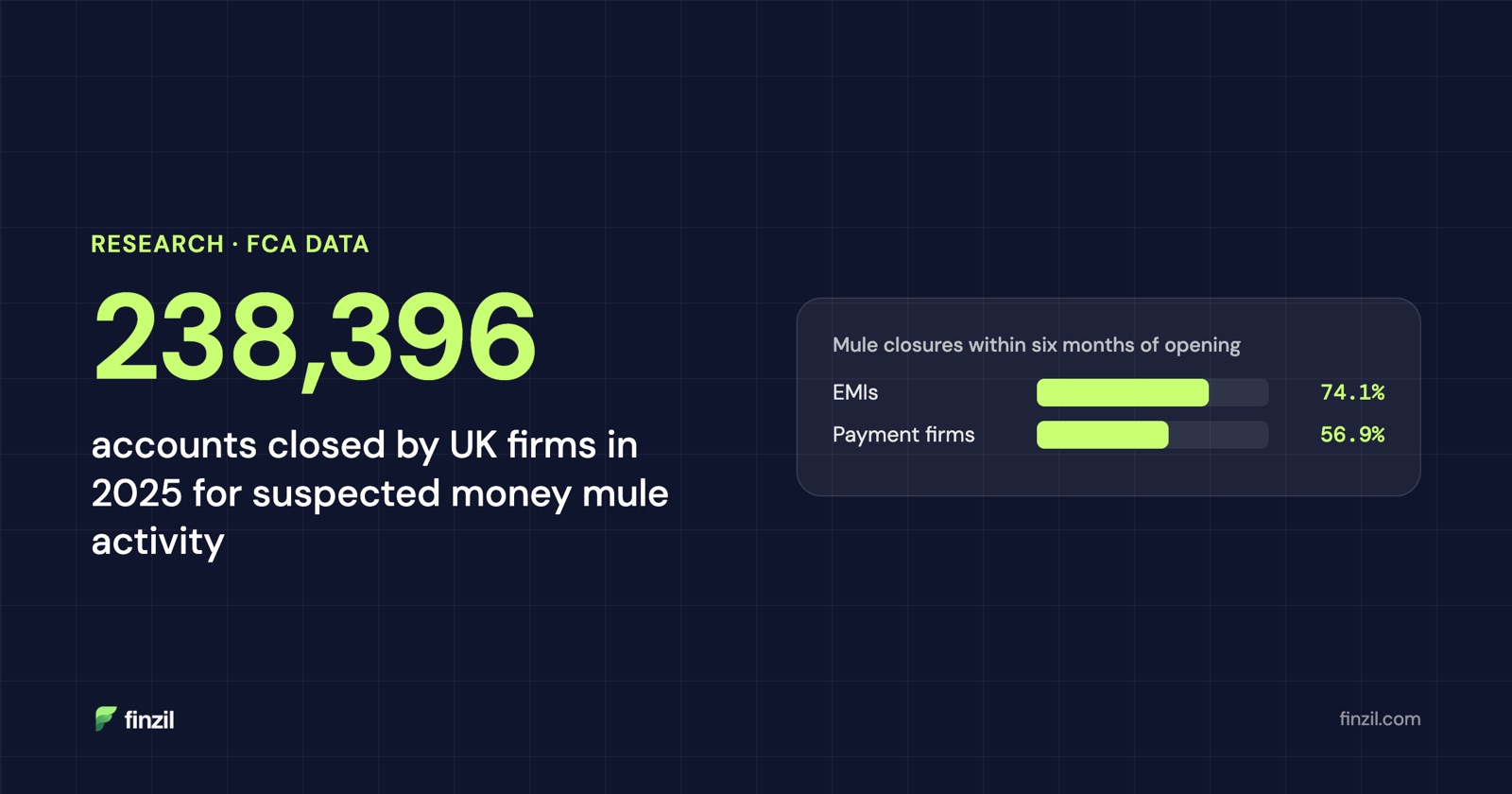
UK banks and payment firms closed 238,396 accounts in 2025 because they suspected money mule activity, up from 184,935 in 2023, according to a review the FCA published on 23 September 2026. The fastest rise was at e-money institutions, where closures grew 164.6% in a year and 74.1% came within six months of the account being opened. The FCA counted suspicion, not proof. For an honest business, the first six months at a new EMI are when an account is most likely to be closed, and the reasons are usually about how the account is used, not who owns it.
What the FCA counted
The FCA surveyed 35 firms: retail banks, building societies, challenger banks, payment institutions and e-money institutions. Each reported how many customers it had offboarded for suspected mule activity in 2023, 2024 and 2025. A money mule account is one used to receive and pass on money from crime, knowingly or not.
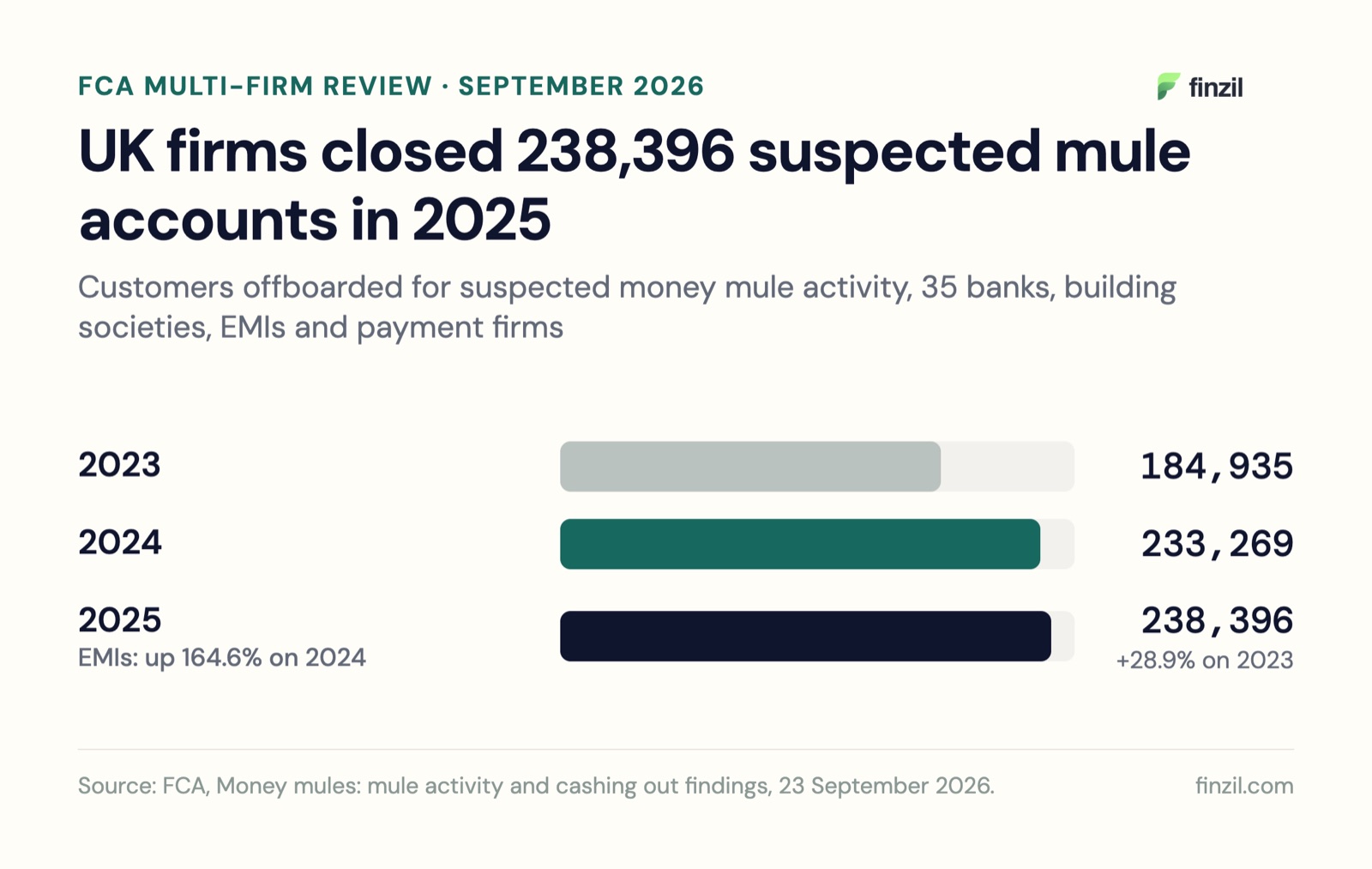
Over the three years that came to 656,600 customers. Retail banks and building societies still made 56.1% of the closures in 2025, a figure 10.9% lower than in 2024. Challenger banks made 33%. The growth came from EMIs.
Two limits matter before reading anything into this. The review doesn't split personal accounts from business accounts. And the FCA itself says that more closures at EMIs and payment firms may reflect more customers and better detection, not a larger share of mules.
Most EMI closures happen in the first six months
The timing is the part that matters for anyone opening a new account. At EMIs, 74.1% of suspected mule accounts were closed within six months of opening. At payment institutions it was 56.9%. Across all 35 firms, 114,984 accounts were closed within their first year, and 55,353 of them within three months.
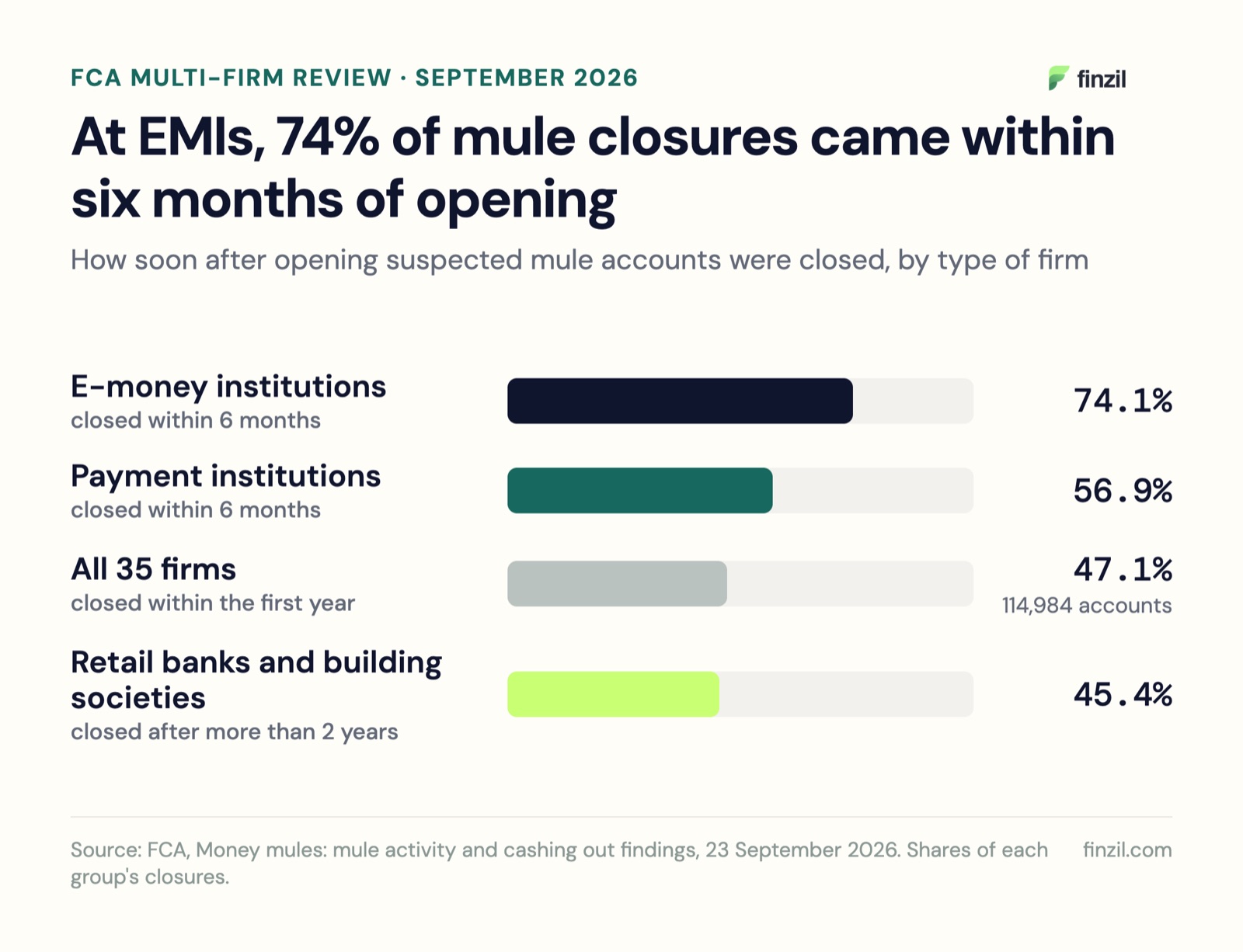
Banks look different. At retail banks and building societies, 45.4% of the accounts they closed had been open for more than two years.
The pattern fits how the two kinds of firm work. An EMI opens an account in days, often with a short online form, and then learns about the customer from the transactions. A bank checks more before opening and closes later. So at an EMI, the first months are the review.
Suspicion is enough
The FCA's figures are offboardings for suspected mule activity. Firms report confirmed fraud to the National Fraud Database, run by Cifas, and the FCA notes that the bar for a filing is higher than the bar for closing an account. In 2025, EMIs made 105 filings to the database. Retail banks and building societies made 23,397.
Our view: most of these closures are a decision about risk, not a finding that anyone did anything wrong. The review doesn't say how many of the 238,396 customers were honest people or companies caught by a rule. Nobody publishes that number.
Why honest businesses get closed
In our experience, closures of legitimate business accounts come from a short list of causes:
- Activity that doesn't match what was declared. A company that said it would move €50,000 a month and receives €250,000 in its first weeks will trigger the provider's transaction monitoring. So will new countries, new kinds of counterparty or a sudden change in the size of payments.
- Money in, money straight out. Large receipts paid out again the same day look like a pass-through account, which is how mule accounts move money on. The FCA found that criminals usually cash out between the second and fifth account in a chain.
- Corridors. Payments to or from certain countries can take an account outside the provider's risk appetite, even when each payment is legitimate.
- The provider's banking partner. Most EMIs hold customer money and reach payment systems through a bank. When that bank tightens its own rules, the EMI can close whole groups of customers it has no complaint about.
- Risk appetite changes. Sometimes the provider simply decides a customer no longer fits. Nothing in the account has to change for that to happen.
The last two are outside the customer's control. The first three are mostly about the gap between what the provider was told at onboarding and what it sees afterwards.
What the closure email says
The emails we've seen follow the same template. The provider regrets the decision, says it can't explain the reasons, and gives a deadline, typically a few days or a few weeks, to move the money out. Asking the account manager doesn't help: they usually can't say why either.
There's a legal reason for some of that silence. If a firm has filed a suspicious activity report, telling the customer could be tipping off, which is a criminal offence in the UK. The firm can't say whether a report exists, so the template covers every case.
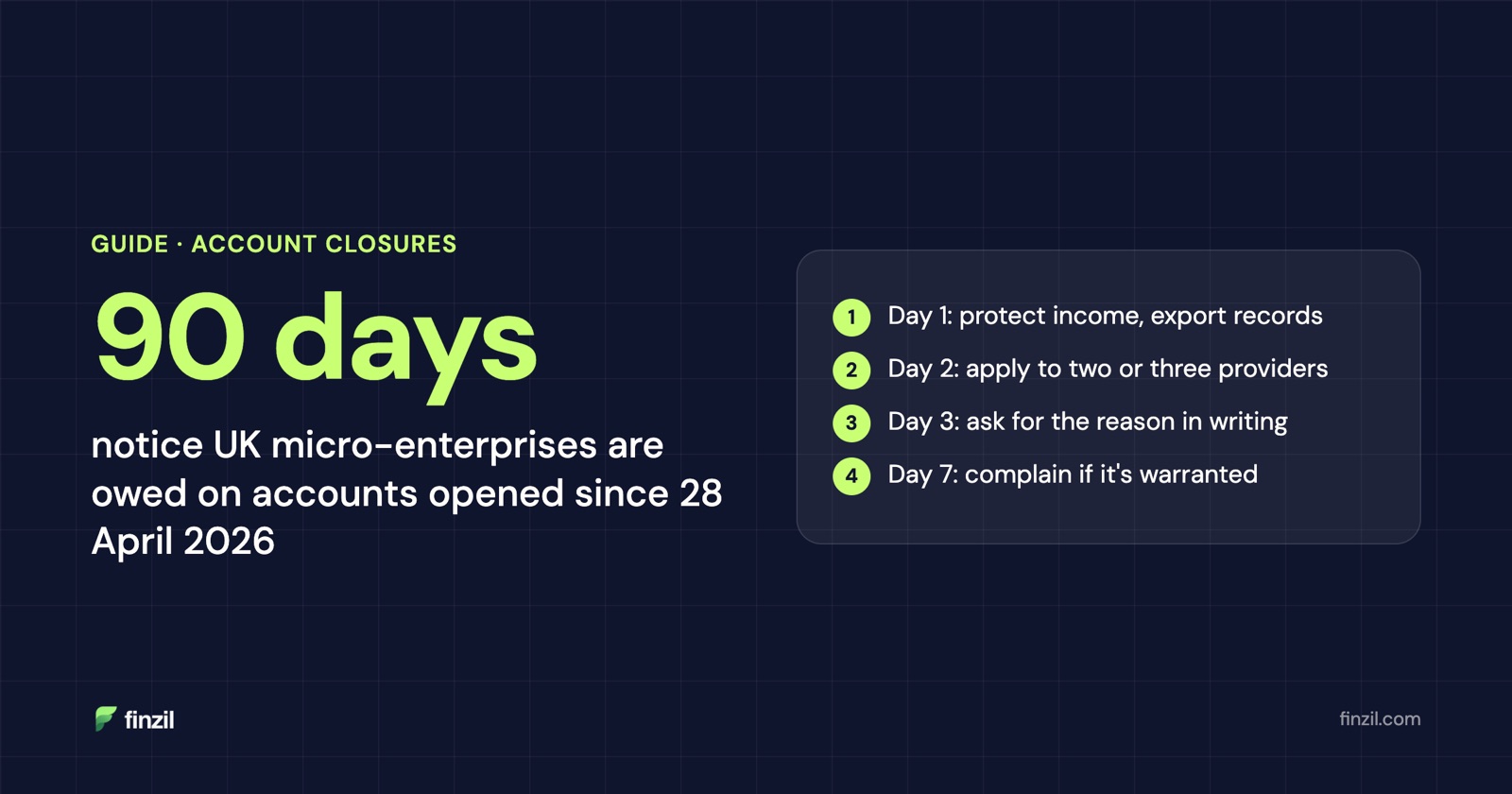
Since 28 April 2026, UK providers must give micro-enterprises, charities and consumers 90 days' notice and a specific reason when they end a payment account agreed on or after that date. The rule has exceptions for money laundering and terrorist financing, so a suspected mule closure can still be immediate and unexplained. Our guide to what to do when a business account is closed covers the notice rules, complaints and getting the balance back.
What businesses can do
- Describe the business precisely at onboarding. Who pays the company and who it pays, the countries involved, expected monthly volumes and the largest single payment. A form filled in quickly with low estimates sets the baseline the account will be measured against.
- Keep a copy of what was declared. Save the application answers, the documents sent and any emails with the provider. If an account is questioned later, that record shows the activity was explained from the start. Few businesses keep one.
- Tell the provider before things change. A large new contract, a new supplier country or a jump in volume is better announced in writing beforehand than explained after a freeze.
- Build up volume in the first months. At an EMI, the first six months are when closures concentrate. Moving the main flows across gradually gives the provider a history to compare against.
- Keep a second account with a different provider. Ideally one that uses a different banking partner, so one bank's decision can't close both. The second account matters most on the day the first one gets the template email.
- If an account is closed, move fast. Withdraw the balance within the deadline, ask for the reason in writing, and complain if a UK provider gave less notice than the rules require.
Questions people ask
Why do EMIs close business accounts without giving a reason?
Often because they legally can't. If a UK firm has filed a suspicious activity report, telling the customer could be tipping off, a criminal offence, so closure emails use a standard template whatever the reason. The FCA's September 2026 review found EMIs closed 74.1% of suspected mule accounts within six months of opening.
How many accounts were closed for money mule activity in the UK?
238,396 in 2025, up from 233,269 in 2024 and 184,935 in 2023, according to the FCA's multi-firm review of 35 banks, building societies, EMIs and payment firms, published on 23 September 2026.
Can a business account be closed for using it as intended?
Yes, if the activity differs from what was declared at onboarding or falls outside the provider's risk appetite. Volumes far above the stated estimate, new countries and same-day pass-through payments are common triggers for transaction monitoring, even when each payment is legitimate.
Does the 90-day notice rule protect against mule closures?
Not fully. Since 28 April 2026, UK providers must give micro-enterprises 90 days' notice and a reason for accounts agreed on or after that date, but there are exceptions for money laundering and terrorist financing.
General information, not financial or legal advice. Figures from the FCA, "Money mules: mule activity and cashing out findings", multi-firm review published 23 September 2026 (fca.org.uk). UK notice rules from the Payment Services and Payment Accounts (Contract Termination) (Amendment) Regulations 2025, in force 28 April 2026. Checked 23 October 2026.