
The short answer
We read the published rules of 148 banks, e-money institutions and payment firms that offer business accounts. Where your company is registered rules you out more often than where you live. Adult content, weapons and gambling top the industry lists. A gambling licence changes the answer at 26 of 66 providers; a crypto licence at 4 of 52.
The numbers that matter most:
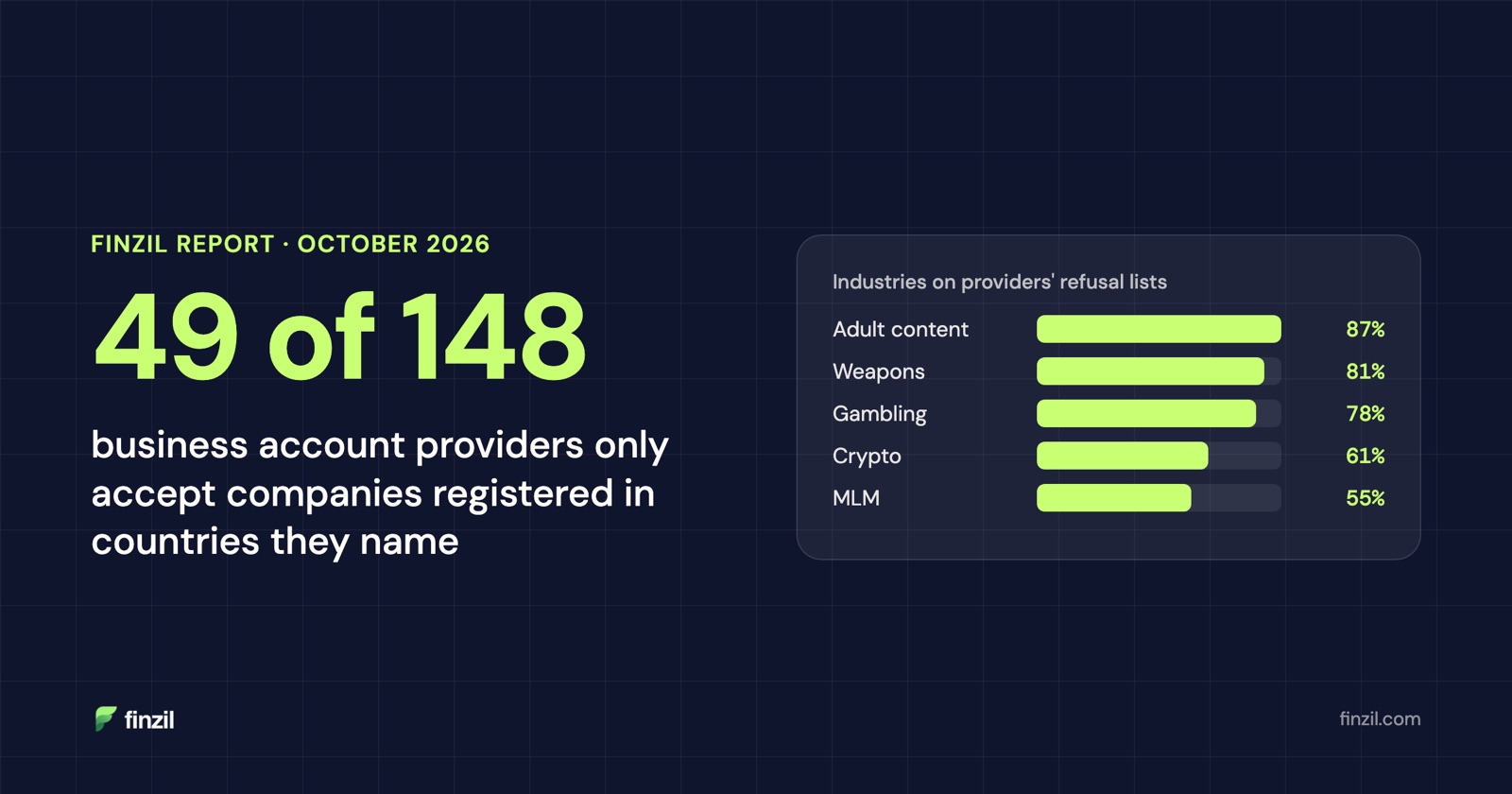
- 49 of 148 providers only accept companies registered in countries they name. 29 of them accept one country only.
- 38 of the 51 providers that say whether owners may live abroad accept them.
- 85 providers publish a list of industries they refuse or restrict. 74 of those lists name adult content, 69 weapons, 66 gambling and 52 crypto.
- 22 providers publish a list of countries they won't serve. The United States is on 9 of them.
How we got these numbers
Every provider on Finzil has a profile built from its own documents: account terms, acceptable use policies, eligibility pages, help-centre articles and price lists. When a provider publishes a list, such as the countries it accepts or the industries it refuses, we copy the list as the provider wrote it. We don't count what a sales rep said on a call, and we don't count review sites.
The figures here come from the 148 profiles on Finzil on 14 October 2026: 71 e-money institutions, 49 banks, 11 payment institutions and 17 others, mostly business account apps that hold your money at a partner bank. The profiles were checked between 1 and 14 October 2026.
Two things to keep in mind as you read. A published rule is the minimum: providers also turn down applications their lists don't mention. And a provider that publishes nothing still has rules. You just find them out after you apply.
Country of registration is the first filter
Most founders worry about where they live. The data says they should worry first about where the company is registered.
49 of the 148 providers (33%) only accept companies registered in countries on a list they publish. 29 of those accept companies from one country only, almost always their home market:
| Country | Providers that accept companies from that country only |
|---|---|
| United Kingdom | Starling, Monzo Business, Tide, Mettle, Zempler, Countingup, Allica, ANNA, Paysend Business |
| United States | Brex, Ramp, Bluevine, Relay, Novo |
| Hong Kong | ZA Bank, Ele Bank, livi bank, Ping An Digital Bank |
| UAE | Mashreq NeoBiz, RAKBANK, Emirates NBD, Commercial Bank of Dubai |
| One each | Kontist (Germany), Shine (France), Tot (Italy), Lunar (Denmark), Knab (Netherlands), Bank of Cyprus (Cyprus), ANEXT Bank (Singapore) |
Being a non-resident is a smaller obstacle than many people expect. 51 providers say whether owners and directors may live outside the country where the company is registered, and 38 of them accept it. Tide, for example, only opens accounts for UK companies, but it accepts UK companies whose owners live abroad.
So the first question to ask a provider is not "do you accept foreigners?" It is "do you accept companies registered in my country?"
Here is how often common countries of registration appear on those 49 published lists:
| Company registered in | Lists that include it (of 49) |
|---|---|
| Germany | 18 |
| United Kingdom | 17 |
| Netherlands, Italy | 17 each |
| France, Spain | 16 each |
| Cyprus | 14 |
| United States, Estonia, Malta | 13 each |
| Lithuania | 12 |
| Hong Kong | 11 |
| UAE, Singapore | 8 each |
| British Virgin Islands | 5 |
| Seychelles, Cayman Islands | 4 each |
The other 99 providers either take companies from most countries apart from those they refuse, or don't publish a list at all. That is where companies registered offshore, or in countries the big lists leave out, tend to find their accounts.
The industries on the lists
85 providers publish a list of industries they refuse or restrict. The wording varies a lot, so we grouped similar entries. "Names it" means the industry appears on the provider's list in some form, whether refused outright or allowed only under conditions.
| Industry | Lists that name it | Share of the 85 |
|---|---|---|
| Adult content and services | 74 | 87% |
| Weapons, ammunition and defence | 69 | 81% |
| Gambling and betting | 66 | 78% |
| Crypto and virtual assets | 52 | 61% |
| Multi-level marketing and pyramid schemes | 47 | 55% |
| Pharmaceuticals and prescription drugs | 44 | 52% |
| Money service businesses and unlicensed payment firms | 44 | 52% |
| Charities and non-profits | 41 | 48% |
| Cannabis and CBD | 37 | 44% |
| Tobacco and e-cigarettes | 36 | 42% |
| Precious metals and stones | 35 | 41% |
| Shell companies or shell banks | 30 | 35% |
| Political organisations | 30 | 35% |
| Forex, CFDs and binary options | 29 | 34% |
| Nominee shareholders or bearer shares | 18 | 21% |
| Trusts | 10 | 12% |
Some entries surprise people. Charities appear on almost half the lists, usually because donations from many small, unknown senders are hard to check. Precious metals sit next to weapons on most lists because gold and stones hold value and move easily across borders. And "money service businesses" is broad enough to catch a company that simply collects payments on behalf of its clients.
A licence changes the answer for gambling, rarely for crypto
The wording on the lists matters as much as the industry. Many providers don't refuse gambling. They refuse unlicensed gambling.
Of the 66 lists that mention gambling, 26 only exclude operators that are unlicensed, illegal or regulated outside an approved country. LHV Bank lists "unlicensed gambling". Memo Bank refuses gambling except operators approved by France's gambling authority, the ANJ. Bank of Cyprus refuses online gambling that is not regulated in an approved country. For an iGaming company with a recognised licence, those providers are open doors. A further 22 providers name iGaming among the industries they serve.
Crypto works differently. Of the 52 lists that mention crypto, only 4 limit the exclusion to unlicensed firms: Genome, Paysera, Clear Junction and Finsei. The other 48 refuse crypto businesses, or a broad part of them such as exchanges and brokers, whatever licence they hold.
That doesn't mean crypto companies can't bank. The market has split in two. Mainstream providers refuse crypto, and a group of specialists is built for it: 31 providers on Finzil name crypto among the industries they serve, including BCB Group, BVNK, Fiat Republic, OpenPayd, Sygnum Bank and AMINA Bank. Since the EU's MiCA transition period ended on 1 July 2026, a crypto firm serving EU customers needs MiCA authorisation to operate at all, so expect specialists to ask for it.
Forex sits in between: 29 lists mention forex, CFDs or binary options, and 8 of them only exclude unlicensed brokers.
The countries on the lists
22 providers publish a list of countries whose companies or owners they won't serve. The countries that appear most often are the ones you'd expect from international sanctions and money-laundering watchlists:
| Country | Lists it appears on (of 22) |
|---|---|
| Iran | 16 |
| North Korea, Russia | 15 each |
| Afghanistan, Belarus, Myanmar, South Sudan, Venezuela, Yemen | 14 each |
| Democratic Republic of the Congo, Libya, Sudan, Syria | 13 each |
| Cuba, Iraq, Somalia | 12 each |
| Lebanon | 10 |
| United States | 9 |
The United States is the outlier. It appears on 9 of the 22 lists, sometimes for companies and sometimes for owners: PayDo, Vialet, Emerald24, Dukascopy, Bankera, Sygnum Bank, Currenxie, and for owners Statrys and Black Banx. Providers rarely say why. The usual reason is cost: under the US tax law known as FATCA, financial institutions outside the US have to identify and report accounts held by US persons, and some prefer not to have them at all. If you are a US citizen who owns a company elsewhere, check owner-level rules before you apply.
What providers don't publish
The gaps are as telling as the lists:
- 63 of 148 providers publish no list of the industries they refuse.
- 126 of 148 publish no list of the countries they won't serve.
- 97 of 148 don't say whether owners may live abroad.
- Of the 103 providers whose exchange fee we could check, 45 don't publish the markup they add to the exchange rate.
None of this means those providers have no rules. It means you learn the rules by applying, waiting, and sometimes being declined without a reason. This is the gap Finzil exists to close.
What to do with this
- Start with your country of registration. Rule out every provider whose published list leaves your country off before you look at fees or features.
- Find your industry's exact wording. Open the provider's acceptable use policy and search for your industry. "Gambling" and "unlicensed gambling" are different answers.
- Lead with your licence. If you hold a gambling, forex, payments or crypto licence, put it at the top of the application, with the licence number and the regulator's register link.
- US owner? Check owner rules. Nine providers exclude US companies or US owners even when the company itself is registered elsewhere.
- Ask before you upload. When a provider publishes nothing, send one short email describing your company's country, industry and ownership, and ask whether they would consider it. It costs less than a full application.
Finzil's matcher runs the first four checks against all 148 profiles in a couple of minutes. Check your company.
Questions people ask
Which businesses do banks and EMIs refuse most often?
Adult content, weapons and gambling. Of the 85 providers that publish a list of industries they refuse or restrict, 74 name adult content, 69 name weapons and defence and 66 name gambling (Finzil, October 2026).
Do banks accept crypto companies in 2026?
Mainstream providers mostly don't: 52 of 85 published lists name crypto, and only 4 limit the exclusion to unlicensed firms. Specialist providers do: 31 providers on Finzil name crypto among the industries they serve.
Why do some providers refuse US owners?
Under FATCA, financial institutions outside the United States must identify and report accounts held by US persons. Nine of the 22 providers that publish a country list exclude US companies or US owners.
Can a non-resident open a business account?
Often, yes. Of the 51 providers that state a policy, 38 accept companies whose owners or directors live outside the country of registration. The country where the company is registered is the stricter filter: 49 of 148 providers only accept companies from countries they name.
About this data
Source: 148 provider profiles on Finzil, built from each provider's own published documents and checked between 1 and 14 October 2026. Industry figures count providers whose published list names the industry in any form, whether refused outright or allowed only with conditions. Country figures count providers that publish a list of countries they won't serve. We update this report every quarter as profiles are refreshed and new providers are added. If you work at a provider and something here is out of date, tell us and we'll correct it.
Providers in this article
How they compare
The providers named above, with where they are licensed and what they are known for. Each links to its full profile.
| Provider | Licensed in | Known for |
|---|---|---|
| SStarling BankBank |  | Free accountDeposit protection |
 Monzo BusinessBank Monzo BusinessBank |  | Free planDeposit protection |
 TideE-money institution TideE-money institution | | Free planNon-residents accepted |
 MettleBank MettleBank | | Free accountDeposit protection |
 Zempler BankBank Zempler BankBank | | Free planDeposit protection |
 CountingupBusiness account app, accounts held at Griffin Bank CountingupBusiness account app, accounts held at Griffin Bank | | BookkeepingDeposit protection |
43 more providers are linked in the article.
Not sure which one fits? Your profile ranks them for your business, with the reason behind each.