The short answer
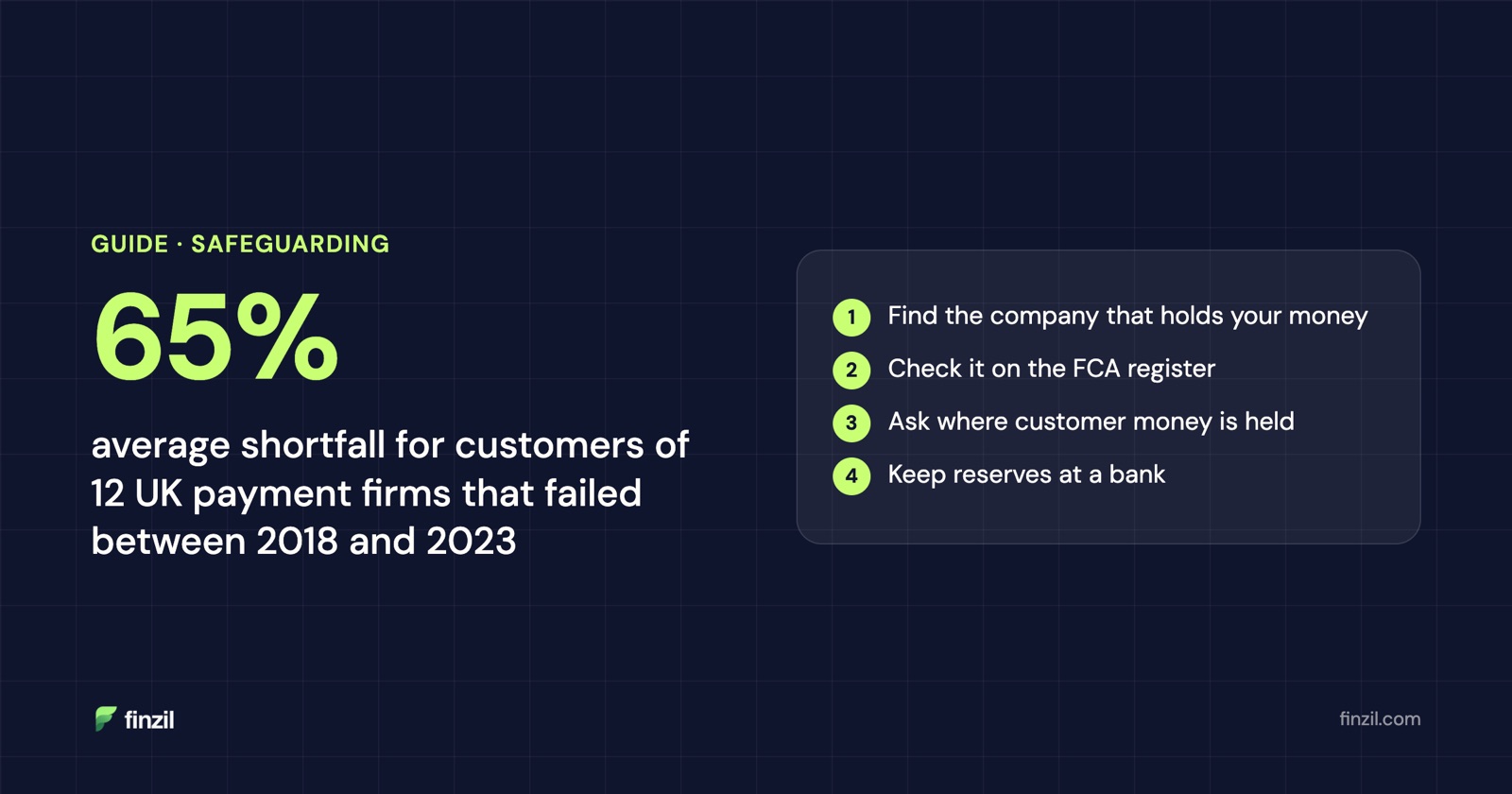
Money in a business account at an e-money institution (EMI) is not a bank deposit, so the FSCS does not cover it if the firm fails. It is safeguarded instead: kept apart from the firm's own money and returned to customers first. That works only if the firm safeguarded properly. When the FCA looked at 12 payment firms that failed between 2018 and 2023, customers were on average 65% short, and payouts took 2.3 years on average.
- 76 of the 177 business account providers on Finzil are e-money institutions; 56 are banks (October 2026).
- 48 of them hold an e-money licence from the FCA.
- FSCS cover at a UK bank is £120,000 per eligible depositor, per bank, since 1 December 2025.
What happened at ePayments
On 15 October 2026, ePayments Systems Limited, an FCA-authorised e-money institution, entered special administration. The FCA named Mark Boast and Allister Manson of Opus Restructuring LLP as joint special administrators.
Customer accounts are frozen. Customers can't withdraw, cancel payments or make new ones. The FCA's notice says the FSCS does not cover payment services, that the firm was required to safeguard customer money, and that the administrators will now assess what it actually holds. They will explain how to claim later.
The FCA also warns customers about firms offering to recover their money for a fee, and says most customers gain nothing from using one. If someone contacts you claiming to be from ePayments, Opus or the FCA, hang up and contact them through the details on the FCA's own page.
ePayments suspended customer accounts in 2020 and began winding down in 2022, so few active businesses still bank there. The questions it raises apply to every EMI, though, and most people with a business account at Wise, Airwallex or a smaller provider have never asked them.
Safeguarding is not deposit protection
The two systems protect you in different ways, and the difference only shows on the day a firm fails.
| Bank | E-money institution | |
|---|---|---|
| What your balance is | A deposit, lent on by the bank | E-money, which the firm must back one for one |
| Protection if the firm fails | FSCS: up to £120,000 per eligible depositor, per bank (EU: €100,000) | Safeguarding: your money should be held apart and paid back to customers before other creditors |
| Who pays if money is missing | The compensation scheme | Nobody. Customers share whatever was safeguarded |
| How fast | The FSCS aims to pay within 7 days | Through an insolvency process. The FCA's sample averaged 2.3 years |
| Costs | None to you | The administrators' costs of returning the money can come out of the safeguarded funds |
Safeguarding is a legal duty, not an insurance policy. When a firm got it right, customers get most of their money back, later and minus costs. When a firm got it wrong, there is no scheme behind it. The FCA's own numbers are the reason it rewrote the rules: across the 12 failures it studied, the average shortfall was 65%, and 80% at e-money firms alone.
What changed on 7 May 2026
New FCA rules for UK payment and e-money firms (policy statement PS25/12) have applied since 7 May 2026. Firms must:
- reconcile safeguarded money against what they owe customers on every working day,
- keep a resolution pack, so an administrator can find the money and the records quickly,
- have an annual safeguarding audit, unless they safeguarded under £100,000 over the year,
- report their safeguarding position to the FCA every month.
These rules make shortfalls rarer and payouts faster. They don't turn safeguarding into a guarantee, and the FCA has said a second stage will follow after further consultation.
Which kind of provider are you with?
Brand names don't tell you. The licence does. From the 177 provider profiles on Finzil, checked between 1 and 15 October 2026:
| Provider | What it is | What protects your balance |
|---|---|---|
| Wise | E-money institution | Safeguarded. Wise states it is not a bank |
| Airwallex | E-money institution | Safeguarded, separate from Airwallex's own money |
| Payset | E-money institution | Safeguarded at authorised UK or EEA banks. No FSCS |
| Tide | E-money institution | Depends on the account: ClearBank accounts have FSCS cover up to £120,000; e-money accounts from PrePay Technologies are safeguarded |
| Revolut | Bank in the UK since 11 March 2026 | FSCS up to £120,000 for eligible deposits at Revolut Bank UK |
| Mercury | US fintech, not a bank | FDIC insurance through its partner banks |
Two things in that table catch people out. A provider can be both: Tide offers FSCS-protected accounts and safeguarded e-money accounts under the same brand. And a provider can change: Revolut moved UK customers to its new bank in stages during 2026, and money still held by its e-money company is safeguarded rather than covered by the FSCS. Your app or your terms say which company holds your money.
Our view: an EMI is a good place for money that moves. Payments in, payments out, foreign currency, cards. It is a poor place for money that sits: tax reserves, payroll for next quarter, a year of runway. Keep those at a bank, under the £120,000 limit per bank where you can.
How to check your own provider in 15 minutes
- Find the legal entity. Open your account terms and look for "your account is provided by". That company, not the brand, is what matters.
- Look it up on the register. In the UK, search the FCA register. It says whether the firm is a bank, an e-money institution, a small e-money institution or an agent of another firm, and whether the FCA has restricted it. In the EU, use your national regulator's register.
- Ask where the money is held. A safeguarded firm should be able to tell you which banks hold its customer money, or whether it uses an insurance policy instead. A vague answer is an answer.
- Check what kind of account you have. Some providers offer e-money and bank accounts side by side. Ask which one yours is.
- Count what you couldn't do without for two years. That figure is what should not sit at a single EMI.
If your provider fails
- Stop new money going in. Send your customers new payment details as soon as you have a working account elsewhere, and move direct debits and payroll.
- Save your records today. Download statements, invoices and a screenshot of your balance. Access to the app can stop without warning.
- Use only official contact details. Get the administrators' details from the regulator's announcement, not from an email or a call.
- Don't pay a recovery firm. The claims process is free, and the FCA says most customers gain nothing from paying someone to claim for them.
- File your claim when invited, with your records, and keep a copy of everything you send.
If you need a second account quickly, Finzil shows which providers accept your company before you apply. Check your company.
Questions people ask
Is money in a Wise Business account protected by the FSCS?
No. Wise is an e-money institution, so the FSCS does not cover it. Customer money is safeguarded, held separately from Wise's own funds, and would be returned through an insolvency process if Wise failed.
Is Revolut Business covered by the FSCS?
Since Revolut Bank UK received its licence on 11 March 2026, eligible deposits in UK business accounts held with Revolut Bank UK are protected up to £120,000. Money still held by Revolut's e-money company is safeguarded instead, so check which company holds your account.
What happens to my money if an e-money institution goes bust?
An administrator collects the safeguarded money and pays it back to customers ahead of other creditors, minus the costs of doing so. If the firm didn't safeguard properly, customers share what is left. The FCA found 12 failures between 2018 and 2023 left customers 65% short on average.
Are EMIs safe for a business account?
For day-to-day payments, most businesses use them without trouble, and new UK rules since 7 May 2026 require daily checks and monthly reporting. They carry a risk banks don't: no compensation scheme stands behind them. Keep large reserves at a bank.
General information, not legal or financial advice. Provider details from 177 profiles on Finzil, checked between 1 and 15 October 2026. ePayments details from the FCA's notice of 15 October 2026. Failure figures from the FCA's 2024 safeguarding consultation (CP24/20).
Providers in this article
How they compare
The providers named above, with where they are licensed and what they are known for. Each links to its full profile.
| Provider | Licensed in | Known for |
|---|---|---|
 Wise BusinessE-money institution Wise BusinessE-money institution |   | Low FX costsStandard businesses |
 AirwallexE-money institution AirwallexE-money institution |   | Global accountsOnline businesses |
 PaysetE-money institution PaysetE-money institution | | 35 currenciesHigh-risk industries |
 TideE-money institution TideE-money institution | | Free planNon-residents accepted |
 Revolut BusinessBank Revolut BusinessBank |  | Cards and spend controlsStartups and SMEs |
 MercuryFintech company MercuryFintech company |  | US business accountNon-residents accepted |
Not sure which one fits? Your profile ranks them for your business, with the reason behind each.