
The short answer
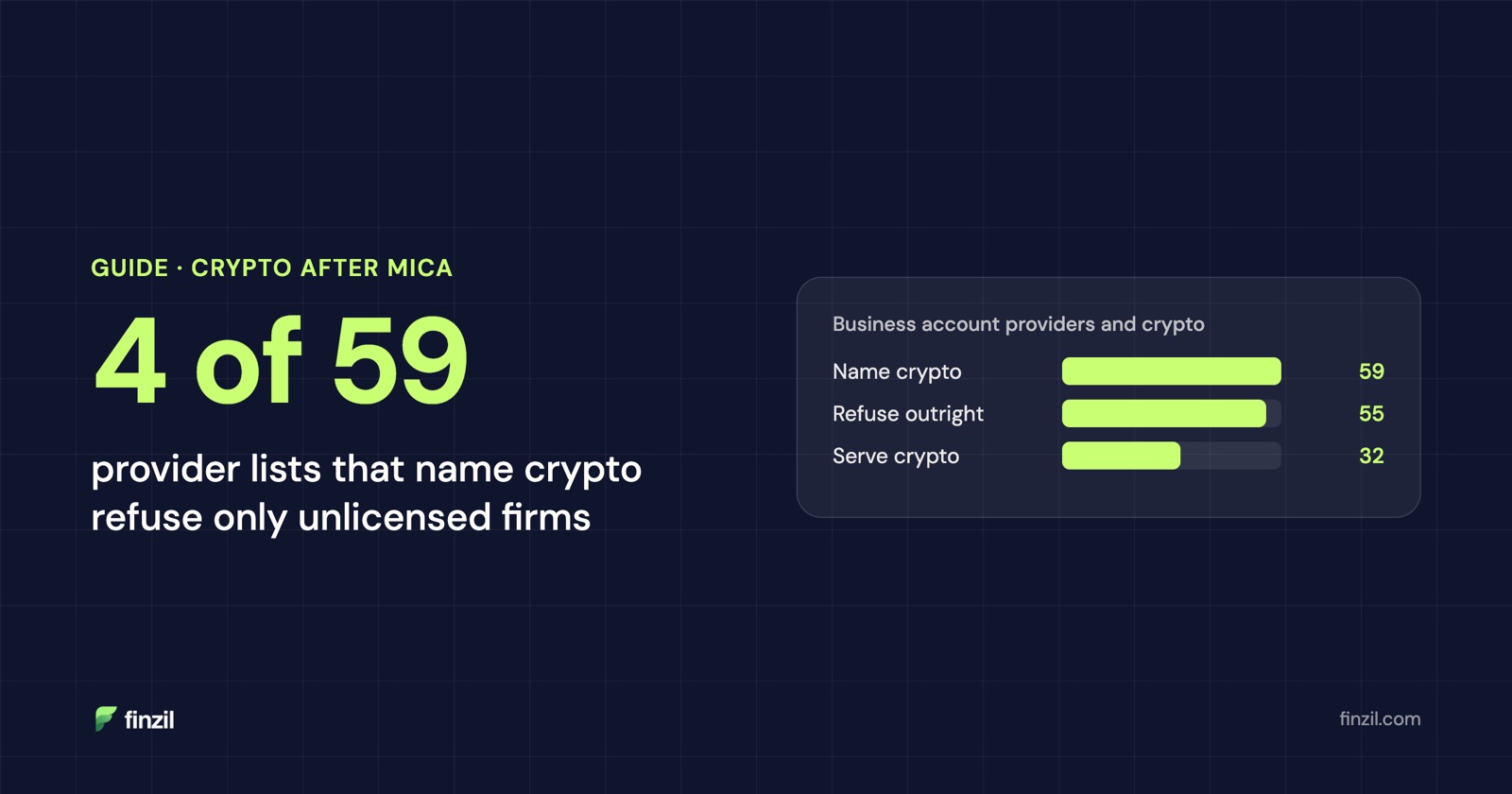
Crypto is still one of the hardest industries to bank, and MiCA has split the market in two. Of 94 providers on Finzil that publish a list of industries they refuse, 59 name crypto, and only 4 of those limit the refusal to unlicensed firms. 32 providers say in their own documents that they serve crypto businesses. Since MiCA's transition ended on 1 July 2026, an EU authorisation is the first thing most of them ask for.
- 59 of 94 published industry lists name crypto (63%), Finzil, October 2026.
- 55 of those 59 refuse crypto with no exception for licensed firms.
- About 360 crypto-asset service providers were on ESMA's interim MiCA register at the end of September 2026.
What changed on 1 July 2026
MiCA, the EU's Markets in Crypto-Assets Regulation, gave firms already registered under national rules a transition period to get a full licence. The longest of those periods ended on 1 July 2026. ESMA has said that any firm providing crypto-asset services to people in the EU without MiCA authorisation after that date is breaking EU law.
For banking, this changed the question providers ask. Before, a national registration in Lithuania, Poland or Estonia was often enough to start a conversation. Now a provider that takes on a crypto firm wants to see a MiCA authorisation, or a clear reason the firm doesn't need one. Banks and some other regulated firms can offer crypto services by notifying their regulator instead of applying, but for an exchange, a broker or a custodian, the licence is the ticket.
About 360 firms were on ESMA's interim register of authorised crypto-asset service providers at the end of September 2026. Those firms are now easier to bank than before MiCA. Firms without authorisation are harder to bank, and they are also operating illegally in the EU.
How the published lists read crypto
| What the provider's list says | Providers | What it means |
|---|---|---|
| Crypto, with no qualifier | 55 | Closed, licensed or not |
| Only unlicensed or unregulated crypto | 4 | Open in principle to licensed firms |
| Crypto named as a sector they serve | 32 | Open, usually on a separate price list |
The four that refuse only unlicensed crypto are Genome, Paysera, Clear Junction and Finsei. Clear Junction's wording shows how narrow "licensed" can be: it refuses unlicensed, unregistered or offshore cryptoasset businesses, anonymity-enhanced exchanges and crypto ATMs.
Compared with gambling, the gap is stark. 26 of the 70 lists that name gambling refuse only unlicensed operators. For crypto it is 4 of 59. Most providers that don't serve crypto haven't left room for a licence to change their mind.
Who says they serve crypto
These 32 providers name crypto businesses among the sectors they serve, from the 177 profiles on Finzil checked between 1 and 15 October 2026.
| Type | Providers |
|---|---|
| Banks in Switzerland, Liechtenstein, the EU, Gibraltar and the UAE | AMINA Bank, Bank Frick, Magnetiq Bank, Sygnum Bank, Turicum Private Bank, Zand Bank |
| Banks licensed outside Europe | Arival Bank, Black Banx, FV Bank, Hamilton Reserve Bank, Jetonbank |
| E-money, payment and money services firms | Bankera, BCB Group, Bilderlings, BVNK, Checkout.com, Clear Junction, Equals Money, Fiat Republic, FinXP, Ibanera, Monerium, Nexpay, OlkyPay, OpenPayd, Papaya, Payset, Pervesk, Verifo, Vialet, Wallter, xpate |
Some of these are crypto firms themselves. Sygnum Bank and OlkyPay hold MiCA crypto-asset service provider authorisations, as does LHV Bank. A provider that is supervised for crypto knows what it is looking at, which tends to make for a shorter conversation.
Several of the 32 serve only licensed firms. Bilderlings has a separate plan for UK and EU licensed crypto firms at €350 a month. Clear Junction lists licensed cryptoasset firms. Others publish crypto tiers alongside gaming and payments: Bankera and Pervesk both charge €200 a month and a €900 set-up fee.
Five are licensed outside Europe: in Puerto Rico, Dominica, Anjouan, St Kitts and Nevis, and Panama. They accept businesses that European banks won't, and they carry their own trade-offs: no EU deposit protection, and some counterparties that won't send them money. Read their profiles for what each publishes.
You may not be a crypto company, but you'll be read as one
Compliance teams match words, not business models. These businesses often get treated as crypto firms:
- Software companies building wallets, smart contracts or blockchain tools for clients.
- Businesses paid in stablecoins by some customers, or that pay contractors in USDC.
- Online shops that accept crypto through a payment processor.
- Companies holding part of their treasury in bitcoin or stablecoins.
- Founders whose starting capital came from selling crypto.
For each of these, the fix is the description. Say what the company does first, and then exactly how crypto touches it: "We build accounting software. Two clients pay us in USDC through [processor], converted to euros on receipt." A provider that refuses crypto exchanges may still accept a software company with a clear, limited crypto flow. A provider that sees "blockchain" in your company name and nothing else will usually stop reading.
The last case, crypto wealth, applies to every industry. If the money you put into the company came from selling crypto, expect to show the trail: exchange statements, wallet addresses and the bank transfer that brought it out.
The pack for a licensed crypto firm
- Your MiCA authorisation, the name of the authority that granted it, and the link to its entry on ESMA's register. Add any passporting notifications for the countries you serve.
- What the account is for: your company's own money, or customers' money. Accounts that hold client funds are harder to get and are often a separate product.
- Your AML and counter-terrorist financing policies, your MLRO, and your most recent independent audit.
- Travel Rule compliance. Since 30 December 2024, EU crypto firms must send and receive sender and recipient details with every transfer. Name the tool you use.
- Blockchain analytics: which provider screens your incoming and outgoing wallets, and what you do with a hit.
- Flows by currency and country, including which exchanges and banks money arrives from.
- Ownership, up to the real people, and the source of the founders' wealth.
Our view: apply to providers that are supervised for crypto themselves, or that publish a crypto price list, before you try anyone else. A provider that has written down what it charges crypto firms has already decided to take them.
Finzil checks your licence, country of registration and owners against the published rules of 177 providers. Check your company.
Questions people ask
Which banks accept crypto companies in Europe?
Of 177 providers on Finzil, 32 say they serve crypto businesses (October 2026). The banks among them include AMINA Bank and Sygnum Bank in Switzerland, Bank Frick in Liechtenstein, Magnetiq Bank in Latvia and Turicum Private Bank in Gibraltar. Most of the rest are e-money and payment institutions.
Do I need a MiCA licence to open a bank account for my crypto business?
For an exchange, broker, custodian or other crypto-asset service provider serving EU customers, effectively yes. Operating without MiCA authorisation has been illegal since 1 July 2026, and providers that accept crypto firms ask for the authorisation first.
Will a bank accept me if my company gets paid in crypto?
Often, if crypto is a small, clearly described part of an ordinary business. Say what you do first, then how the crypto arrives and how it is converted. Applications that lead with crypto get read as crypto firms.
How many crypto firms are authorised under MiCA?
About 360 crypto-asset service providers were on ESMA's interim MiCA register at the end of September 2026. The number grows each week as national regulators approve applications.
General information, not legal or financial advice. Figures from 177 provider profiles on Finzil, checked between 1 and 15 October 2026; counts of crypto wording read by hand. Register count from ESMA's interim MiCA register, 30 September 2026 file.
Providers in this article
How they compare
The providers named above, with where they are licensed and what they are known for. Each links to its full profile.
| Provider | Licensed in | Known for |
|---|---|---|
 GenomeE-money institution GenomeE-money institution |  | Published pricesVisa cards |
 PayseraE-money institution PayseraE-money institution |  | Low fees16 support languages |
 Clear JunctionE-money institution Clear JunctionE-money institution |    | Financial institutionsDigital assets |
 FinseiE-money institution FinseiE-money institution |  | 38 currenciesVisa cards |
 AMINA BankBank AMINA BankBank |   | Crypto-friendly19 currencies |
 Bank FrickBank Bank FrickBank |  | Crypto-friendlyFinancial intermediaries |
30 more providers are linked in the article.
Not sure which one fits? Your profile ranks them for your business, with the reason behind each.