The short answer
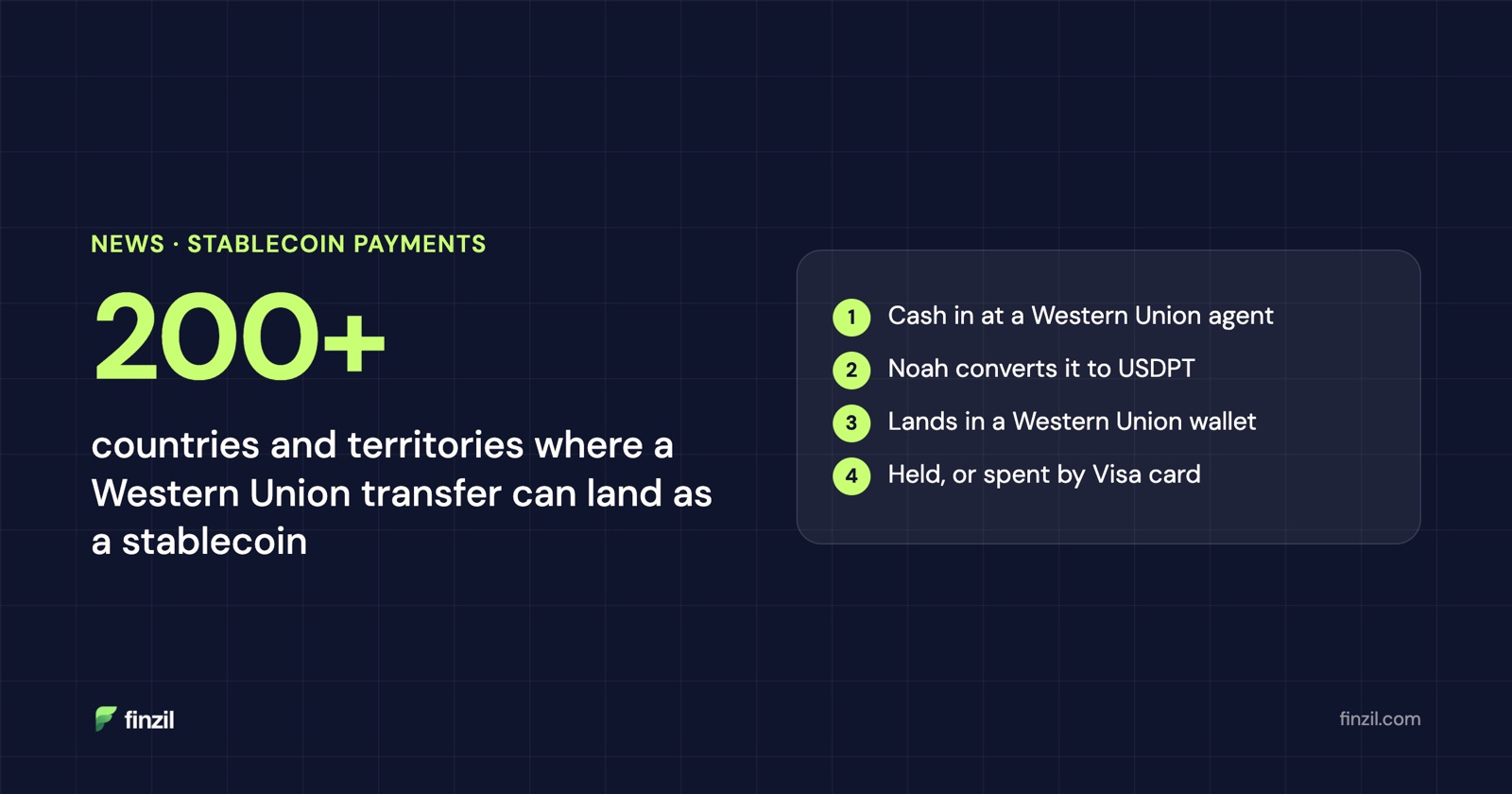
On 20 October 2026 Noah, a London stablecoin payments company, said Western Union had selected it to power Receiver Redirect: a transfer sent at any Western Union agent can arrive as USDPT, Western Union's dollar stablecoin, in the recipient's wallet. Noah provides the treasury and licences to pre-fund, convert and pay out. Businesses can't sign up for it. What it shows is how the licence behind a payment now sits with a company the customer never sees.
- 200+ countries and territories and 60+ currencies covered by the service (Noah, 20 October 2026).
- 6.36% is the global average cost of sending $200 abroad (World Bank, Q3 2025).
- 47 of the 122 providers on Finzil that publish a list of refused industries name money service or remittance businesses (October 2026).
What Noah and Western Union announced
The announcement came from Noah on 20 October 2026, with a quote from Western Union's Global Head of Digital Assets, Malcolm Clarke. When we checked the same day, Western Union's investor relations page had no release of its own on it. The facts, from Noah's announcement:
| Item | Detail |
|---|---|
| Service | Receiver Redirect: the recipient of a Western Union transfer takes it as USDPT in a Western Union wallet instead of cash |
| Reach | 60+ currencies, 200+ countries and territories, Western Union's 150 million+ customers |
| Where money comes in | Western Union's 500,000+ agent locations |
| The stablecoin | USDPT, a US dollar stablecoin issued by Anchorage Digital Bank, N.A. on Solana |
| Noah's role | Treasury and licences to pre-fund, convert and pay out USDPT, and local compliance for each transfer |
| Holding the balance | Recipients can keep USDPT in Stablecard, Western Union's wallet and Visa card launched in August 2026 |
Western Union already lets some recipients redirect a transfer to a mobile wallet instead of collecting cash: its own pages show this for Zain Cash in Iraq. What is new is a stablecoin as the destination, in every market the service covers.
Clarke called it "a global first" in Noah's announcement. Noah's chief executive, Shah Ramezani, called it a watershed for stablecoins. Those are the two companies' words. The numbers to watch are how many markets go live and what the transfer costs, and neither has been published.
Four companies behind one transfer
The customer sees Western Union. Behind it, each part of the transfer is run by a different company with a different licence.
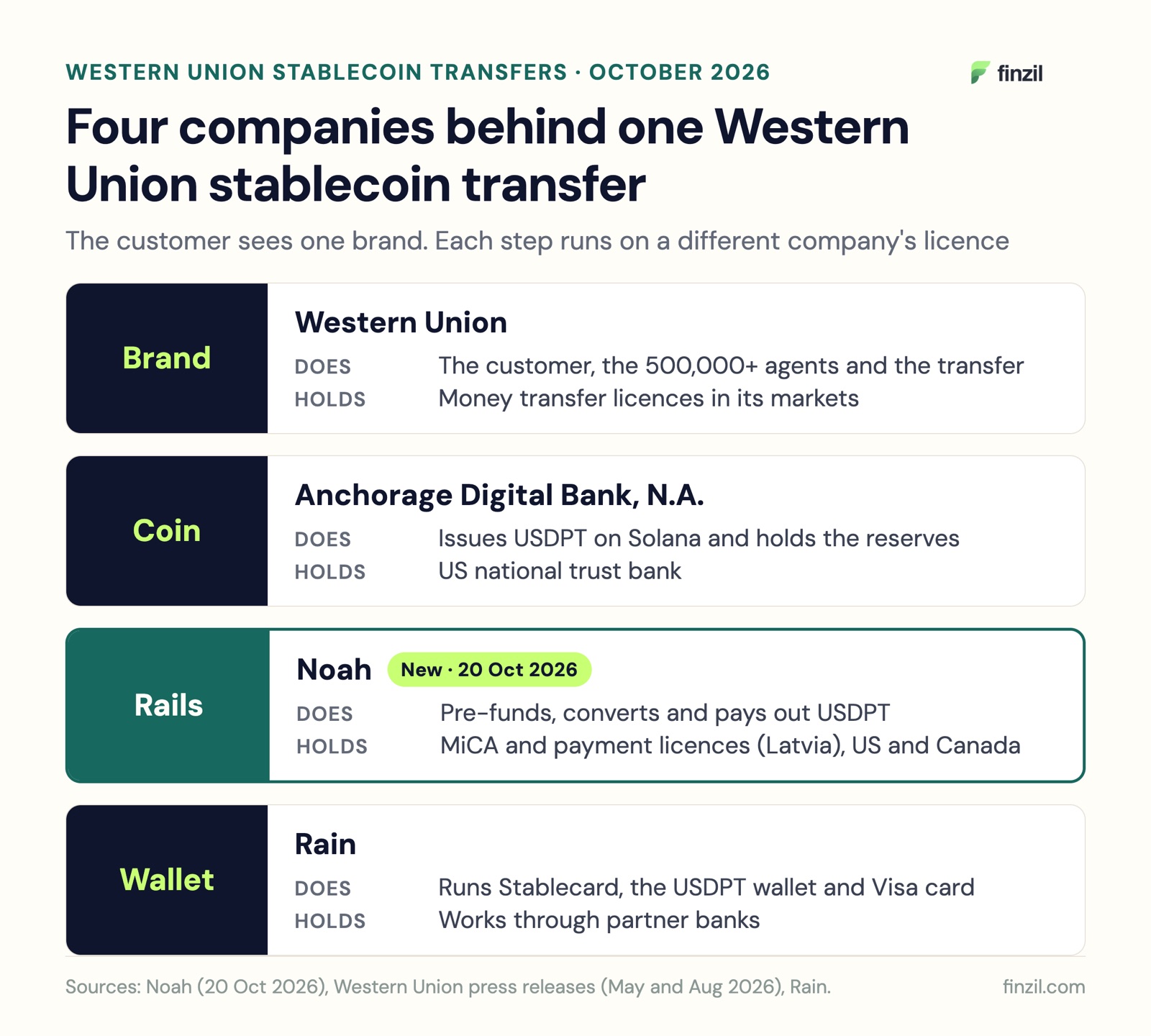
| Company | Role | What it holds |
|---|---|---|
| Western Union | The brand, the agents and the customer relationship | Money transfer licences in the markets it serves |
| Anchorage Digital Bank, N.A. | Issues USDPT and holds its reserves | A US national trust bank charter |
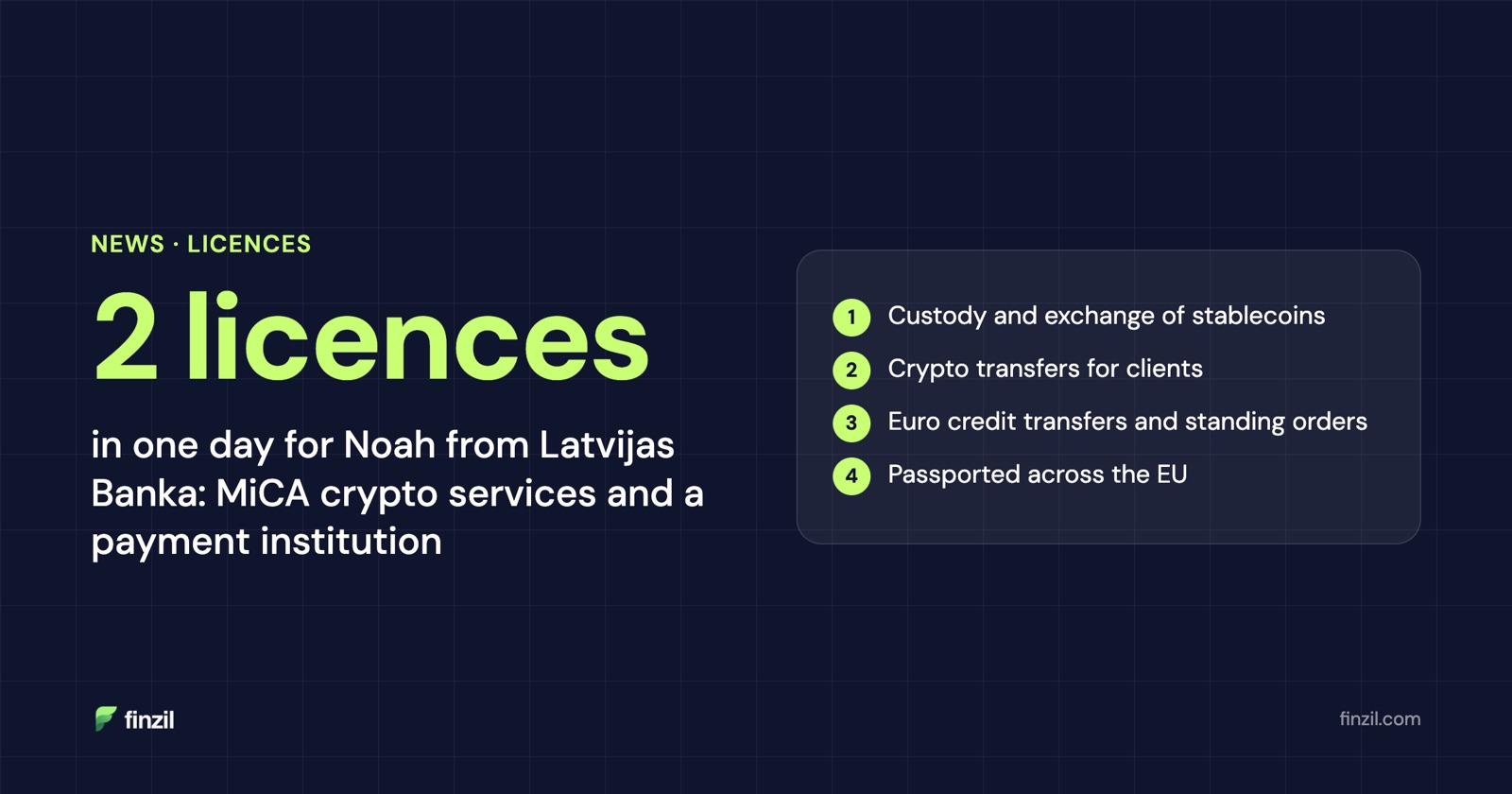
| Noah | Pre-funds, converts and pays out USDPT | A MiCA and a payment institution licence in Latvia, US money transmitter licences, a Canadian money services registration |
| Rain | Runs Stablecard, the wallet and Visa secured credit card | No licence of its own: works with partner banks |
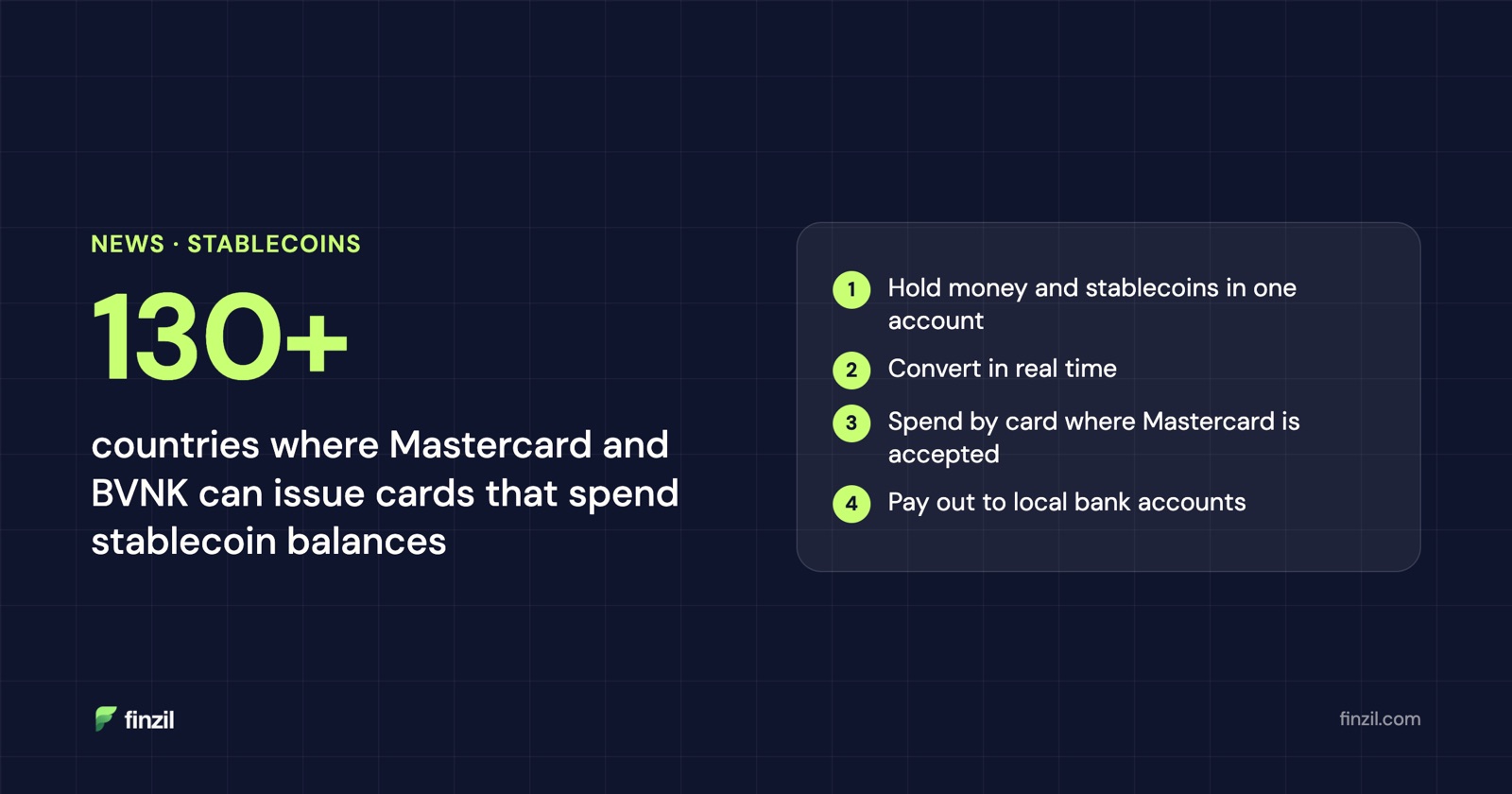
This is the pattern we saw when Noah got two EU licences in one day and when Mastercard and BVNK launched their Global Money Platform. The company that converts money to stablecoins and back stays out of sight. Western Union now uses two of the infrastructure companies with a page on Finzil, Rain for the card and Noah for the transfer.
Western Union's stablecoin year
Western Union has moved from announcing a stablecoin to running products on it in twelve months, according to its own press releases.
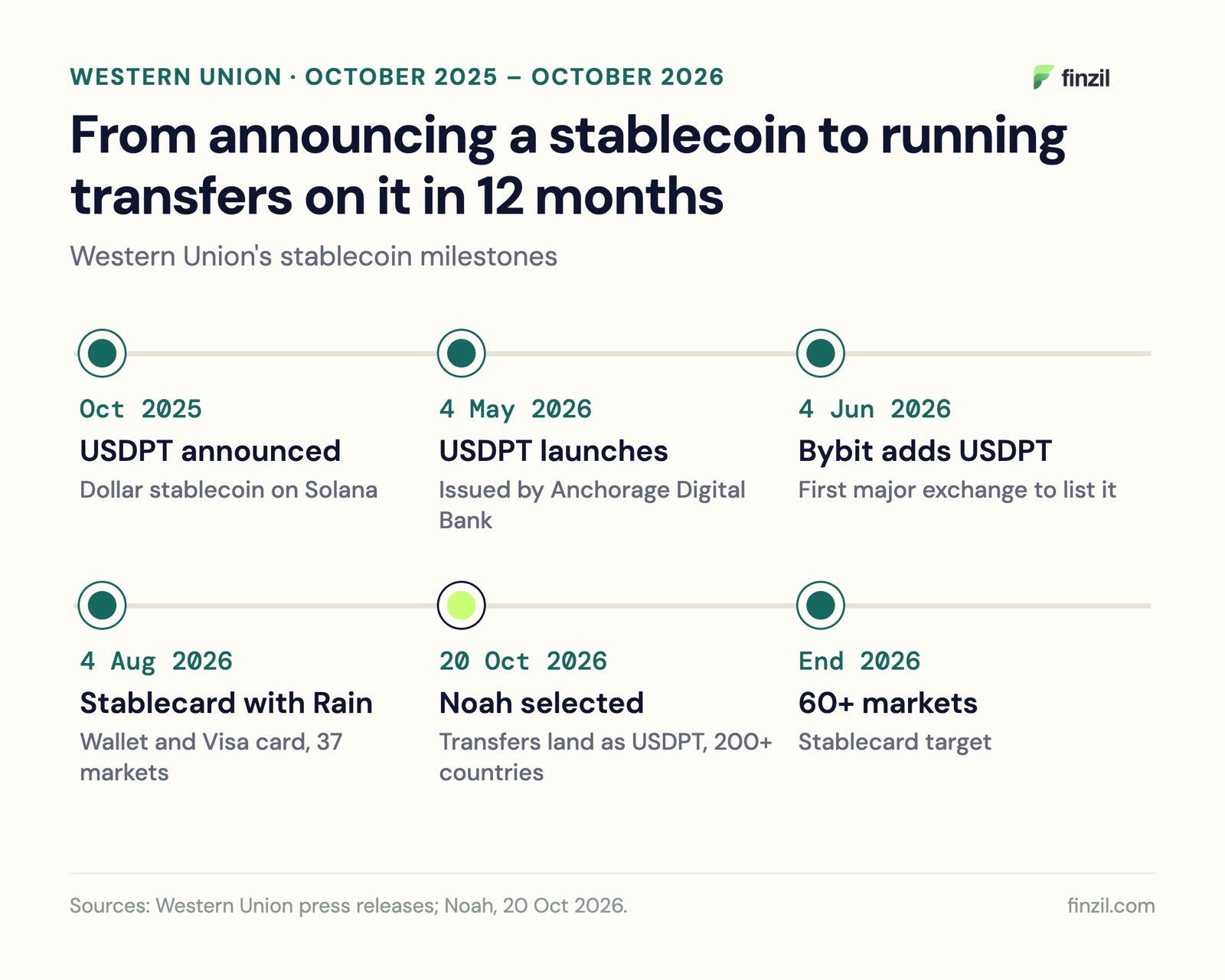
Stablecard went live in 37 markets on 4 August 2026, with a target of 60+ by the end of the year. It is a USDPT wallet with a Visa secured credit card, built by Rain. Receiver Redirect is the way money gets into it: a sender pays cash at an agent, and the recipient holds dollars.
Two cautions, both from Western Union's own wording. USDPT is not insured by the FDIC or any other US government agency. And a dollar stablecoin protects a recipient from a weak local currency only for as long as they hold it: once spent or cashed out, the conversion rate applies again.
Why remittance businesses should read this
Remittance and money service businesses are among the hardest companies to bank, and this announcement doesn't change that. Of the 122 providers on Finzil that publish a list of industries they refuse, 47 name money service businesses, remittance firms or informal transfer systems such as hawala. Only 12 of them refuse just the unlicensed ones.
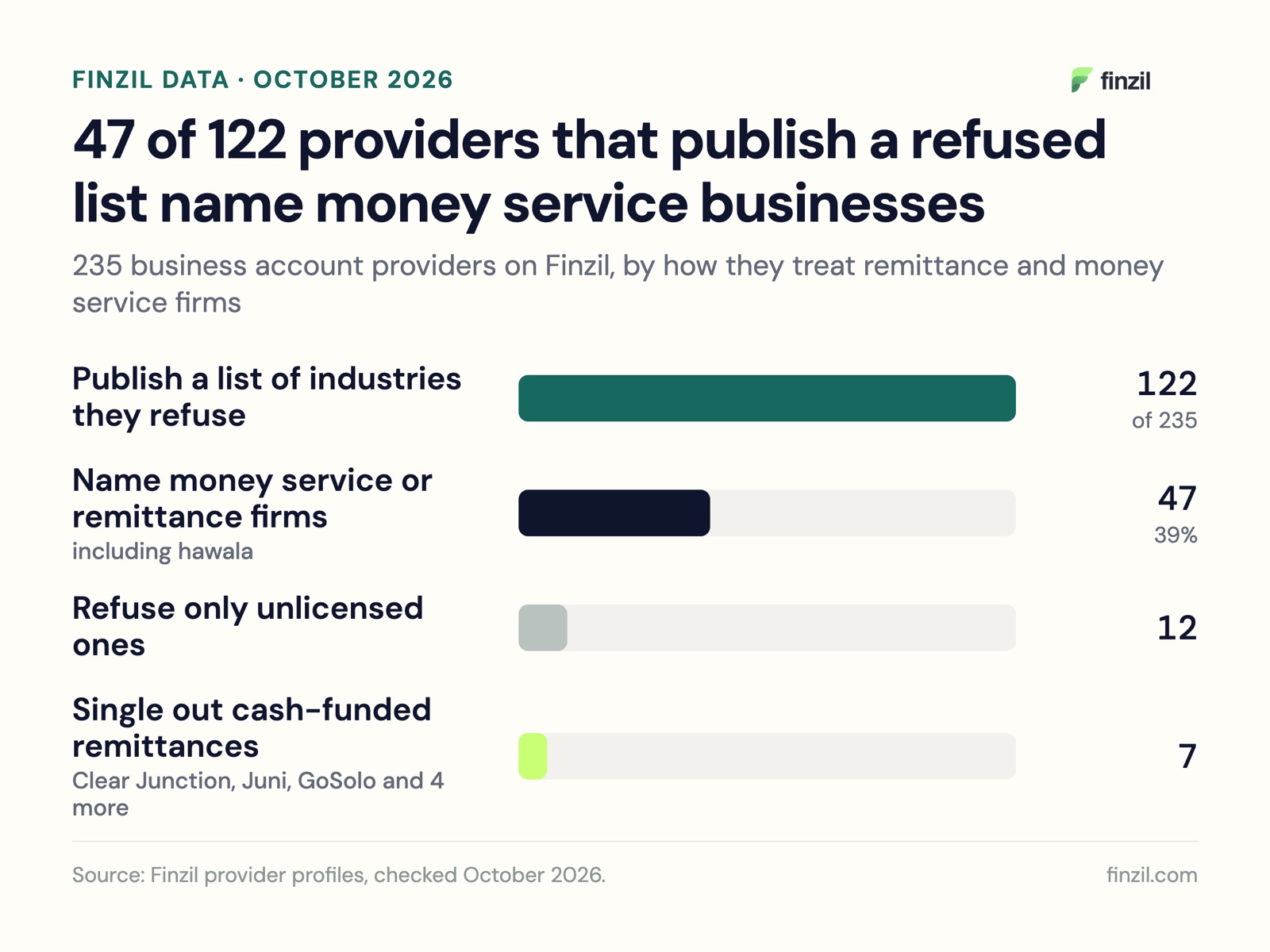
Seven go further and single out remittances or money services funded in cash: Clear Junction, Juni, GoSolo, MultiPass, Amnis, Finsei and OMG.one. Cash in at an agent, value out somewhere else, is exactly what Receiver Redirect does. Western Union can do it at scale because it holds the licences and the compliance team to match.
Our view: a 175-year-old remittance company putting stablecoins at the end of a cash transfer will make some banks more comfortable with the idea. It won't move a provider's refused-industries list. For a smaller money service business, the questions stay the same: which licence you hold, where your customers' money sits, and who converts it.
Who handles stablecoins and takes financial firms
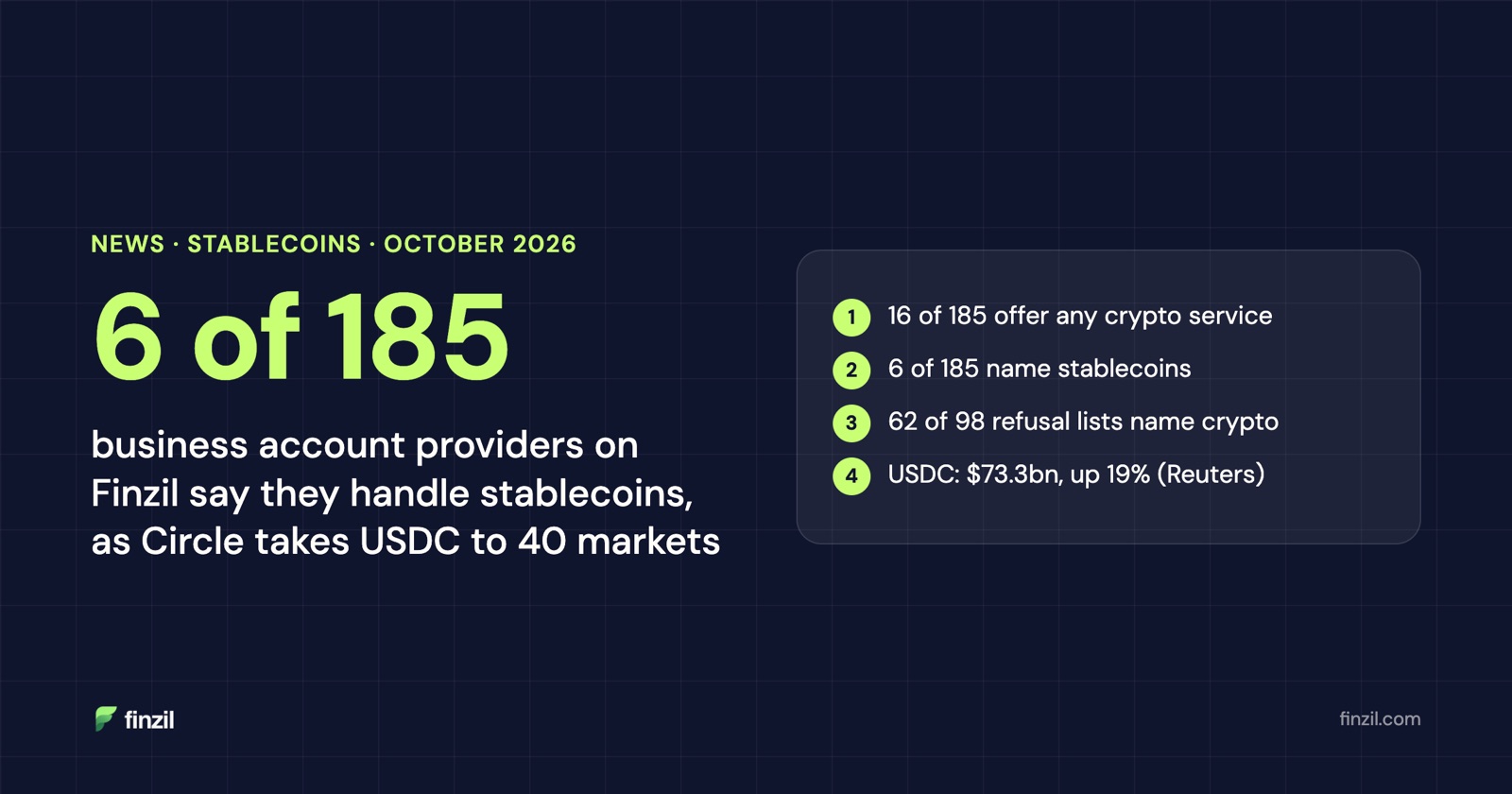
13 of the 235 providers on Finzil name stablecoins in their own published services. Eight of those also list financial or payment companies among the businesses they serve (October 2026).
| Provider | Licensed in | What it publishes |
|---|---|---|
| Clear Junction | UK, Canada, Poland | Accounts and payment rails for banks, e-money and payment firms, remittance and FX providers, and licensed digital-asset firms. Refuses remittance businesses funded mainly in cash |
| BVNK | UK, Malta | Accounts joining bank payments and stablecoin settlement in USD, EUR and GBP, for $500,000+ a month. Owned by Mastercard |
| FV Bank | Puerto Rico | US dollar accounts with stablecoin deposits and conversion, for fintech, blockchain and digital-asset companies |
| Damisa | Canada, Australia | Multi-currency accounts and virtual IBANs, with payouts in 55 currencies settled over stablecoin rails |
| Mesta | United States | Named USD, EUR, GBP and MXN accounts with stablecoin on- and off-ramps, sold mainly to payment firms |
| Ibanera | United States | US dollar accounts, crypto conversion and card issuing, mostly used by API |
| Paybis | Latvia, United States | A corporate account for fiat and crypto with named virtual IBANs in 17 currencies and USDT and USDC custody. Payments from $1,000 to $5 million |
| Reap | Hong Kong, Mexico | A stablecoin business account funded in USDC or USDT, with Visa corporate cards and supplier payments in 18 currencies. No IBAN in the company's name |
None of them will take a remittance firm on the strength of a stablecoin story alone. Each asks for the licence, the corridors and the source of the money, and Clear Junction states the cash-funded limit in its own list.
What to do
- If you run a remittance or payment business, lead with the licence. Name the regulator, the licence number and the corridors you serve before you mention stablecoins. Who providers refuse has the full numbers by industry.
- Say how money comes in. Cash, card or bank transfer changes the answer. Seven providers on Finzil refuse cash-funded remittances by name.
- Find out who converts. If a partner pays you or your customers in stablecoins, ask which company does the conversion and under which licence. For Western Union's Receiver Redirect, it is Noah.
- Keep stablecoin balances small. USDPT, like other stablecoins, is not covered by deposit insurance or e-money safeguarding. Our safeguarding guide explains what is protected.
- Keep a second account with a different partner. Payment firms are reviewed more often than other clients. Account closed: a 7-day plan covers the first week.
Questions people ask
What is Western Union's Receiver Redirect with Noah? A service that lets the recipient of a Western Union transfer take it as USDPT, Western Union's dollar stablecoin, in a Western Union wallet instead of cash. Noah announced on 20 October 2026 that it provides the stablecoin infrastructure behind it, in 60+ currencies across 200+ countries and territories.
What is USDPT? A US dollar stablecoin issued for Western Union by Anchorage Digital Bank, N.A., a US national trust bank, on the Solana blockchain. Western Union launched it on 4 May 2026. It is not FDIC-insured.
Can my business use Noah directly? No. Noah sells to platforms such as Western Union through an API and offers a demo, not a sign-up (noah.com, checked 20 October 2026). Its services are not available to UK residents.
Is Western Union's Stablecard run by Noah? No. Stablecard, launched on 4 August 2026, is built by Rain. Noah runs the conversion and payout for Receiver Redirect, which can deliver a transfer into the Stablecard wallet.
Do banks accept remittance businesses? Some do, with conditions. Of 122 providers on Finzil that publish a refused-industries list, 47 name money service or remittance businesses, and 12 of those refuse only unlicensed ones (Finzil, October 2026).
Sources: Noah, "Western Union Selects Noah to Power Global Stablecoin Payments Network", 20 October 2026; Western Union, "Western Union Launches USDPT on Solana", 4 May 2026, "Bybit Becomes First Major Crypto Exchange to Integrate Western Union's USDPT Stablecoin", 4 June 2026, and "Western Union Launches Stablecard in Partnership with Rain", 4 August 2026; westernunion.com USDPT page, checked 20 October 2026; World Bank, Remittance Prices Worldwide, Q3 2025; provider profiles on Finzil, checked October 2026. General information, not financial or legal advice.
Providers in this article
Stablecoin providers that take financial firms
Each names stablecoins in its own services and lists financial or payment companies among its clients. Read who they accept before applying.
| Provider | Licensed in | Known for |
|---|---|---|
 Clear JunctionE-money institution |    | Financial institutionsDigital assets |
 BVNKE-money institution |  | StablecoinsEnterprise |
 FV BankInternational bank |   | Crypto-friendlyUS dollar account |
 DamisaMoney services business |  | StablecoinsEnterprise |
 MestaMoney services business | | StablecoinsAPI |
 IbaneraMoney services business | | CryptoAPI |
 PaybisCrypto-asset service provider and payment institution |  | CryptoVirtual IBANs |
 ReapStablecoin payments and card issuer |   | StablecoinsCards |
Not sure which one fits? Your profile ranks them for your business, with the reason behind each.