
The short answer
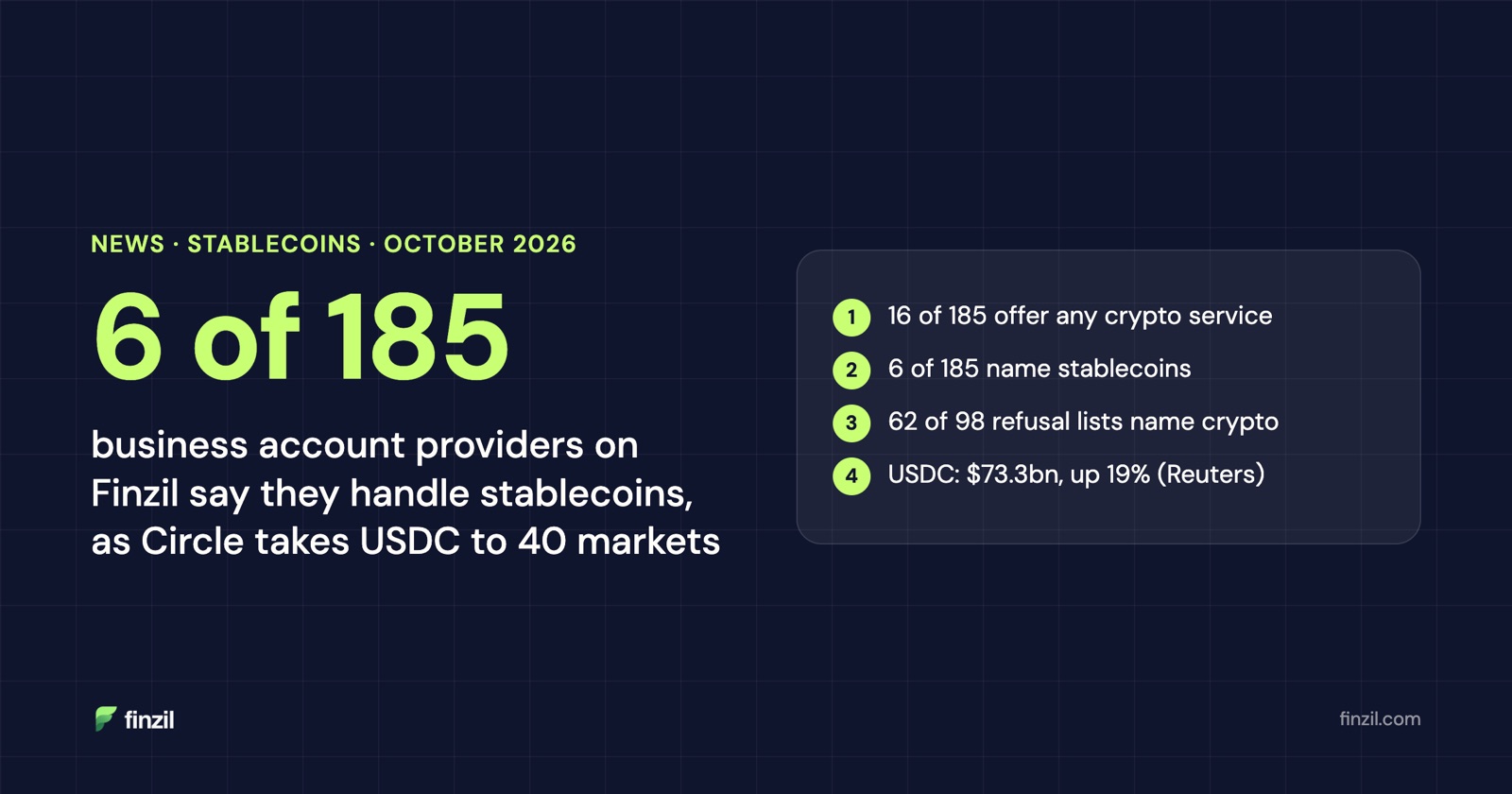
Circle, the company behind the USDC stablecoin, plans to enter about 40 emerging and developing markets, its chief executive told Reuters on 16 October 2026. Receiving USDC is getting easier. Turning it into money in a business account is not. Of 185 banks, EMIs and payment firms on Finzil, 6 say in their own documents that they handle stablecoins, and 62 of the 98 that publish a list of refused industries name crypto.
- 6 of 185 providers on Finzil name stablecoins in their published services (October 2026).
- 16 of 185 say they offer crypto services of any kind.
- 62 of 98 published industry lists name crypto (63%).
What Circle announced
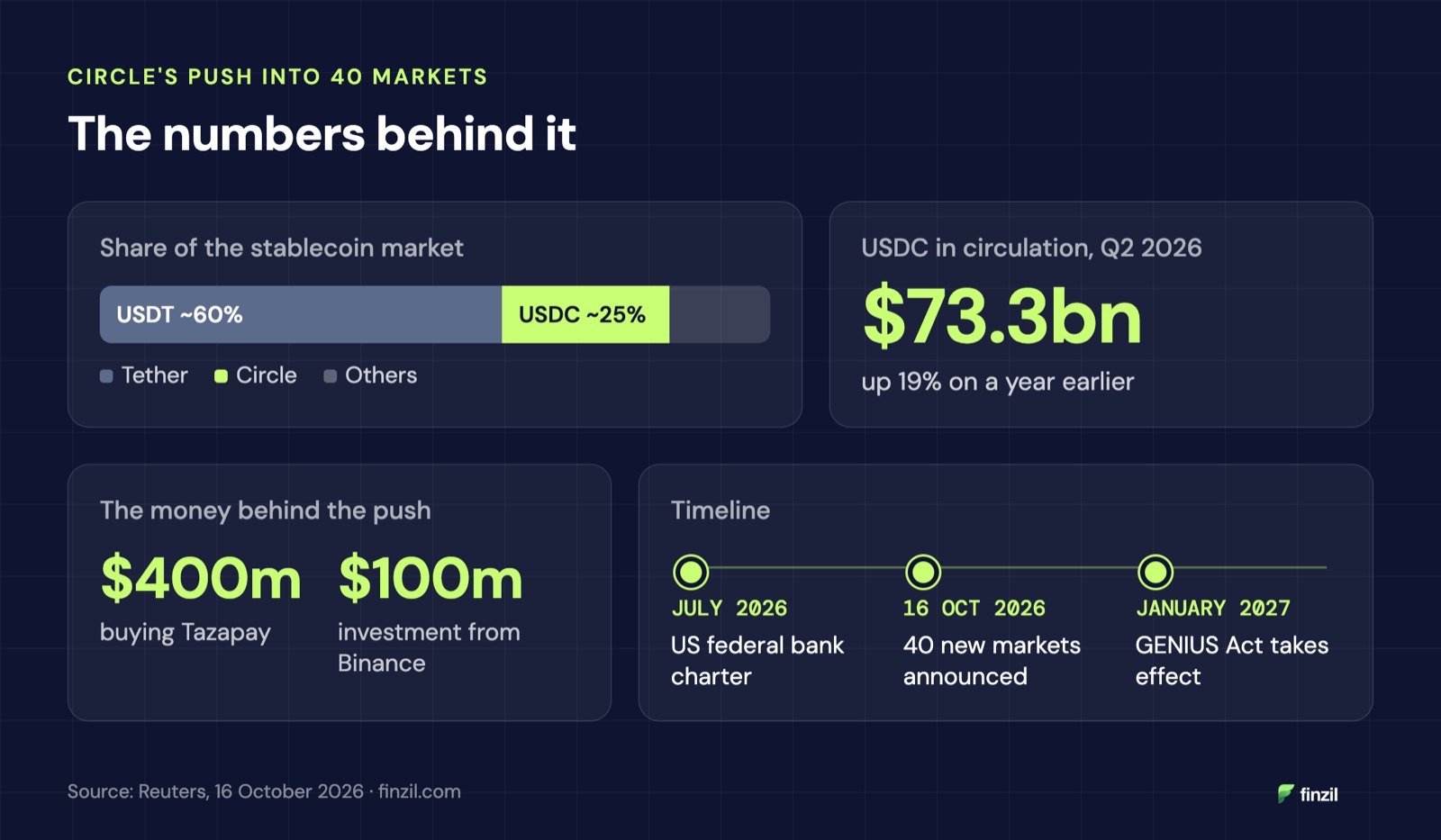
Jeremy Allaire, Circle's chief executive, told Reuters on 16 October 2026 that the company is pushing into about 40 emerging and developing countries, naming Southeast Asia, Latin America, Africa and the Middle East. He was speaking at the IMF and World Bank meetings in Bangkok.
The facts behind the push, as Reuters reported them:
| Item | Figure |
|---|---|
| USDC in circulation, second quarter of 2026 | $73.3 billion, up 19% on a year earlier |
| Circle's share of the stablecoin market | About 25% (Tether's USDT: nearly 60%) |
| Acquisition of Tazapay, a cross-border payments firm | $400 million |
| Strategic investment from Binance | $100 million |
| US federal bank charter | Held since July 2026 |
| US GENIUS Act, the federal stablecoin law | Due to take effect in January 2027 |
Reuters also reported that BlackRock, Visa and Standard Chartered use Arc, Circle's on-chain infrastructure, and that payments between AI agents are adding to USDC use.
Why this is a banking question
A stablecoin moves in minutes between two wallets. The problem starts when a business wants to pay rent, salaries or tax, because those still leave from a bank account. Somewhere the USDC has to be sold for dollars, euros or local currency, and the money has to land in an account whose provider is comfortable with where it came from.
That provider reads its own rules, not Circle's. Most published rules on Finzil were written to keep crypto out. Of the 98 providers that publish a list of industries they refuse, 62 name crypto in some form. A transfer that arrives from an exchange or an on-ramp can trigger the same review as a payment from a crypto business, even when the company sells software or exports coffee.
Our view: stablecoin rails are spreading faster than the rules of the banks at the other end. The businesses in between, paid in USDC and spending in local money, will be the ones explaining every incoming transfer until those rules catch up.
Who says they handle stablecoins
These 6 providers name stablecoins in their published services, from the 185 profiles on Finzil checked between 1 and 16 October 2026.
| Provider | Licensed in | What it publishes |
|---|---|---|
| BVNK | UK, Malta | Accounts that join bank payments and stablecoin settlement in USD, EUR and GBP, for businesses moving $500,000 a month or more. Owned by Mastercard since August 2026 |
| Clear Junction | UK, Canada | Holds USDC and USDT next to 15 currencies. Serves financial companies and licensed digital-asset businesses |
| FV Bank | Puerto Rico | Stablecoin deposits in USDC, PYUSD and USDT converted to US dollars. Business Plus costs $200 a month and $200 to open |
| Monerium | Iceland | A euro IBAN in the company's name linked to a blockchain wallet: euros paid in arrive as EURe tokens, tokens sent back leave by SEPA |
| Ibanera | United States | US dollar accounts with crypto conversion, mostly used through its API by fintechs and platforms |
| Jetonbank | Dominica | USDT among the account's currencies, next to EUR, GBP and USD. No deposit compensation scheme |
Eleven more say they offer crypto services without naming stablecoins: AMINA Bank, Arival Bank, Bank Frick, BCB Group, Black Banx, emoni, Fiat Republic, LHV Bank, OlkyPay, Sygnum Bank and Zand Bank for digital-asset custody. Several of them are built for crypto firms rather than for a company that is simply paid in USDC.
Two patterns stand out. The European options are mostly for financial firms or for large volumes. The options open to smaller companies are often licensed offshore, in Puerto Rico or Dominica, with no deposit protection. Read each profile for who they accept.
What to do if customers pay you in stablecoins
- Say it in the application. Describe what the company does first, then how stablecoins touch it: "We sell design software. About 20% of revenue arrives in USDC and is converted to dollars through [provider] within a day." A clear, limited flow is easier to approve than one the provider finds later.
- Keep the trail for every conversion. The wallet address, the transaction hash, the exchange or on-ramp statement and the bank transfer that followed. Providers ask for these in source-of-funds reviews.
- Use one route for conversion. Money that arrives from one named on-ramp reads as a business process. Money from five exchanges reads as something to investigate.
- Check the provider's industry list before applying. If it names crypto with no exception, the stablecoin share of your revenue may matter more than what you sell. Our crypto and MiCA guide shows how those lists read.
- Have a second account. If the account that receives conversions is reviewed or closed, a second account keeps salaries and suppliers paid. Account closed: a 7-day plan covers the first week.
Questions people ask
Can a business bank account receive USDC? Most can't. Of 185 providers on Finzil in October 2026, 6 say in their own documents that they handle stablecoins; the rest only receive the dollars or euros after the USDC has been converted elsewhere.
Which banks accept stablecoin deposits? FV Bank, a Puerto Rico international bank, publishes stablecoin deposits in USDC, PYUSD and USDT converted to dollars, and Clear Junction holds USDC and USDT for financial and licensed digital-asset firms (Finzil, October 2026).
Will my bank close my account if I convert USDC? It depends on the provider's published rules: 62 of 98 published industry lists on Finzil name crypto, so conversions can trigger a review. A declared, regular flow with full records is far less likely to cause problems than an unexplained one.
What is Circle's expansion to 40 markets? On 16 October 2026 Circle's chief executive told Reuters the company is entering about 40 emerging and developing countries in Southeast Asia, Latin America, Africa and the Middle East, after a $400 million acquisition of Tazapay and a $100 million investment from Binance.
Sources: Reuters, "Stablecoin issuer Circle to push into 40 new markets, CEO says", 16 October 2026; provider profiles on Finzil, checked 1–16 October 2026. General information, not financial or legal advice.
Providers in this article
How they compare
The providers named above, with where they are licensed and what they are known for. Each links to its full profile.
| Provider | Licensed in | Known for |
|---|---|---|
 BVNKE-money institution BVNKE-money institution |   | StablecoinsEnterprise |
 Clear JunctionE-money institution Clear JunctionE-money institution |   | Financial institutionsDigital assets |
 FV BankInternational bank FV BankInternational bank |   | Crypto-friendlyUS dollar account |
 MoneriumE-money institution MoneriumE-money institution |  | On-chain euroNamed IBAN |
 IbaneraMoney services business IbaneraMoney services business | | CryptoAPI |
 JetonbankBank JetonbankBank |  | Offshore bankNon-residents accepted |
11 more providers are linked in the article.
Not sure which one fits? Your profile ranks them for your business, with the reason behind each.