The short answer
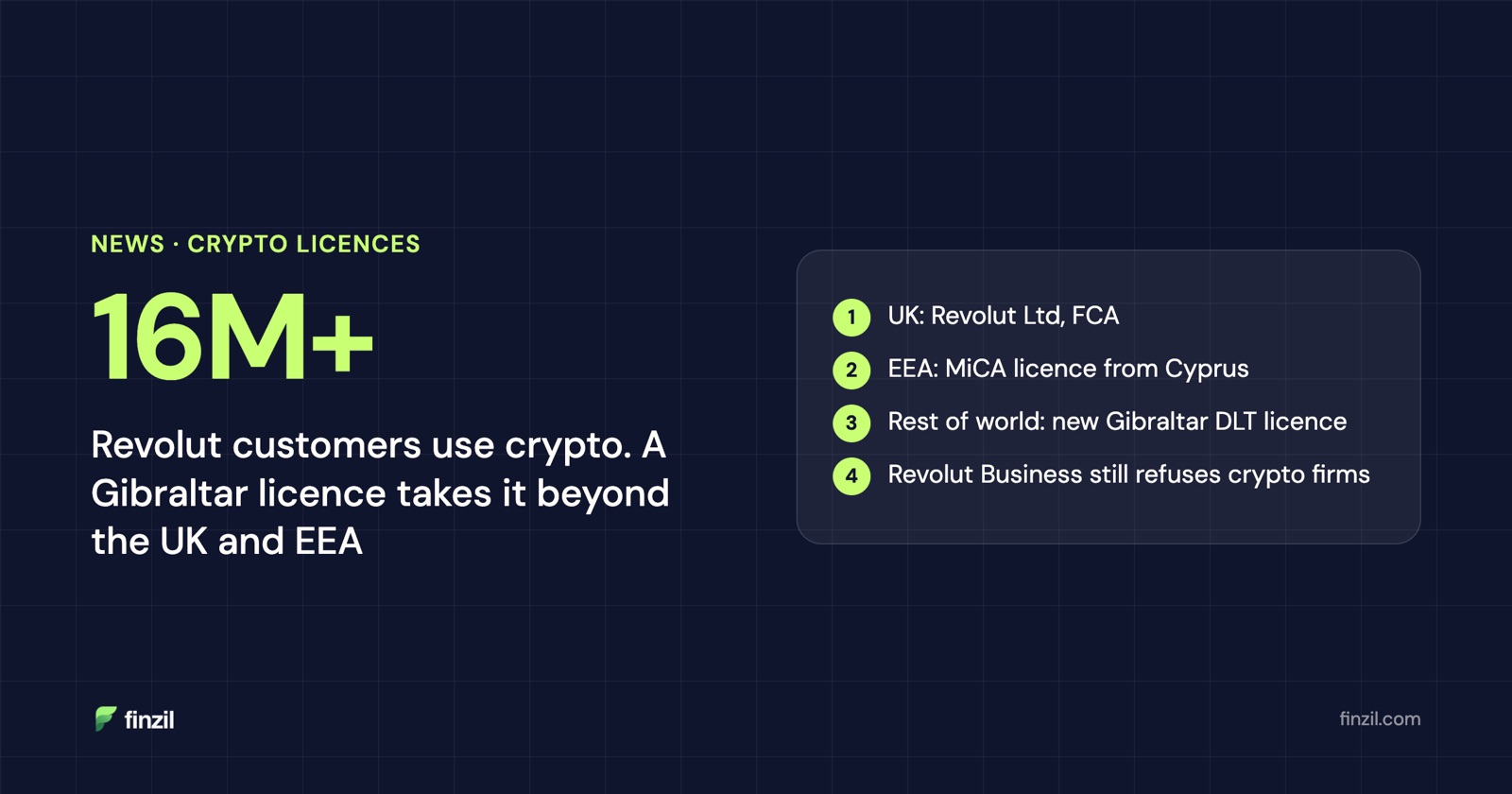
On 19 October 2026 the Gibraltar Financial Services Commission gave Revolut Global Digital Assets Limited, a new Revolut company, a licence to run crypto services: buying and selling, custody and staking. It is Revolut's third crypto set-up, after the UK and the EEA, and it is meant for markets outside both. Revolut hasn't said which ones. Nothing changes for business customers: Revolut Business still refuses crypto companies.
- 16 million of Revolut's 80 million retail customers use crypto, about 1 in 5 (Revolut, October 2026).
- 77 of the 120 providers on Finzil that publish a refused-industries list name crypto (October 2026).
What Gibraltar granted, and to whom
The licence is a Distributed Ledger Technology (DLT) provider permission under Part 7 of Gibraltar's Financial Services Act. It covers three activities: transmitting and executing orders in virtual assets, holding them in custody, and staking. The Government of Gibraltar announced it in press release 796/2026, the same day Revolut did.
The same release carried a second piece of news that got less attention: Revolut has fully resumed onboarding Gibraltar residents to its e-money app. The government credited "close collaboration" between Revolut, the government and the GFSC. It didn't say when or why onboarding had been paused.
Revolut called Gibraltar one of the first places to build a dedicated framework for DLT, and that is accurate. Gibraltar's DLT rules took effect on 1 January 2018, six years before the EU's MiCA regulation applied in full. Firms such as eToro, Huobi and Bullish have held the licence. It is not quick to get. Applications go through three stages (business model and capital; risk, IT, governance and financial crime; conduct and policies), the firm presents to the regulator, and the GFSC visits after approval to test that the controls work. Licensees must meet ten principles, including keeping customers' crypto separate from the firm's own and having a plan to wind down in an orderly way.
Revolut's three crypto companies
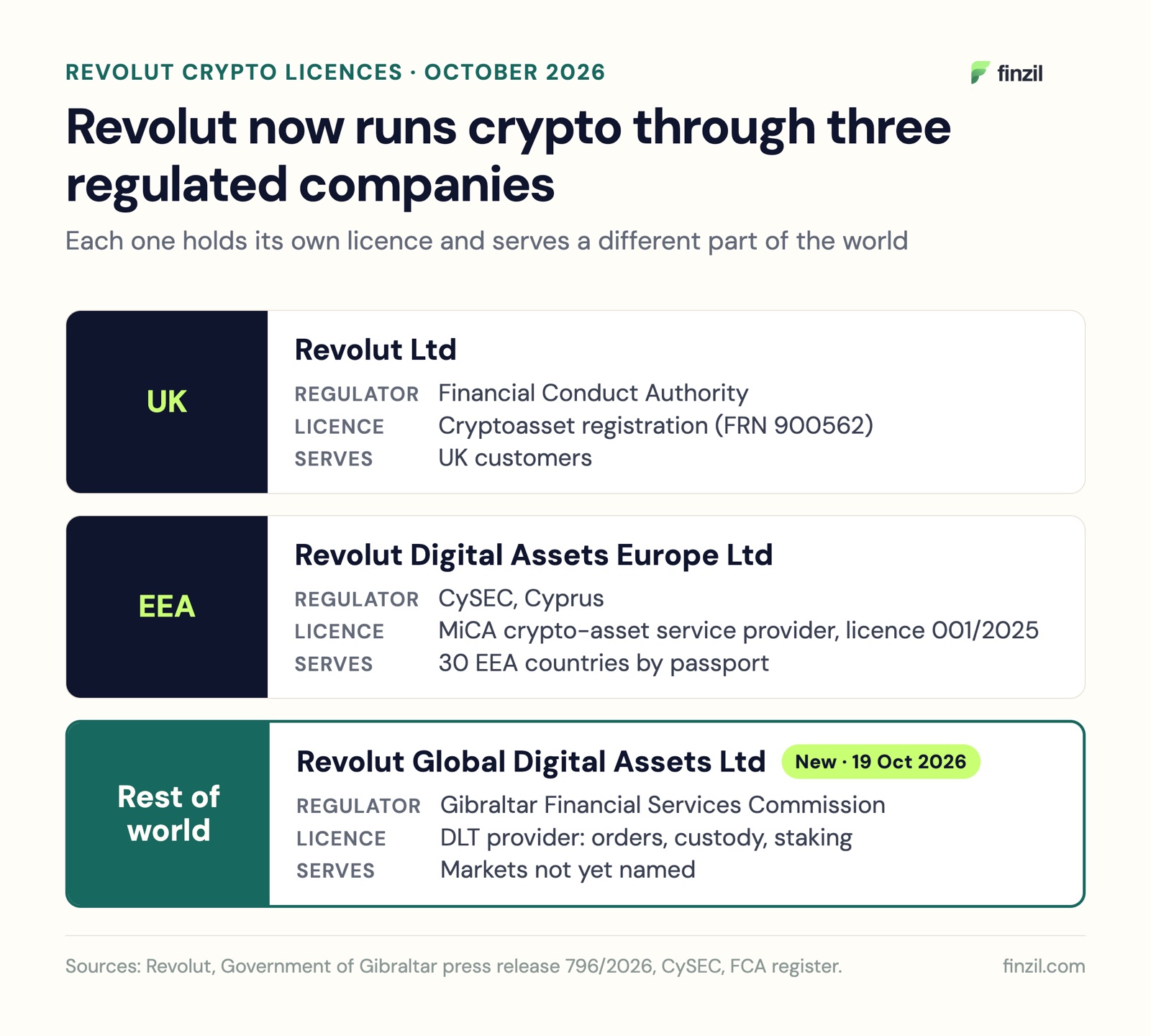
Each company serves a different part of the world, because crypto licences rarely travel:
| Region | Company | Regulator | Licence |
|---|---|---|---|
| UK | Revolut Ltd | Financial Conduct Authority | Cryptoasset registration, FRN 900562 |
| EEA (30 countries) | Revolut Digital Assets Europe Ltd | CySEC, Cyprus | MiCA crypto-asset service provider, licence 001/2025 |
| Elsewhere, markets not yet named | Revolut Global Digital Assets Ltd | Gibraltar Financial Services Commission | DLT provider |
The Cyprus licence is the only one that passports. A MiCA authorisation from one EU regulator covers all 30 EEA countries. Gibraltar left the EU with the UK, so a Gibraltar licence carries no right to serve customers in the EU, and it doesn't cover the UK either. That's why Revolut needs it: for the countries that neither its UK nor its EU company can serve.
Revolut hasn't named those markets and says details will come "in due course". Revolut already runs regulated businesses in Australia, Singapore, Brazil, Mexico and other markets outside Europe, and those are the obvious candidates.
Thirty months of Revolut crypto moves
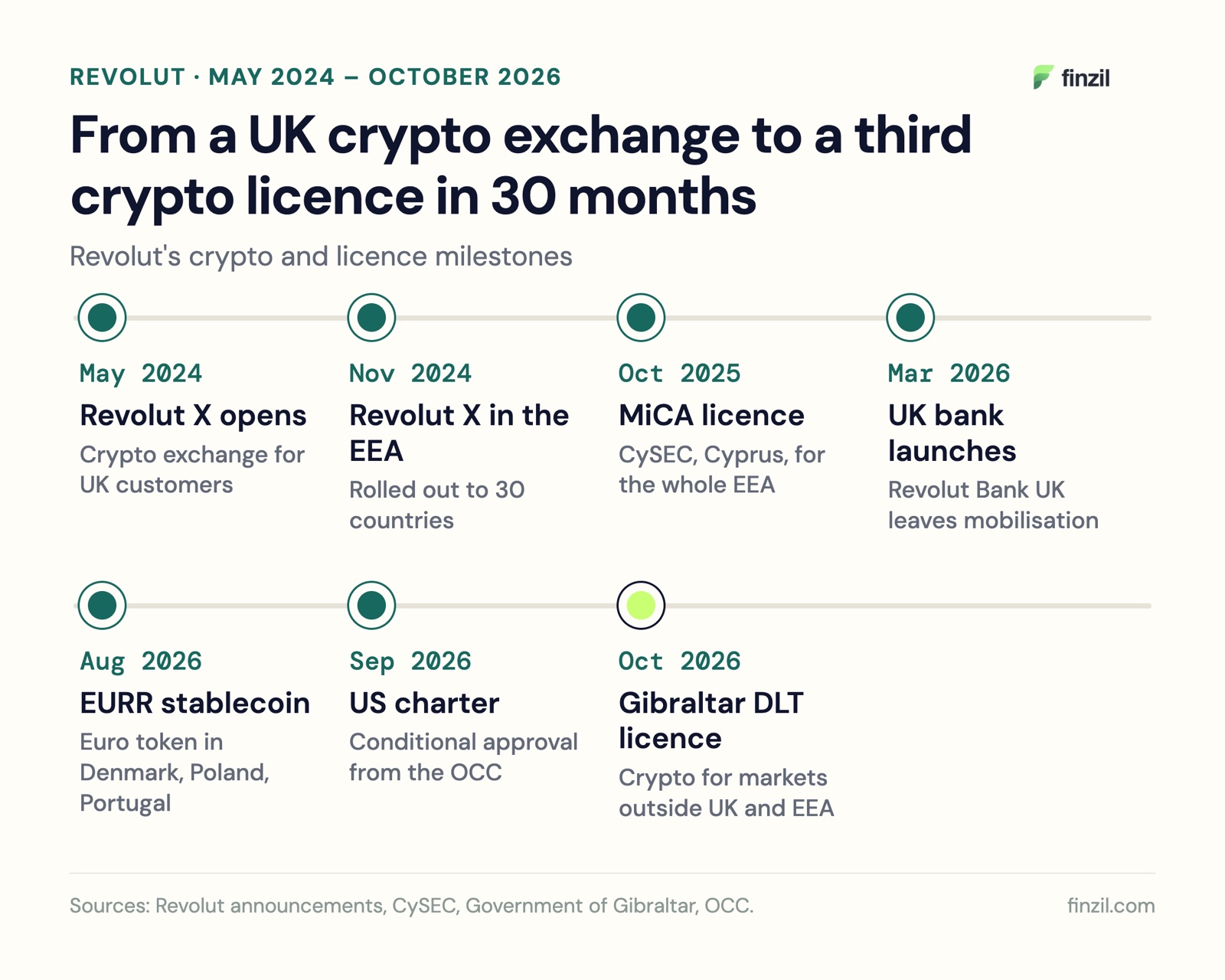
The Gibraltar licence is the latest step in a run that started with Revolut X, its own crypto exchange, in the UK in May 2024. Revolut X reached 30 EEA countries in November 2024. CySEC granted the MiCA licence in October 2025. In 2026 Revolut launched its UK bank (March), began rolling out EURR, a euro stablecoin, in Denmark, Poland and Portugal (August), and won conditional approval from the US Office of the Comptroller of the Currency for a US bank charter (September).
The numbers behind it are large. Revolut's 2025 annual report shows revenue of £4.5 billion, up 46%, and a pre-tax profit of £1.7 billion. Crypto is one of the products that pulls people into the app: 16 million users out of 80 million.
Where crypto regulation stands, October 2026
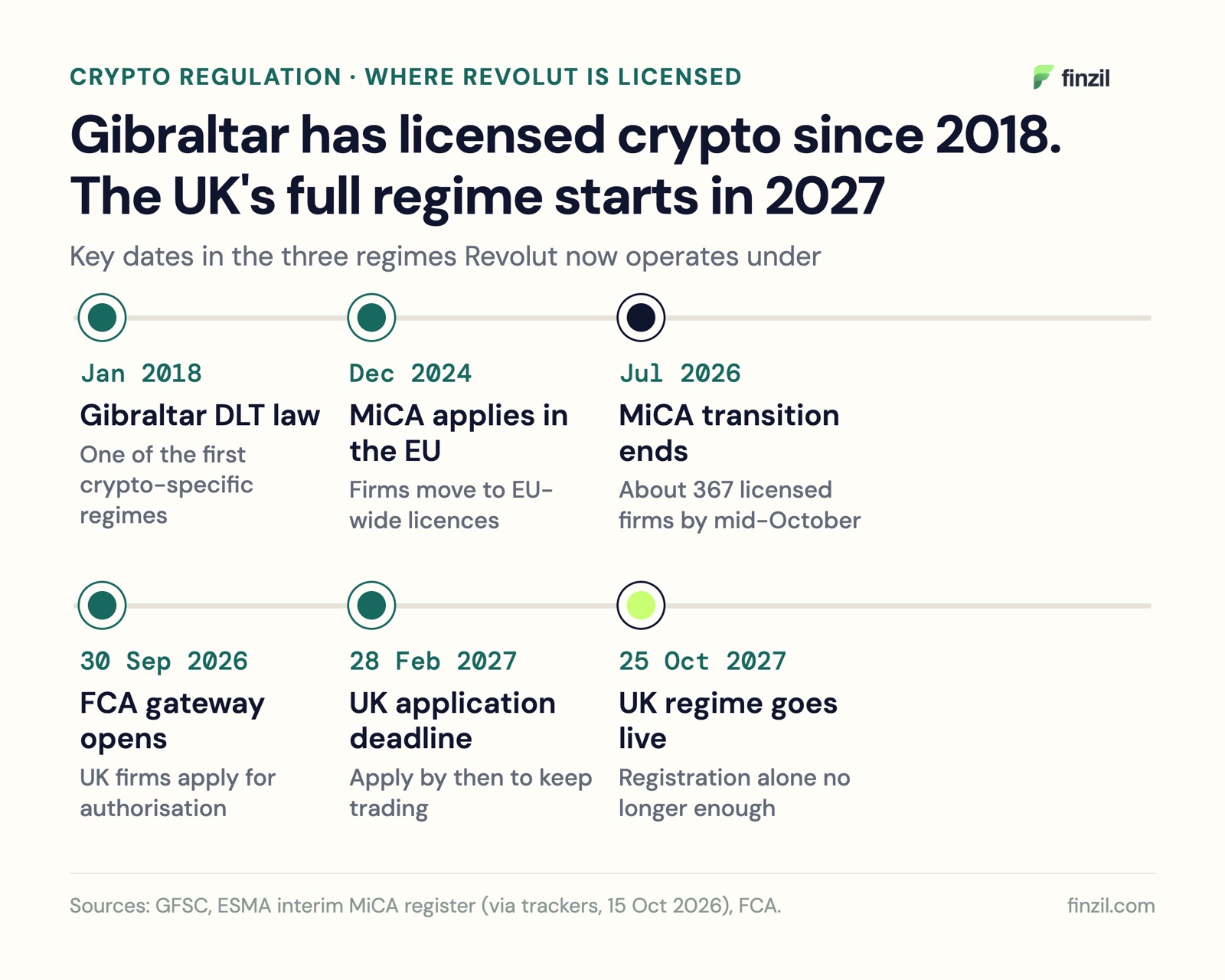
Revolut now works under three regimes that are at very different points.
The EU. MiCA's transition ended on 1 July 2026. Since then, any firm offering crypto services to people in the EU needs a MiCA authorisation. About 367 crypto-asset service providers were on ESMA's interim register by mid-October 2026, with Germany granting the most. We covered what this means for crypto companies' bank accounts in crypto company bank accounts after MiCA.
The UK. The UK is a year behind. The FCA opened its authorisation gateway for crypto firms on 30 September 2026. Firms that want to keep trading when the regime starts must apply by 28 February 2027, and the regime goes live on 25 October 2027. Today's FCA crypto registration, the one Revolut Ltd holds, is an anti-money-laundering registration. It does not carry over.
Gibraltar. The oldest of the three. The government said three DLT permissions were due to be issued in the week of Revolut's, so the territory is still licensing new firms while the EU and UK build their regimes.
What this means for businesses
For a business, the headline is what hasn't changed. Revolut's licences cover crypto for its personal customers. Revolut Business publishes a list of 25 industries it doesn't support, and six of them are crypto: exchanges, brokers and dealers; on- and off-ramps including crypto ATMs; some ICO providers; mining, investment and trading firms; crypto asset managers; and unregulated custodial wallets (checked 8 October 2026). A crypto company holding a MiCA licence of its own is still on that list.
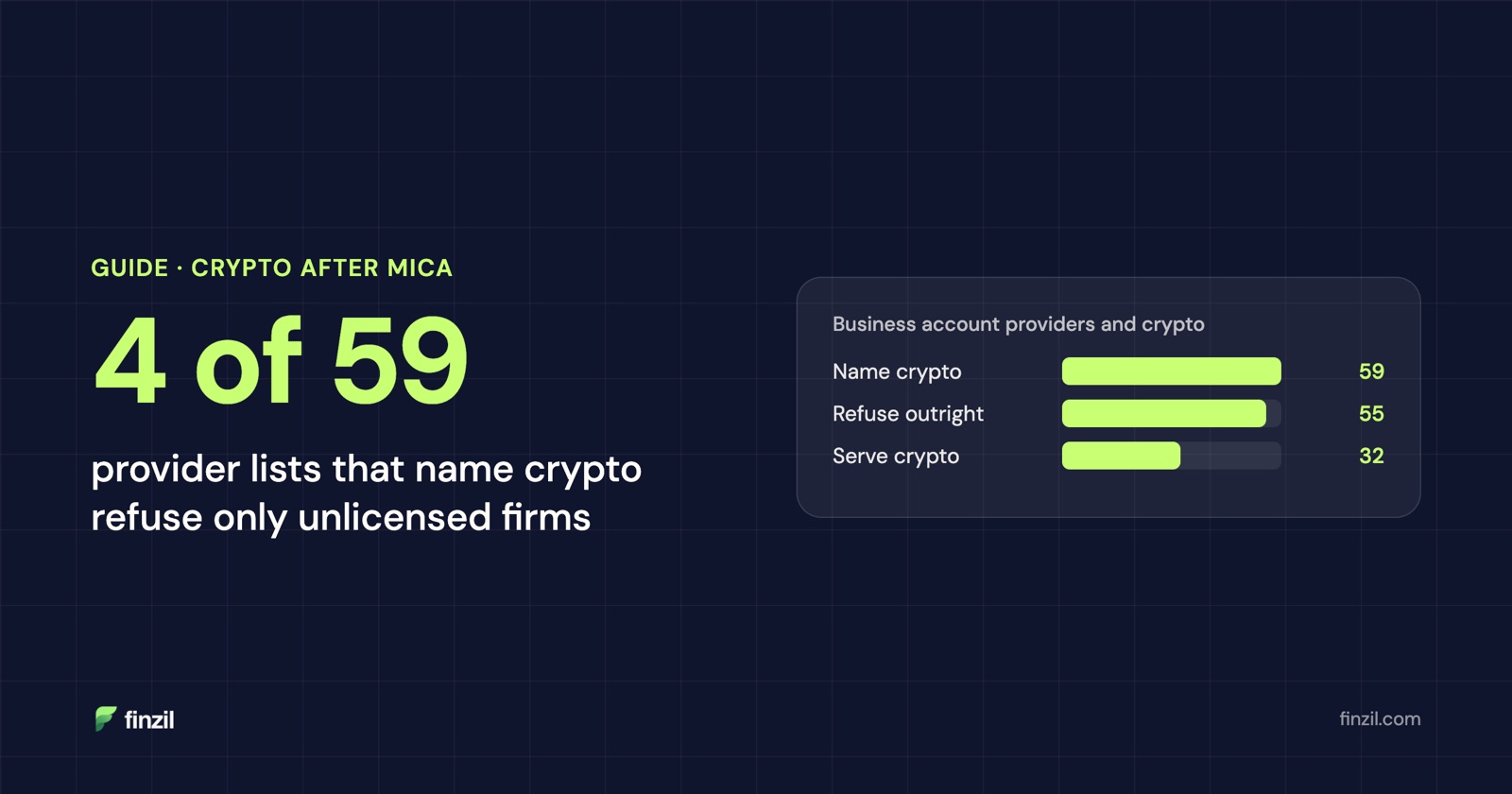
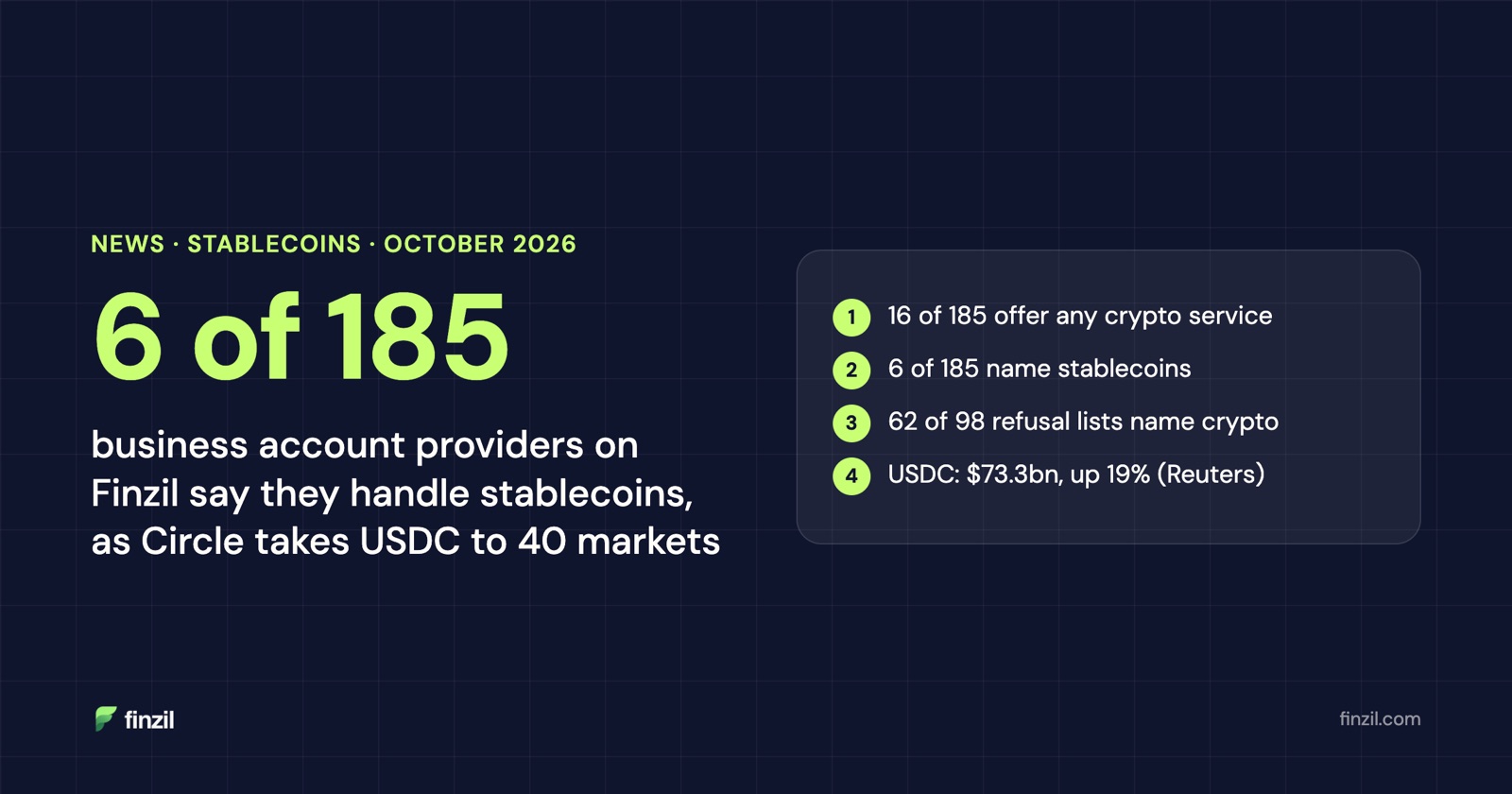
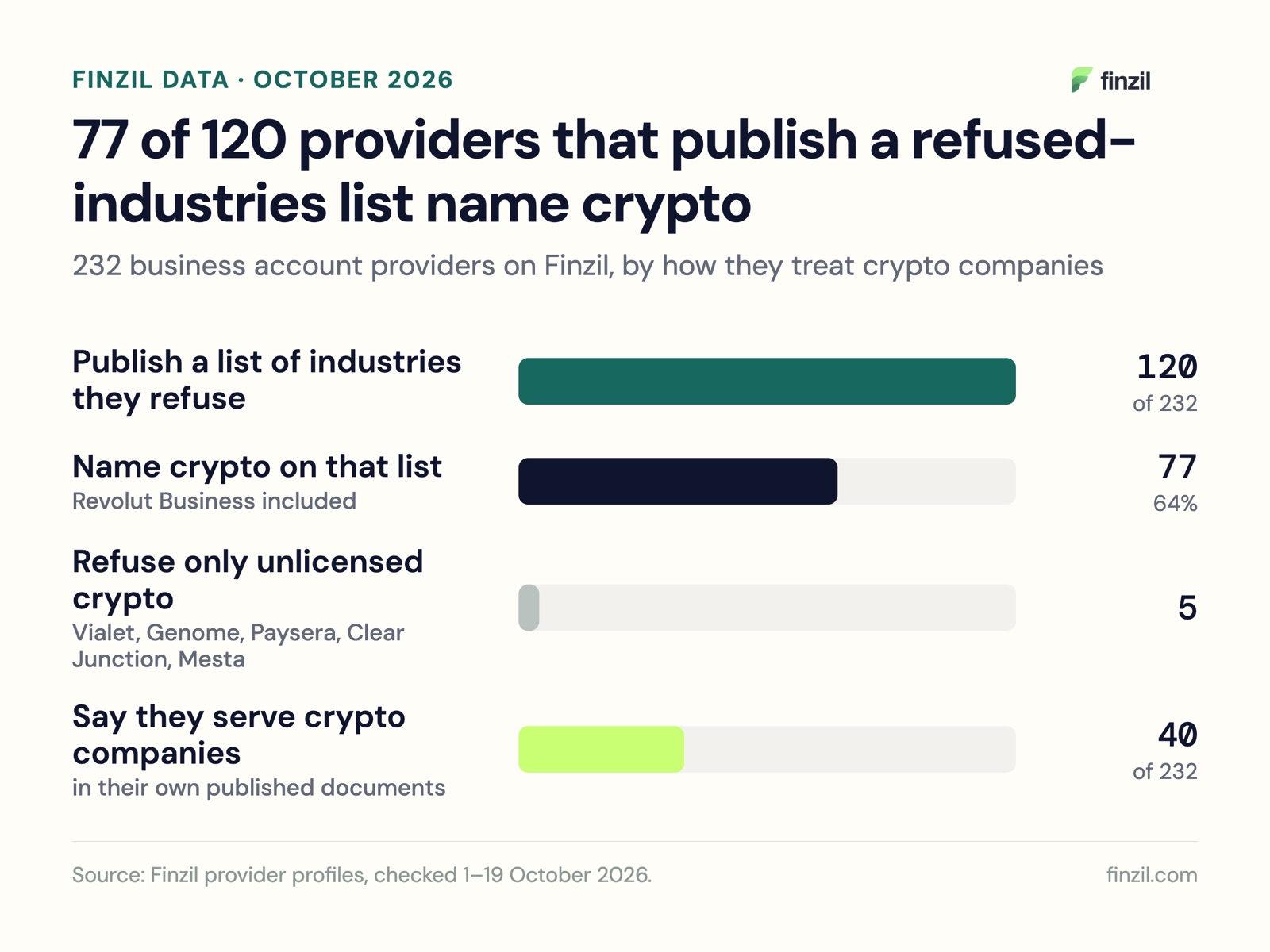
Revolut is far from alone. Of the 232 providers on Finzil, 120 publish a list of the industries they refuse, and 77 of those lists name crypto. Only five limit the refusal to unlicensed firms: Vialet, Genome, Paysera, Clear Junction and Mesta. On the other side, 40 providers say in their own documents that they serve crypto companies.
Our view: a big fintech offering crypto to consumers and refusing crypto companies as business customers is normal. Holding customers' crypto under your own licence is a risk you control. Banking another crypto firm means taking on its customers, its licence and its compliance, which the bank can't see. Don't read a provider's crypto features as a sign it will open an account for a crypto business.
If you run a crypto or Web3 company, the providers that do take you are a short list: Swiss and Liechtenstein banks such as Sygnum Bank, AMINA Bank and Bank Frick, Gibraltar's own Turicum Private Bank, and payment firms built for the sector such as BCB Group, OpenPayd and Clear Junction. If your company is paid in stablecoins, read stablecoin payments and your business bank account and what the Mastercard and BVNK platform changes.
What to do
- If you're a Revolut personal customer outside the UK and EEA, wait for Revolut to name the markets. Until then, nothing changes for you.
- If you live in Gibraltar, you can open a Revolut personal account again.
- If you run a crypto company, don't apply to Revolut Business: its own list refuses you. Start with providers that name crypto among the sectors they serve, and have your MiCA, FCA or other licence ready.
- If you're a UK crypto firm, apply through the FCA gateway before 28 February 2027 if you want to keep trading when the new regime starts.
- Match on your industry before you apply. Finzil reads each provider's published crypto rules and shows the ones that fit your licence and countries.
Questions people ask
Does Revolut have a crypto licence in Gibraltar? Yes. On 19 October 2026 the Gibraltar Financial Services Commission granted a DLT provider licence to Revolut Global Digital Assets Limited, covering crypto orders, custody and staking.
Which countries will Revolut's Gibraltar crypto entity serve? Revolut hasn't said (October 2026). The entity is for markets outside the UK and EEA, which Revolut serves through Revolut Ltd and Revolut Digital Assets Europe Ltd.
Is Revolut crypto regulated under MiCA? In the EEA, yes. Revolut Digital Assets Europe Ltd holds MiCA licence 001/2025 from CySEC in Cyprus, which covers all 30 EEA countries.
Can a crypto company open a Revolut Business account? No. Revolut Business lists crypto exchanges, brokers, miners, on- and off-ramps and crypto asset managers among the industries it doesn't support (checked 8 October 2026).
How many Revolut customers use crypto? More than 16 million of Revolut's 80 million retail customers, about one in five (Revolut, 19 October 2026).
Sources: Government of Gibraltar, press release 796/2026, 19 October 2026; Revolut announcement, 19 October 2026, as reported by The Block and securities.io; Revolut help centre, "Who provides Revolut's crypto services" (CySEC licence 001/2025); Revolut Group Holdings annual report 2025; FCA cryptoasset regime timeline; ESMA interim MiCA register as counted by trackers, 15 October 2026; Revolut Business, "What industries are not supported", checked 8 October 2026; provider profiles on Finzil, checked October 2026. General information, not financial or legal advice.
Providers in this article
Providers that serve crypto companies
Each of these names crypto businesses among the sectors it serves, in its own published documents. Read the licences and markets it accepts before applying.
| Provider | Licensed in | Known for |
|---|---|---|
 Sygnum BankBank |     | Crypto-friendlyInstitutional |
 AMINA BankBank | | Crypto-friendly19 currencies |
 Bank FrickBank |  | Crypto-friendlyFinancial intermediaries |
 Turicum Private BankBank |  | Private bankingCrypto-friendly |
 BCB GroupPayment institution |  | Crypto-friendlyInstitutional |
 OpenPaydE-money institution |  | Virtual IBANsFintech infrastructure |
 Clear JunctionE-money institution |   | Financial institutionsDigital assets |
| OOlkyPayPayment institution |  | High-risk friendlyFR or LU IBAN |
Not sure which one fits? Your profile ranks them for your business, with the reason behind each.