The short answer
UAE banks rarely open an account for a UAE company when nobody behind it lives in the UAE. The reason sits in UAE anti-money-laundering rules: a non-resident without a UAE identity card counts as a higher-risk customer. A residence visa and Emirates ID for one owner or signatory changes the answer most. Until then, look outside the UAE: 36 providers on Finzil name UAE companies in their published country lists (November 2026).
The "no" starts in the rules, not at the branch
Many founders read a UAE bank's refusal as a judgement on their business. Usually it's a judgement on where they live.
The Cabinet decision that implements the UAE's anti-money-laundering law defines high-risk customers. Its examples include a customer "non-resident in a country that does not hold an identity card" (quoted in the CBUAE Rulebook, section 6.4.2). An owner who lives in London or Mumbai without an Emirates ID fits that description word for word. The rulebook puts you in the higher-risk group before anyone reads your business plan.
Higher risk means enhanced due diligence (EDD: the bank collects more evidence and a senior person signs off). The first thing it should look for is "an illogical reason" for a foreign owner's presence in the UAE (same section). In plain words, the bank must be able to answer one question on file: why is this company in the UAE if its people aren't?
The CBUAE does set a fast lane: three business days to open an SME account. It applies only to low-risk applicants with complete documents, and is waived where financial crime checks need longer (CBUAE SME Customer Protection Regulation, 4.46). An owner abroad rarely gets it.
The FATF, which sets international anti-money-laundering standards, kept the UAE on its grey list from March 2022 to 23 February 2024 (FATF). Onboarding tightened in those years, and banks have little reason to loosen it now.
What a UAE bank checks, and what you can change
Most reasons for a refusal have a known fix. Some take weeks, not months.
| What the bank checks | Why | What changes it |
|---|---|---|
| An Emirates ID for at least one owner or signatory | The high-risk definition above | A residence visa through the company. You must be in the UAE for it: ICP allows 60 days from entry to finish the residence steps, including a medical test and fingerprints (ICP) |
| Meeting you | Checks on a customer never met must be at least as strict as in person | A video call. The CBUAE says a relationship built over video is not "non-face-to-face" (CDD guidance, 3.7). Some banks still want a visit |
| A reason to be in the UAE | The "illogical reason" red flag | A lease or flexi-desk agreement, UAE customers or suppliers, staff on UAE visas |
| Who owns the company | UAE law names owners at 25% (Cabinet Decision 109 of 2023) | Clear, documented ownership. For higher-risk customers banks may look down to 10%, and they want a foreign parent company's documents notarised (CBUAE CDD guidance) |
| Where the money comes from and goes | Activity must match the licence and the owner's background | Contracts, invoices and a business description that matches the licence activity |
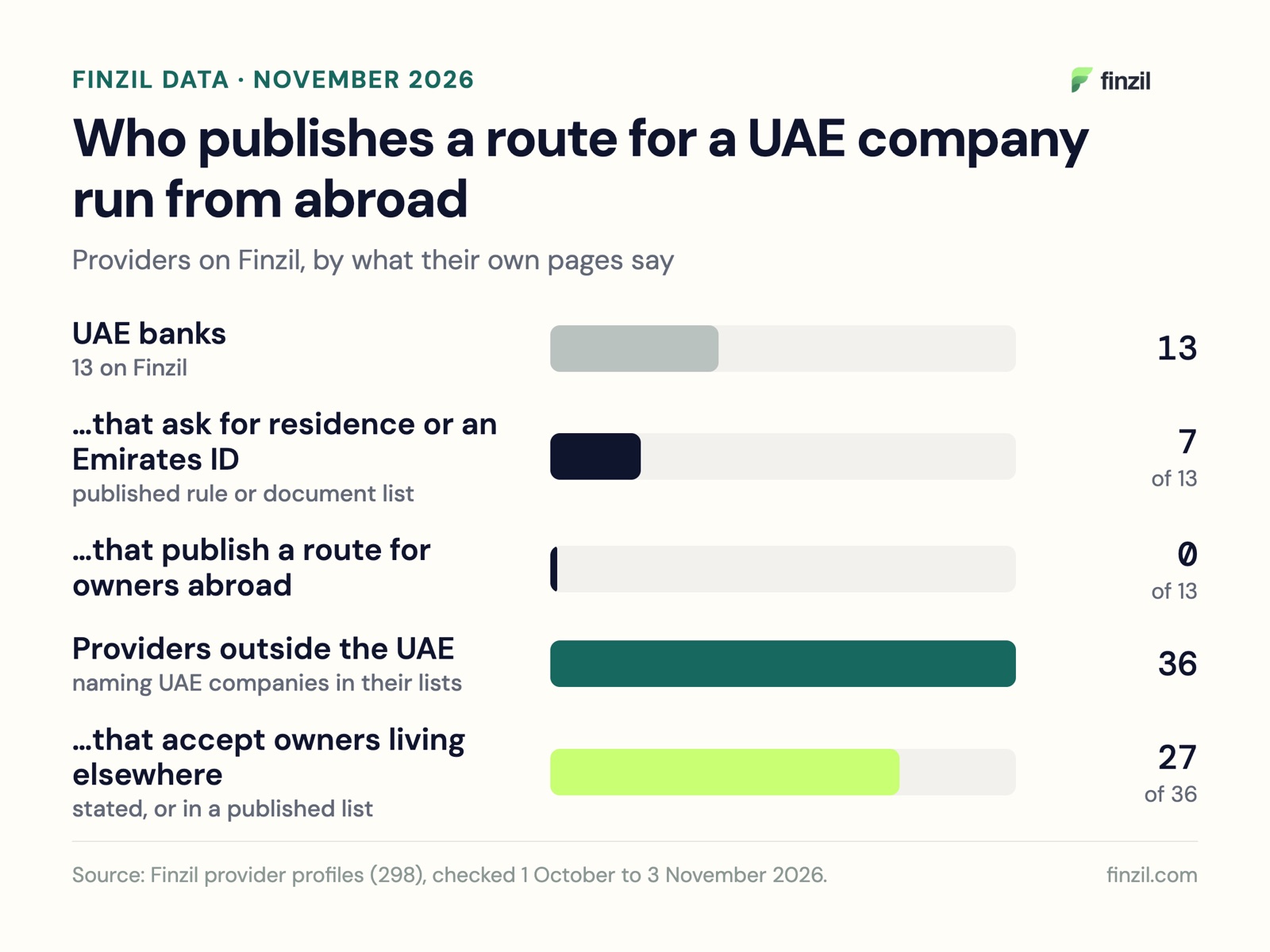
Of the 13 UAE banks on Finzil, 7 publish a residence rule or ask for Emirates IDs:
- Mashreq NeoBiz and Emirates NBD: at least one signatory must live in the UAE.
- RAKBANK: the Emirates ID is validated in person.
- ADCB: SmartStart needs signatories with a residence visa.
- NBF, Mbank and ADIB: Emirates IDs are on the document list.
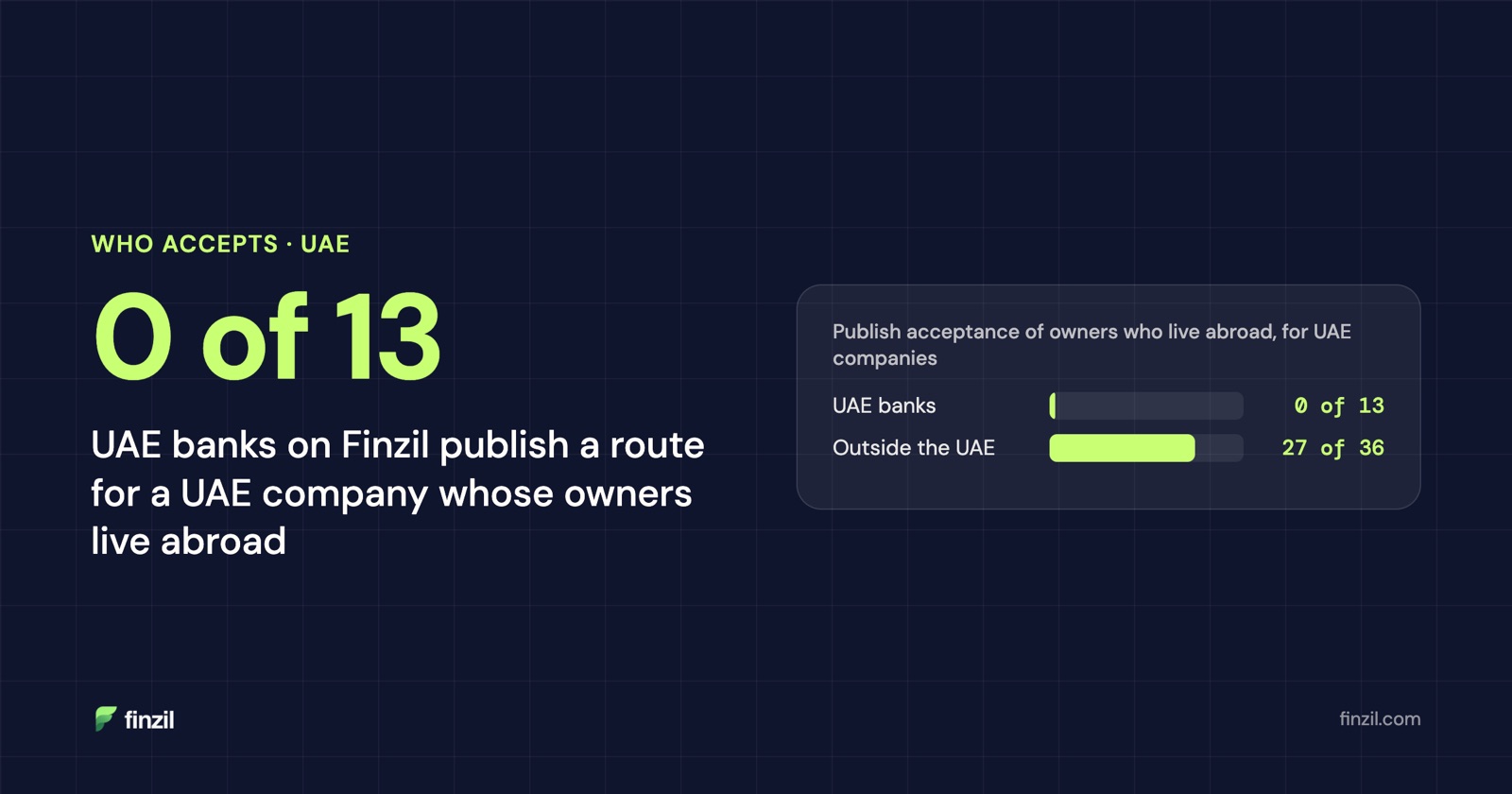
The other six don't publish a residence rule. None of the 13 publishes a route for owners who live abroad.
Economic substance reports were cancelled in October 2024 (K&L Gates, on the Ministry of Finance announcement), but the idea stayed. A free zone company on the 0% corporate tax rate must keep assets, full-time employees and running costs there (FTA guide on Free Zone Persons). Banks read the same signals.
Opening online doesn't mean opening from abroad
Seven of the 13 UAE banks on Finzil let you apply online, among them Wio Bank, Zand, Ruya and Mbank. The online forms ask for the same identity. NBF's online route needs an authorised representative with a valid Emirates ID. Mbank's upload step asks for the shareholders' Emirates IDs.
"Open in the app in minutes" is true. "Open from anywhere" isn't: the app runs the same checks faster, and the Emirates ID is one of them.
Three kinds of provider, three different answers
| Kind of provider | What you get | What it asks of owners abroad |
|---|---|---|
| UAE banks, including digital ones (13 on Finzil) | A UAE IBAN, AED payments, WPS salary runs, the account UAE customers and authorities expect | In practice, an Emirates ID for a signatory. None publishes a route for owners who live abroad |
| Providers outside the UAE that name UAE companies (36 on Finzil) | An account in the company's name, usually multi-currency, opened online (35 of the 36) | 27 of the 36 state they accept owners who live outside the company's country |
| Foreign firms with a UAE licence (18 on Finzil) | A regulated presence in DIFC, ADGM or onshore | Only 2 of the 18, Sokin and Emerald24, publish a country list that includes UAE companies |
The third row catches people out. DIFC and ADGM are financial free zones with their own regulators (the DFSA and the FSRA). A licence there tells you where a firm is regulated, not which companies it takes. Read its country list, not its address.
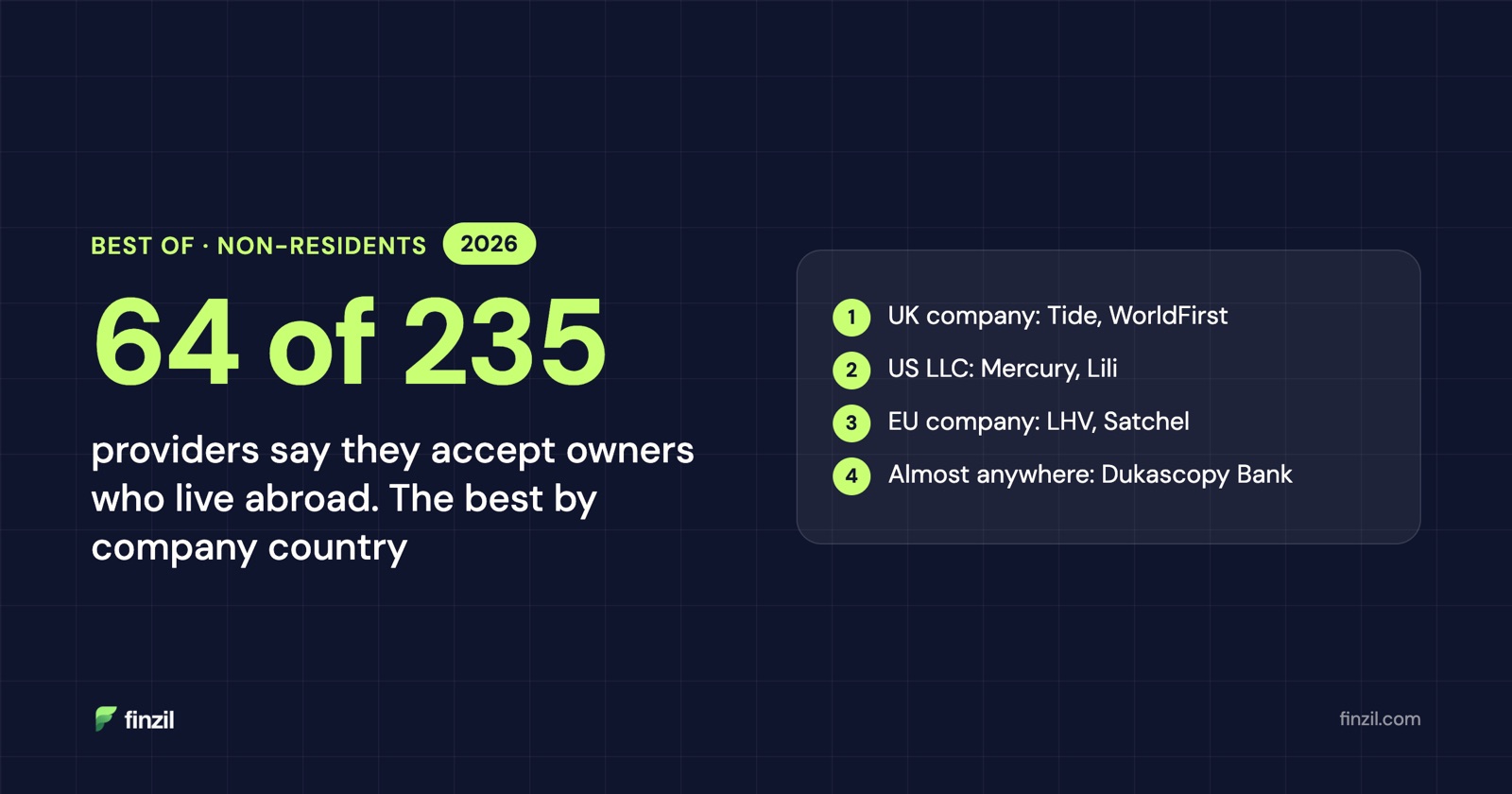
The second row is where most founders abroad end up, and it works for a reason people miss. A Lithuanian or UK e-money institution (EMI: licensed to hold and move your money, but not a bank) applies its own country's anti-money-laundering rules, not the UAE's. The UAE's "non-resident without an identity card" definition doesn't follow your company there. Payset, Emerald24, Satchel and Dukascopy Bank are examples that publish both answers: UAE companies accepted, owners living elsewhere accepted.
These counts come from what each provider publishes. A provider with no published rule may still say yes, and none of this predicts a single application.
Where international accounts stop
- They still ask why the company is in the UAE. 32 of the 148 providers on Finzil that publish a list of refused businesses name shell companies or nominee structures. Arival defines them as companies "with no clear business purpose, physical presence, or verifiable economic activity". A UAE company with no office, no staff and no UAE customers can look like that from Vilnius too.
- Some refuse the UAE outright. TeslaPay and Exactly list the UAE among the countries they don't accept. Wise refuses UAE-based oil, gas and shipping companies.
- No WPS. The Wage Protection System, the UAE's salary payment system for registered employers, runs through UAE banks and exchange houses. A company paying UAE staff needs a local account for payroll.
- Usually no UAE IBAN. UAE customers and government fees are simpler from a UAE account. 3S Money is one of the few outside providers with a UAE IBAN, operated from DIFC.
Mainland, free zone or offshore
For UAE banks, mainland and free zone companies sit in the same queue: Commercial Bank of Dubai, Mbank and NBF name free zone companies among those they accept. Activity and presence separate applications, not the licence authority.
UAE offshore companies are different. They can't trade in the UAE. The FTA won't issue them a tax residency certificate because they are "not considered established in the UAE" (FTA). Dubai Islamic Bank is one of the few banks on Finzil that lists UAE offshore companies, through a relationship manager.
Our view
Our view, from the published rules: first decide whether anyone will live in the UAE in the next six months.
- Someone will. Get the residence visa and Emirates ID first, then apply to a UAE bank. Open an account outside the UAE now so the company can trade in the meantime; it stays useful for international payments later.
- Nobody will. Treat a UAE bank as out of reach for now and stop applying to them one by one; each refusal costs weeks. Pick a provider outside the UAE that names UAE companies and accepts owners where you live, and build the evidence of presence the next reviewer will ask for.
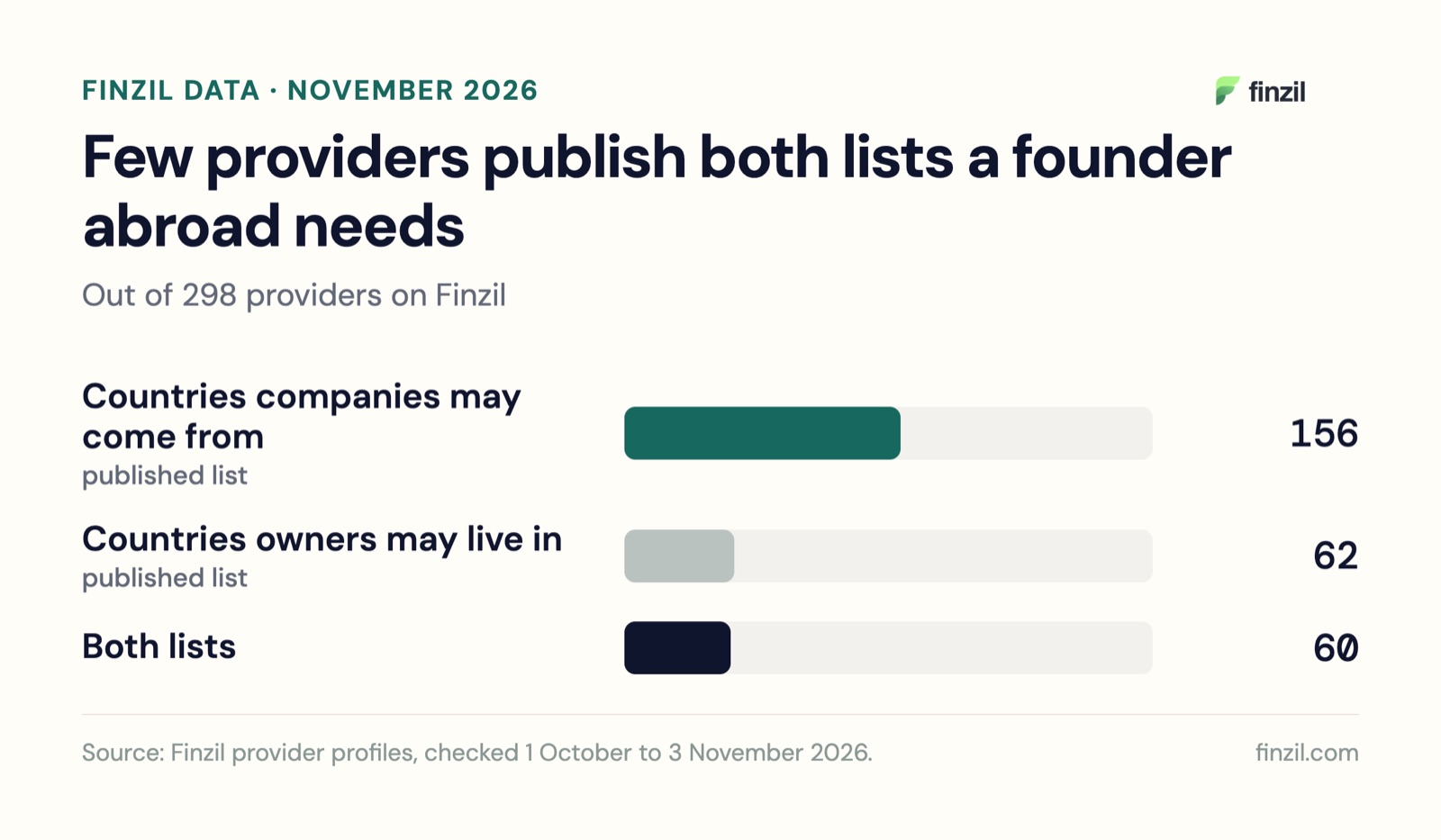
The hard part is matching two lists at once: the countries a provider takes companies from, and the countries it takes owners from. Of 298 providers on Finzil, 156 publish the first list and only 60 publish both.
What to do
- Write down the company's licence authority, its activity and the country each owner and signatory lives in. Every provider asks for these.
- If one of you can spend time in the UAE, start the residence visa through the company. Plan a stay of up to 60 days for the medical test and fingerprints.
- Gather the presence evidence: lease or flexi-desk agreement, UAE contracts or invoices, and a business description that matches the licence activity.
- Draw the ownership chart down to every person with 10% or more. If a foreign company owns shares, notarise its documents.
- Apply first to providers that state both rules you need: UAE companies accepted, and owners in your country accepted. Check which providers accept your company.
- Once someone has an Emirates ID, apply to a UAE bank for the local account. The UAE bank requirements and fees compare seven of them.
Questions people ask
Can a UAE company open a bank account if the owners live abroad?
Rarely at a UAE bank. UAE rules treat a non-resident without a UAE identity card as higher risk. None of the 13 UAE banks on Finzil publishes a route for owners abroad (November 2026). Providers outside the UAE are the usual option.
Do I need an Emirates ID to open a UAE business bank account?
In practice, at least one owner or signatory needs one. Of the 13 UAE banks on Finzil, 7 publish a residence rule or ask for Emirates IDs; the other six publish no residence rule (November 2026).
Which providers accept a UAE company with non-resident owners?
On Finzil, 36 providers outside the UAE name UAE-registered companies in their country lists, and 27 of them state they accept owners who live elsewhere (November 2026). Most are e-money institutions in Lithuania or the UK.
How long does a UAE business bank account take to open?
The Central Bank of the UAE asks banks to open accounts within three business days for low-risk applicants with complete documents. The deadline doesn't apply where financial crime checks need longer, which is usual when owners live abroad.
Sources: CBUAE Rulebook, ICP, FTA, FATF and the Ministry of Finance announcement, checked 3 November 2026. Provider counts from 298 Finzil profiles checked between 1 October and 3 November 2026. General information, not financial or legal advice.
Providers in this article
UAE banks and the providers outside the UAE that name UAE companies
Each profile shows who the provider accepts, where owners may live, the full price list and its licences, from its own published pages.
| Provider | Licensed in | Known for |
|---|---|---|
 Mashreq NeoBizBank |    | Digital bankNo initial deposit |
 Emirates NBDBank |     +4 | Business packagesVisa debit card |
 RAKBANKBank | | SME banking4 currencies |
 ADCBBank | | Small businessesAED only |
 Wio BankBank | | Digital bank7 currencies |
 MbankBank | | No minimum balanceAED only |
 PaysetE-money institution | | 35 currenciesHigh-risk industries |
 Emerald24E-money institution | | UK local railsNon-residents accepted |
 SatchelE-money institution |  | European IBANMastercard cards |
 Dukascopy BankBank |    | Swiss bank accountNon-residents accepted |
 3S MoneyE-money institution |  | Local IBANsNon-residents accepted |
 SokinE-money institution |  | Free accountLocal payment routes |
Not sure which one fits? Your profile ranks them for your business, with the reason behind each.