The short answer
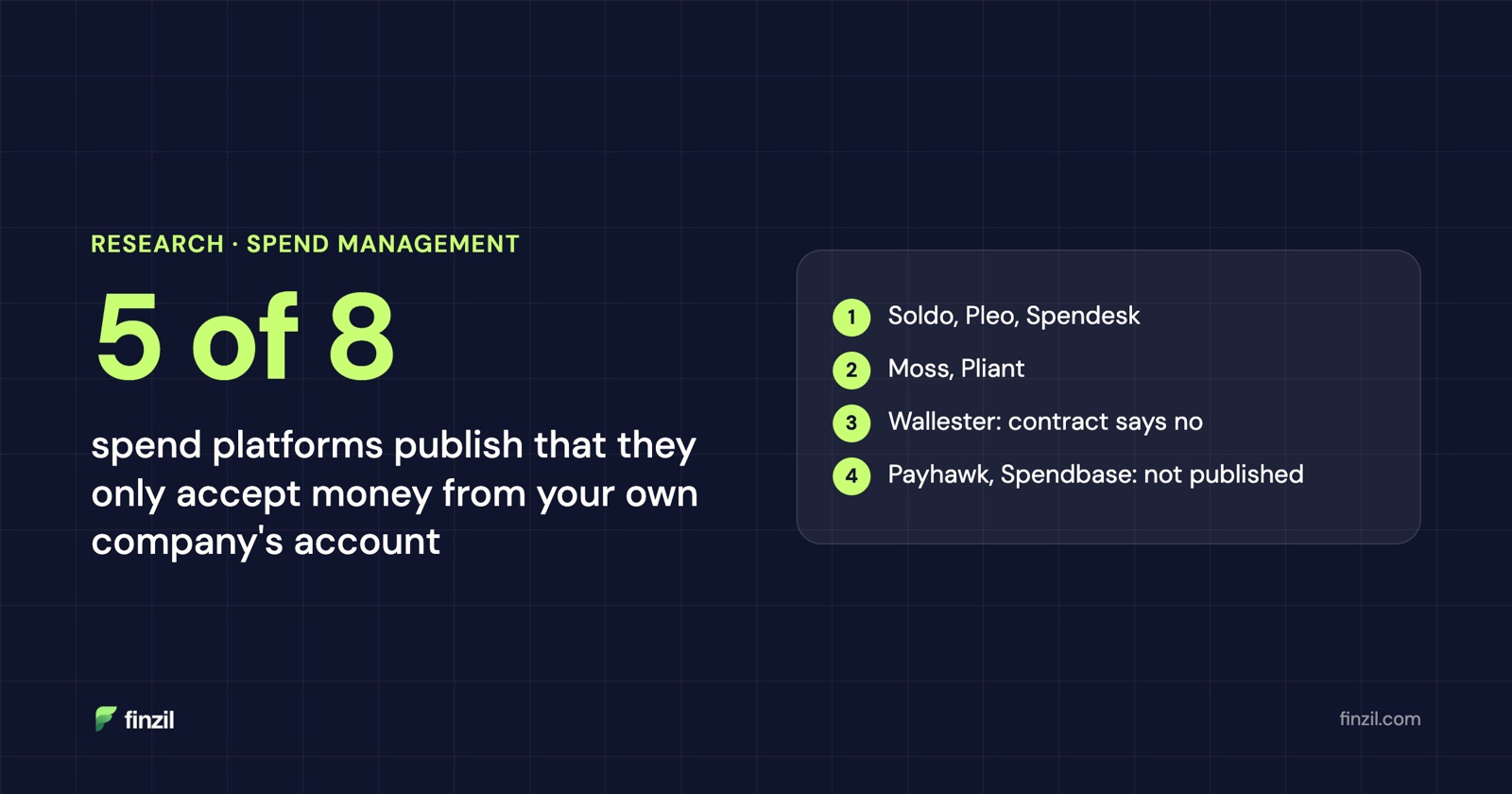
No, for every spend management platform that publishes a rule. Soldo, Pleo, Spendesk, Moss and Pliant only accept money from a bank account in your own company's name. A customer's payment, a marketplace payout or a card processor's settlement sent there is returned, at Pleo within 7 business days and at Spendesk within 12 days. Payhawk and Spendbase don't publish a rule either way. Customers should pay a business account, which then tops up the spending account.
What we checked
We read the funding rules of eight platforms that Finzil lists as spending accounts or spend-led business accounts: Soldo, Pleo, Spendesk, Moss, Pliant, Payhawk, Wallester and Spendbase. The sources are each provider's help centre, terms and payment-account agreements, read on 23 October 2026. We looked for three things: who may send money in, what happens to a payment that breaks the rule, and any exception.
| Platform | Who may send money in | A payment from anyone else | Exception |
|---|---|---|---|
| Soldo | Your company's own bank account | Not stated | None stated |
| Pleo | A bank account in your organisation's name | Returned within 7 business days | None stated |
| Spendesk | A bank account in your company's name | Returned within 12 days | A holding company may fund its subsidiaries |
| Moss | A business account in your company's name | "Will not be accepted" | None stated |
| Pliant | A bank account in your organisation's name; not PayPal | Returned to the sender | None stated |
| Wallester | Your own top-ups, by its instructions | Rejected and returned, less costs; or blocked or debited | Refunds from merchants |
| Payhawk | Not published | Not published | Refunds from third parties are credited |
| Spendbase | Not published | May be refused, delayed or returned | None stated |
Soldo is the only one that answers the question in so many words: it says it is not a business bank account "and thus can only receive money transferred from the company's own bank account". The others answer it through a name check. Pleo checks the first transfer, and any transfer from a new bank account, against the organisation's name. Spendesk says regulation prohibits funding an account from another company's bank account.
Why these accounts refuse your customers' money
A spend management platform holds e-money so your staff can spend it. It is licensed and checked for that job. Money paid in by your customers is a different flow, with different anti-money-laundering checks: the platform would have to know who your customers are and why they pay you. A same-name rule keeps the account a closed loop: your money in, your team's spending out.
The money flow the platforms expect looks like this.
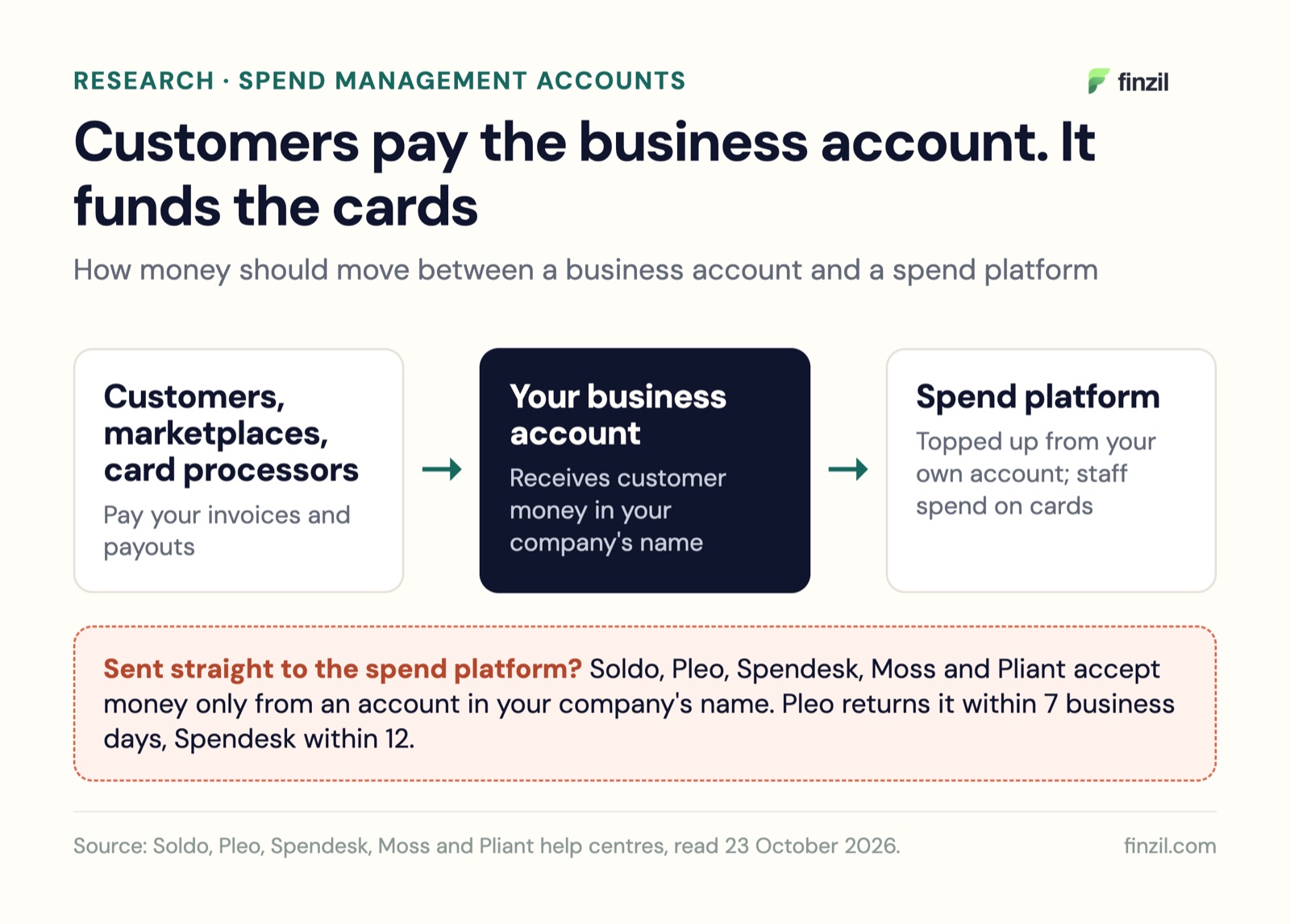
The account details make this easy to get wrong. Pleo holds balances in six currencies, Soldo has account details in GBP and EUR, Payhawk in seven currencies and Wallester an IBAN in ten. An IBAN on a dashboard looks like any other account number, and nothing stops someone putting it on an invoice.
Where it goes wrong
Three routine ways it happens. These are illustrations of the rules above, not cases a provider has published:
- An invoice template carries the wrong IBAN. A bookkeeper copies the spend account's details into the invoice footer. Customers pay, the platform returns the money, and the customer's accounts team now has a failed payment to chase.
- A card processor or marketplace is pointed at the spend account. Stripe, PayPal or Amazon payouts come from the processor's own account, so they fail any same-name check. Pliant names PayPal as a sender it doesn't accept.
- A group company tops up a sister company's account. Spendesk allows a holding company to fund its subsidiaries and refuses every other company. Check the rule before your treasury team moves money across the group.
A returned payment isn't lost, but it costs days: up to 7 business days at Pleo and 12 at Spendesk before the money is back with the sender.
Wallester's sales page and its contract disagree
Wallester presents itself as a business account and advertises "invoices and payment links to get paid". Its Business Client Payment Service Agreement (version effective 14 June 2024) is narrower. It accepts top-ups made by its instructions and refunds from merchants. Anything else counts as wrongly transferred, and Wallester may block it or debit it without the client's consent. Top-ups with cards issued to third parties are not permitted.
A newer agreement may exist; we read the version linked from its site on 23 October 2026. Until Wallester confirms otherwise in writing, treat it like the other platforms: a place to spend from, not to be paid into.
Payhawk and Spendbase don't say
Payhawk is the one to watch. Its terms (last updated 9 December 2025) say loads come by transfer "from an account in your name which you have nominated to us". A separate clause covers incoming credit transfers without limiting the sender, apart from the currency, and refunds from third parties are credited. Its help pages say you can deposit from an external, unlinked bank account, without saying who may own it. That reads as permission to receive more than top-ups, but it isn't a published yes.
Spendbase markets an account to "send and receive funds" and its terms (8 July 2026) let it refuse, delay or return any payment where needed to comply with the law. The accounts are issued by Moorwand in the UK and Heuro in the EU. There is no rule about customer payments.
If you want customers to pay either one, ask for the rule in writing before you print the details on an invoice.
What the data doesn't show
We read published rules, not account behaviour. We can't say how strictly each platform applies them, how many payments it returns, or whether a large customer has agreed different terms. Pliant's help centre now needs a login; we read its rule through the indexed text of two help articles, and its public terms (6 February 2026) don't contain the name rule. Soldo's help page showed no date when we read it.
The account your customers should pay
You need a business account that receives customer payments, with the spend platform topped up from it. Some business accounts do both jobs, which saves a subscription if your team is small.
| Account | Receives customer payments | Team cards | Price for the cards |
|---|---|---|---|
| Revolut Business | Yes; local details in several currencies | Physical and virtual cards for every team member, with spending controls | From £10 a month |
| Airwallex | Yes; local details in 20+ currencies | 10 free Visa company cards on Explore, 50 on Grow | From £0 with £10,000 a month paid in |
| Equals Money | Yes; one IBAN for 37 currencies | Mastercard expense cards, free to use in 21 currencies | £10 per physical card |
| Wise Business | Yes; details in 22 currencies | First card free, then £3 each | £50 once |
A spend platform still earns its fee once approvals, receipts and accounting rules matter more than the card itself. Pleo charges from £8 per user a month, Soldo from £21 a month plus VAT, Payhawk from £149 a month, and Moss is free for up to three users. PSP, EMI or bank: which do you need? covers the other accounts in the chain, including the payment provider that settles your card sales.
What to do
- Before you sign, ask one question: top-ups from your own accounts only, or from third parties too? The answer decides whether you are buying a spending tool or a full account. Ask for it in writing, with the clause or help page, because it is the detail sales pages leave out.
- Check what each account is for. Write down which account receives customer money, card settlements and marketplace payouts, and which only funds spending.
- Take the spend platform's details off every invoice, payment link, marketplace and processor dashboard.
- Top up from the company's own account in the company's exact registered name. For a group, read the rule on transfers between companies first.
- If you already use Payhawk, Wallester or Spendbase, get the answer to step 1 in writing before customers pay them directly.
- If you have no account that can take customer payments, open one first. Finzil matches your company against the published rules of every business account on the site.
Questions people ask
Can Pleo receive payments from customers?
No. Pleo returns funds sent from a personal bank account or from an account in a different name than the organisation, within 7 business days, according to its help centre (updated 31 August 2026). Customers should pay your business bank account, which then tops up Pleo.
Can I use Soldo as my business bank account?
No. Soldo says it is not a business bank account and can only receive money transferred from the company's own bank account (help centre, read 23 October 2026). It is a prepaid spending account for company cards.
Can Spendesk receive money from another company?
Only in one case. Spendesk refuses transfers from another company's bank account, except a holding company funding its subsidiaries, and returns rejected transfers within 12 days (help centre, October 2026).
Can Payhawk receive customer payments?
Payhawk doesn't publish a clear rule. Its terms (9 December 2025) say loads come from an account in your name, but a separate clause on incoming transfers doesn't restrict the sender. Ask Payhawk in writing before customers pay it.
How do I know if a spend management account is a full account?
Ask whether it accepts top-ups only from accounts in your company's name, or payments from third parties too. Only the second is a full account that customers can pay. Soldo, Pleo, Spendesk, Moss and Pliant publish own-account rules; Payhawk and Spendbase publish none (October 2026).
Which business accounts have both customer payments and team cards?
Revolut Business, Airwallex, Equals Money and Wise Business receive customer payments and issue team cards on the same account. Airwallex includes 10 free company cards on its Explore plan and 50 on Grow (October 2026).
Rules come from each platform's help centre, terms and payment-account agreements, read on 23 October 2026: Soldo, Pleo (updated 31 August 2026), Spendesk, Moss, Pliant (indexed help text; terms of 6 February 2026), Payhawk (terms of 9 December 2025), Wallester (agreement effective 14 June 2024) and Spendbase (terms of 8 July 2026). Prices from Finzil profiles checked 13 to 16 October 2026. Finzil does not rate providers and nobody paid to appear here. General information, not financial or legal advice.
Providers in this article
Spend platforms and business accounts
The spend platforms whose funding rules we read, and business accounts that take customer payments and issue team cards on the same account.
| Provider | Licensed in | Known for |
|---|---|---|
 SoldoE-money institution |   | Expense cardsSpend management |
 PleoE-money institution |  | Expense cardsSpend management |
 SpendeskPayment institution |  | Expense cardsSpend management |
 MossE-money institution |  | Expense cardsFree plan |
 PliantE-money institution |  | Corporate cardsSpend management |
 PayhawkE-money institution |  | Expense cardsSpend management |
 WallesterPayment institution |  | Visa cards10 currencies |
| SSpendbaseBusiness account platform | | No account feesMastercard |
 Revolut BusinessBank | | Cards and spend controlsStartups and SMEs |
 AirwallexE-money institution |   | Global accountsOnline businesses |
Not sure which one fits? Your profile ranks them for your business, with the reason behind each.